Showing posts with label bird strikes. Show all posts

08 February 2013

Feds ask Centurylink Officials to Reduce Bird Strikes

A letter sent by a federal agency to a CenturyLink Center official asks that efforts be taken to deal with the ongoing deaths of migratory birds at this building on the Omaha riverfront.

Despite attempts to reduce bird collisions, i.e., decals on the glass of the upper facade on the west side, strikes continue to occur, according to the letter sent from the Ecological Services, Nebraska Field Office, of the U.S. Fish and Wildlife Service.

The federal agency "has record" of 440 collisions here during the past five years.

"The Service requests your participation in implementing additional techniques to minimize collisions." - FWS letter verbage

"This number of bird deaths is higher than any other commercial building in Omaha for which we have data and advocates the need for additional corrective measures to be taken," said the letter, signed by Michael D. George, the Nebraska field supervisor.

Included in the letter was an indication that migratory birds are "protected" by provisions of the Migratory Bird Treaty Act, which prohibits the "direct intentional and/or unintentional take (i.e., killing or injuring) or migratory birds."

This letter indicated an interest to "working collaboratively" to find solutions to the problem. "Accordingly, our office would be happy to assist you by providing technical assistance and expertise on this matter," the letter said. Specific details were given on the person to contact at the field office in Grand Island.

The letter was dated January 24, 2013, and sent to Roger Dixon, of the Metropolitan Entertainment and Convention Authority, at a North 10th Street address.

23 June 2012

Sparrow Hawk Dies Upon Hitting Glass


Brevities.

—On Friday morning the following singular incident occurred: T.F. Hudson's canary bird usually sets on the counter, in his store, just opposite the show window. A sparrow hawk, starting from one of the oak trees in the Plaza, which faces the store, made a plunge for the bird and brought up with such force against the plate-glass that it fell dead upon the sidewalk, its skull crushed and eyes protruding from their sockets. This was an enterprising forager; one leg had been shot away and part of the remaining claw, still the bird was in good condition. The plate-glass window was the mistake of its life. — Santa Rosa Democrat.

This news item is significant as it is the first known window-strike for the West Coast.

January 18, 1875. Daily Alta California 27(9056): 1.

13 June 2012

Shower of Birds - Strange Thing at Chicago


Chicago special: A phenomenon occurred during the storm of Saturday night in the vicinity of the Board of Trade tower light. It was none other than a shower of birds. Yesterday when the watchman made his rounds he found the sidewalk and streets fairly covered with dead birds of all sorts. A little later the electrician came down, and when he saw the great pile of birds he said it was the electric light at the top of the tower. When he went up to the lantern with some members of the Board of Trade the roof was found covered with dead birds and each of the lamps in the big circle of light was filled with them, one globe having eight birds in it. These birds are of every known variety, and many unknown, or rather unfamiliar, species among the lot. All shades and colors are there -- scarlet, blue, pink, red, canary, mottled, black and white, and there were some snipe and plover among them. The theory is that they were migratory flocks going from South to North and were attracted by the great light, which the moment they touched killed them. The birds are all of the small species. There was a countless number of them, enough to trim all the ladies; hats in Illinois. Many Bohemians were in the streets with bags and baskets, and in less than two hours the streets were cleared of every vestige of the bird shower, but the roof of the Board of Trade is now covered, and the janitors will remove them to-day.

May 18, 1886. A shower of birds. The strange thing that happened to Chicago during a storm. Macon (Georgia) Weekly Telegraph 61(7): 10.

07 June 2012

Lights Entice Birds for Keeper's Larder

The man on the bell tower has gone to housekeeping in earnest, and hangs out his lamp as in[an] ingenious method blinding birds of the night and salting them down in his larder. Only list night a giant of blue crane, blinded by the electric light, used as an illuminator, attracted by the eyrie of Augusta's night hawk, stalked in upon the glass house of the watchman and was easily captured. The crane was a mammoth one and measured about ten feet from tip to tip.

July 27, 1880. Athens Banner 64(39): 1. From the Augusta News.

24 May 2012

Yellowthroats Suffering at Downtown Omaha

There were nine known instances of Common Yellowthroats striking glass walls at two buildings in downtown Omaha. This became 12 after a mid-day foray to check again for any window-strike instances.

This is the largest number of known instances for this species on any single day. The previous was 11 on an autumn day.

CenturyLink Center Omaha


The first instance was a temporarily disabled female at the north end of the west wall. It heard a nearby male calling and quickly flew to the ground vegetation before a photograph could be taken. There were three dead warblers further to the south. All of these and other recent fatalities despite what is ineffective decals placed upon the windows.


There was also a dead Eastern Wood-Pewee present.

At the mid-day visit, there were two more dead yellowthroats.


Holland Center for Performing Arts


It was completely amazing to see five live yellowthroats at this glass building. They were all disabled along the south wall in the courtyard. Birds in this area within the building often have a difficult time finding their way to escape, and often strike the glass again in their attempt to fly away.


Each of these birds was captured and moved to a green space on the north side of downtown, where it would be safer. Except for the female, the birds flew away with gusto into the shrubbery. Hopefully they all will survive and get away from the dangers of downtown Omaha.

There was also a dead Common Grackle at the same place.

Curtis National Park Service building


Window-strike instance No. 12 was located on the east side of the Curtis Midwest Region National Park Service headquarters along the Omaha riverfront.


There is a website where this quote was found:

"The National Park Service was dedicated to designing a building that exhibited its philosophies about the environment."

This statement certainly does not convey the reality of the building in regards to known deaths of migratory birds.

18 May 2012

Disabled Yellowthroat at Omaha-Douglas Civic Center

This Common Yellowthroat was found the morning of May 18th, at the Omaha-Douglas Civic Center in downtown Omaha. The gentleman sitting on the opposite side of the table did not even know there was a colorful bird also using the same table on the plaza.


After getting a couple of pictures, the male yellowthroat flew, but went southward and struck the glass shown in the picture. It was still lively as it was captured for rescue from an unsafe situation.


The warbler was released elsewhere, after its bus ride to another place with a situation suitable for it to recover away from the hazards of city buildings.

05 May 2012

Window Decal Replacement at CenturyLink Center


Decals on the expanse of windows on the west side of the CenturyLink Center are being replaced.


A crew including two portable lifts and three men washed the windows, and at the same time, replaced the decals placed on the glass some time ago to deter bird-strikes.

The cost of the decal replacement is not known, but it certainly is an expense added to the window washing expense as it requires additional effort and time. For each section of glass, the old decals are scrapped off, the window washed, and new square decals put in place.

Work started on Monday, April 30.

The board of Metropolitan Entertainment and Convention Authority certainly approved the effort, including the additional expense of decal maintenance.

This effort is commendable, but its efficacy is questionable as bird strikes continue to regularly occur at this building.

The obvious reason: there are no decals or other measures sufficient to deter bird strikes for the lowest section of glass, to a height of approximately 20 feet.

A hazardous situation for birds occurs at the CenturyLink Center Omaha because of the tree and ground cover plantings just far enough west of the structure that birds are attracted to the foliage, and then when ready to fly-along, have sufficient momentum to hit the glass — which reflects a scene of greenery — with deadly force.

As of May 1st, half of all of the known bird strikes in the Downtown Omaha area thus far for 2012 have occurred at the west side of the CenturyLink Center Omaha.


Prothonotary Warbler that struck the building glass on April 30, 2012.

06 April 2012

First Bird-strike Fatality of 2012

A White-throated Sparrow found the morning of April 5th was the first known bird-strike fatality of 2012. It was — to no surprise — at the west side and north end of the CenturyLink Center, formerly the Qwest Center.

Nearby, construction is well underway on the building for Zesto, as well as Blatt Beer and Table, which will feature large areas of glass. The structure is across the street from the baseball stadium where trees have been planted. It will be a hazardous mix.

19 September 2011

Omaha Building Notably Dangerous for Migrant Hummingbirds

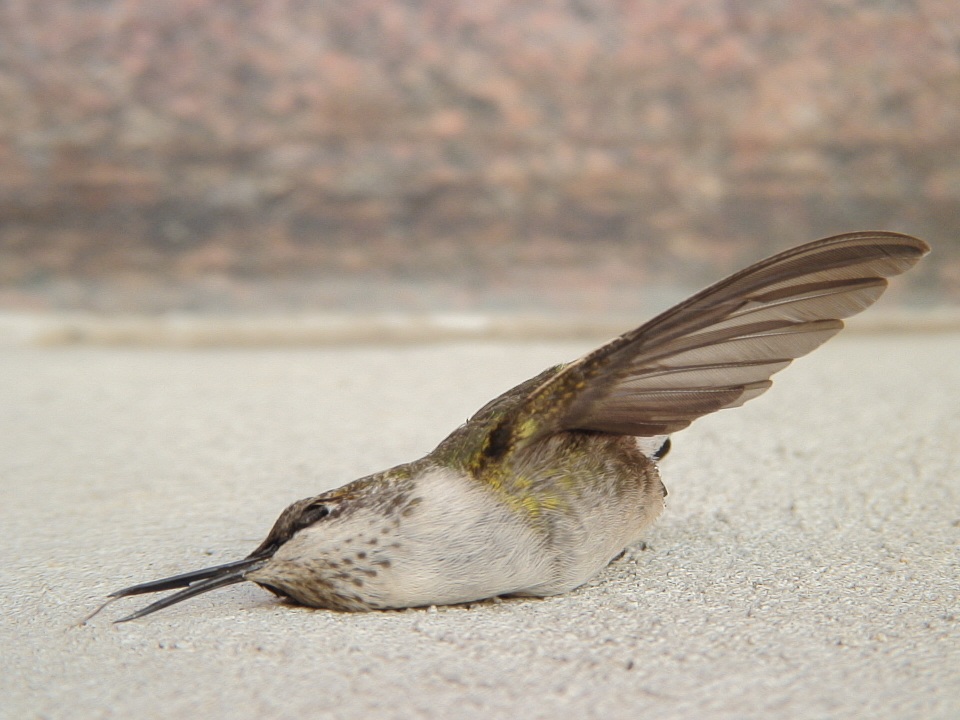
A particular downtown Omaha building is especially dangerous for migrant Ruby-throated Hummingbirds.

Ten dead hummers have been noted in the past four years, with four occurrences in particular associated with the Central Park Plaza.

Most notable is that three of the known instances have been at the same spot of the building's plaza, and within a time period of three days. The only exception among the bunch was a bird that struck glass on the north side of the north tower, ending up on the sidewalk along the street.

It is quite a conundrum why hummingbirds would be killed within the same time period at the same building and within an area no greater than 36 inches in diameter. The specific spot is on the west side of the plaza of the Central Park Plaza, and immediately near the second window from the north end of the windows between the north and south entrances.

A single carcass of a Ruby-throated Hummingbird was noted, corresponding to three particular dates:

  • 13 September 2008,
  • The first instance of a dead hummingbird found at the Central Park Plaza buildings.

  • 13 September 2009, and
  • Another instance of a Ruby-throated hummingbird killed by the glass at the Central Park Plaza.

  • 15 September 2011.

Dead hummingbird noted on 16 September 2011, in a completely drenched condition. Based upon the time when found, and weather conditions, it is likely that this bird was struck dead the previous day.

No available explanation can explain this repeated autumnal occurrence. The building's plaza does not have any greenery that might attract birds of any sort. It is separated from the somewhat green situation of the Central Park Mall by the multi-story downtown Omaha Library. Lights might be a factor, but they mostly shine higher upon the two towers.

What might cause this sordid event is not known...

If the unnecessary demise due to windows strikes occurred twice it might be due to chance, but after three instances, it is more than just a random event. Any first-hand explanation is not forth-coming as birds can't describe their behavior, and, anyway, those involved are now dead, and were thrown into the trash to get rid of the formerly live animals.

Some sort of human explanation is not available, and completely lacking. It could be appropriate to investigate the matter further by staking out the place during the same days in future years and watching any hummingbird behavior in a precise and focused manner to gather some interpretable clues. This determination would be derived from an initial four years of gathering records in the early morning of many days.

The unused Law Building has caused two known hummingbird deaths during the same period.

A recent addition to the list of dangerous buildings is the Sorrell Center at the University of Nebraska Medical Center. The bird that died there languished for a time before it was noted. Once that happened, watching eyes made sure it was removed.

Carcasses have also been recorded at the 1200 Landmark Center, Qwest Center Omaha (now Centurylink, though the signs have not yet been changed), and Omaha Public Power District Energy Plaza, which was also a new addition in 2011. At the latter site, the carcass was left on the sidewalk for an extended period.

These sorts of ponderings should not occur, and they would not if the proprietors of particular buildings in downtown Omaha gave attention to the how their buildings are dangers to migrant birds, especially in spring and autumn. If the many structures which are not bird-safe were otherwise presented, there would be noticeably fewer bird strikes and an insufficient record of occurrence to devise trends or repeated occurrences.

Alas, it is otherwise, to the ongoing detriment of birds migrating through the valley of the Missouri River.

03 June 2011

Omaha's Spring Bird-strike Tally

During late April and May, efforts were made on many of the month's mornings to get downtown by sunrise to check for bird strikes. Some days were missed due to rain, and a couple because of a vague malaise. Overall a qualitative representation of how birds impact dangerous spots at a multitude of buildings was gathered, mostly usually self-propelled.

On April 18th, a Mourning Dove carcass was noted at the Qwest Center Omaha, the first fatality of the season. The next instance was a Myrtle form of the Yellow-rumped Warbler at the Union Pacific Center on April 25th.

These two occurrences set the stage for the mornings of the days in the following month.

There were sixty strikes documented during May and the following summary information is presented for this month. Each of the birds was a species protected by the Migratory Bird Treaty Act, with the one exception of an European Starling on May 30th.

The following table allows a comparison of the strikes denoted for each day of May, for 2011 and the three previous years, as personally recorded.

Julian Date

May 2008

May 2009

May 2010

May 2011

121

-

-

2

-

122

5

1

-

-

123

-

1

2

-

124

-

4

2

1

125

-

5

2

1

126

-

2

-

3

127

3

2

-

2

128

-

1

-

-

129

2

1

4

7

130

-

3

1

7

131

10

-

-

-

132

2

3

1

5

133

3

2

-

-

134

6

-

2

-

135

1

2

8

-

136

1

-

2

4

137

1

-

1

-

138

3

7

-

-

139

7

2

2

5

140

2

4

-

-

141

5

2

-

-

142

4

3

3

-

143

1

1

1

2

144

4

2

1

5

145

2

7

-

-

146

5

3

1

1

147

10

1

1

-

148

2

1

-

6

149

1

-

-

3

150

11

2

-

7

151

3

4

-

1

152

8

-

-

-

During this four year period, 264 instances were recorded, of which 258 instances could be suitably identified to species recognized by the Migratory Bird Treaty Act. Numbers during each of the years is variable and dependent upon an array of factors. The known number of strikes are:

2008: 99 records for identifiable, protected species
2009: 64
2010: 36
2011: 59

Details for May 2011, based upon particular buildings, is readily available since particulars are recorded for each strike observation.

  1. Qwest Center Omaha: 16 instances

    Examples of bird strike victims at Qwest Center Omaha — 30 May 2011

    A "hurting" Dickcissel.

    Disabled Indigo Bunting.

    Dead Yellow-billed Cuckoo.

  2. Holland Performing Arts Center: 5
  3. Union Pacific Center: 5
  4. Gottschalk Freedom Center: 5
  5. Redfield and Company Building: 4
  6. First National Tower: 4

    Dead Common Nighthawk at First National Tower — 28 May 2011

  7. Central Park Plaza: 3
  8. 1200 Landmark Center: 3
  9. Health, Physical Education and Recreation Building at the University of Nebraska at Omaha: 3 noted on one day
  10. Omaha Public Power District Energy Plaza: 2
  11. DJ's Dugout Sports Bar: 2
  12. Omaha-Douglas Civic Center: 2
  13. Law Building: 2
  14. Woodmen Tower Skywalk: 1
  15. OBI Creative Building: 1
  16. DLR Group Building: 1
  17. Brandeis Building: 1

Continuing its dubious position as the most deadly building for migrant birds in River City is the Qwest Center Omaha. The huge expanse of glass on its west side has been recognized as being dangerous to birds of passage for several years. Building management put some decals on the upper extent of the glass in 2010.

This effort has not been effective, based upon the continuous and ongoing bird strikes documented. It should also be noted there is an effort - personally noted - to remove any dead birds from the building site, by facility security, especially in the early morning hours.

Other places were new additions to the list of places dangerous to migrant birds in the Omaha vicinity of the Missouri River Valley.

Particular examples include:

Health, Physical Education and Recreation Building: this spring the situation on the south side of this building became very apparent on one day; placing a vast expanse of reflective glass across the south side of a building which faces a city park presents an obvious threat, which is now known. Officials of the University of Nebraska at Omaha were informed of the situation. No response has been received to sending pictures to management of the facilities department, and from a followup phone call.

There was an indication last autumn that the big glass facing north at DJ's Dugout would pose a danger were realized this spring with more than one bird strike instance. Other new sites on the list include the OBI Creative Building and the DLR Group Building at Aksarben Village.

The latter building was constructed in a manner to meet LEED certification. This company was contacted via email when building construction was announced to inquire if the building was bird safe. No subsequent response was ever received. The species which met their demise is not certain as there was a spot of feathers and bones from an earlier day, though its occurrence was readily indicative.

A bunch of species are represented in the May tally, listed in taxonomic sequence:

  1. American Coot: 1
  2. Mourning Dove: 2
  3. Yellow-billed Cuckoo: 1
  4. Common Nighthawk: 2
  5. Willow Flycatcher: 1
  6. Red-eyed Vireo: 1
  7. Sedge Wren: 1
  8. Marsh Wren: 1
  9. Swainson's Thrush: 2
  10. American Robin: 2
  11. Gray Catbird: 2
  12. European Starling: 1
  13. Tennessee Warbler: 4
  14. Orange-crowned Warbler: 1
  15. Yellow Warbler: 1
  16. Ovenbird: 3
  17. Mourning Warbler: 1
  18. Common Yellowthroat: 9
  19. Clay-colored Sparrow: 4
  20. Grasshopper Sparrow: 1
  21. Lincoln's Sparrow: 7
  22. White-throated Sparrow: 1
  23. Rose-breasted Grosbeak: 2
  24. Blue Grosbeak: 1
  25. Indigo Bunting: 4
  26. Dickcissel: 1
  27. Common Grackle: 1

New additions to the list of May bird-strike instances or this area are the Dickcissel, Marsh Wren and Sedge Wren.

To convey - once again - a consistent and constant fact, the death of any bird is considered a taking according to the Migratory Bird Treaty Act, and is therefore a violation of a federal law. Ongoing, deadly strikes are still a violation of the MBTA, even if efforts have been taken.

An ineffective effort does not provide a "shelter" from legal responsibilities. Each of the owners/managers of the buildings listed are ignoring their legal responsibilities.

Bottom line legally: violations of a long-standing federal law continue unabated in the Omaha.

A more appropriate bottom line: birds continue to suffer and die because of dangerous places at Omaha buildings which could be adapted to reduce the risk. In some places this is obviously being ignored, and otherwise, inefficient attempts are not enough to make a substanative difference.

10 May 2011

A Thousand Birds Strikes at Metro Omaha

As of 10 May 2011, there have been more than 1000 bird strikes at buildings associated with the Metro Omaha area.

There were seven known strikes documented this morning, which take the overall count to 1002.

The instances today when a few species struck hazardous glass were:

Qwest Center Omaha
two Lincoln's Sparrows and two Clay-colored Sparrows on the west side of the structure; translucent decals placed higher up on the extensive glass surface are being ineffective; the birds are striking the glass at a lower level where there are no decals
Union Pacific Center
Common Yellowthroat on the east end of the north side

This yellowthroat record gets the dubious honor of officially being strike instance No. 1000!

Gottschalk Center of the Omaha World-Herald company
Mourning Warbler at the north end of the west side
1200 Landmark Center
Lincolns Sparrow on the north side of the central atrium; the still warm bird had struck the glass on the west side and southward end, near the doorway

Each bird strike casualty is considering a taking under the auspices of the Migratory Bird Treaty Act, and thus each instance is a violation of this federal law.

09 May 2011

First National Corporation Fails to Address Bird Strikes

There have been 35 known occurrences of birds striking the glass facades of buildings associated with the First National Bank Corporation. The structures under consideration include, predominantly the First National tower, with only a few other records available of birds striking a structure owned by this corporation.

A letter dated 13 April 2011 from the U.S. Fish and Wildlife Service, Nebraska Field Office, conveys the situation. A copy of the letter obtained from the agency says a meeting was held at the First National Building on 22 April 2010.

According to personal contacts with the agency, another meeting was held onsite in downtown Omaha in early April 2011.

Details indicated by this letter, denoted as "priority corrective measures" were:

"Based on a review of the documents you provided, information gathered from other sources and citations, and a review of the FNB buildings avian mortality risk factors, the Service recommends the following corrective actions be taken at the FNB Tower, FNB Building, and at the FNB Data Center in downtown Omaha to prevent and minimize migratory bird death and/or injury at windows during peak spring (April 15 - May 31) and fall migration periods (August 15-October 31).
"WINDOWS
"Install temporary transparent of perforated patterned, non-reflective window films that make glass visible to birds (examples include Scotchprint or CollidEscape) on windows that tend to be hazardous, focusing efforts on Atrium (winter garden) windows and those lower windows located on the north east corner of the FNB Tower, and other lower level windows at other buildings.
"Brightly lit lobbies with greenery features are extremely dangerous to a migratory bird that has been drawn into the city by light pollution. Relocate interior plantings, water sources or other features that are causing birds to crash into glass windows.
"Replace interior foliage in atriums with artwork, sculptures, banners, or other forms of art.
"LIGHTING
"Reduce interior light levels during evening and nighttime hours. Staff working late can use task lighting at work stations and turn off ceiling lights closest to windows. Close curtains or blinds during the evenings if the interior is illuminated.
"Eliminate upper architectural lighting from 11:00 pm - 7:00 am during spring and fall migration periods. Building owners and managers can make sure that lights are out at night on unused floors. Lighting control systems can be installed to reduce energy consumption, save money and protect birds' lives. It is important to turn off exterior floodlights during spring and fall migration.
"Reduce spill light and optimize useful light. Street-level light, though preferably down-shielded, and airplane warning lights are not affected. Many buildings are also interested in certification through the LEED system - a "green" rating system for buildings, indicating Leadership in Energy and Environmental Design. Building owners, managers, employees and also tenants also take pride in their participation in Lights Out. There is really no downside to Lights Out."

The letter to the FNB corporation continued and included several web-links to information on "Lights Out" programs.

None of these measures had apparently been implemented as of early May, 2011.

On the morning of 7 May - faux International Migratory Bird Day - a disabled Gray Catbird was readily noticed at the east entrance to the atrium on the north side of the First National Tower. There have been multiple been multiple bird strikes documented at this place.

This particular bird of special significance was carefully grabbed and then kept in a safe place so it could recover from its smashing impact. It received motorized transport to Levi Carter Park, where it was released into a natural habitat so it could fly free in a safe environment. Upon its flight, it flew to a nearby tree, apparently to consider its condition and where it would henceforth fly further along on its spring migration.

FNB Staff Talk Yet do Nothing

Representatives from this corporate entity have said a lot - during personal conversations in the past three years - but have apparently not undertaken any steps to address the apparent and ongoing problem. done nothing.

There will be more bird strikes at this building. How this situation is adequately addressed and resolved is still quite uncertain, years after the first awareness on this issue. The final resolution depends upon the corporation, which based upon government correspondence and personal contacts, talks a lot but does nothing.

Sparrow which was temporarily disabled by striking the atrium glass at the First National Bank Tower. Morning of 9 May 2011.

28 November 2010

Iconic City Structure Deadly to Birds at Philadelphia

When the City Hall Tower was built in downtown Philadelphia, it was topped by a "colossal" bronze figure of William Penn.

The structure - more than 500 feet in height and encircled with a ring of arc lights which burn the night long" - was dedicated on July 4, 1897, which was also when the lights were first turned on.

Within a few weeks it was known to be a hazard for migratory birds. The first report of a dead bird was given in the Philadelphia Evening Bulletin, and had been found at the balcony just below the lights of the tower.

William L. Baily investigated and found that it was a young Sora rail. He also noted: "This was the first bird that had flown against the tower since the lamps had been lighted."

The potential to note other instances piqued his interest, so he continued to monitor the site for bird-strikes for the next three years. His initial report of findings was read before the "Seventeenth Congress" of the American Ornithologists' Union meeting on November 15, 1899 at Philadelphia. A subsequent article was issued in 1900 by the Delaware Valley Ornithological Club of Philadelphia.

Mr. Baily's article titled "Migration Data on City Hall Tower" noted that: "Unintentionally this beautiful circle, crowning the highest point for miles around, has been the destroyer of many birds during their nocturnal migrations between their winter and summer homes. As much as we deplore this unfortunate destruction, we have been able at the same time to obtain some interesting data upon the subject of migration."

He noted species of the dead birds found (with others expected to have been taken away by passer-bys, eaten by cats or dogs, or otherwise removed and therefore not considered), the season of occurrence, kept weather-related notes, and observed bird behavior around the monument.

"In 1987, during the fall observations, nearly the whole month of September was clear and few birds were led astray into the light, and only thirty struck between August 23rd and November 8th. In the spring of 1898 Penn's collection only amounted to six birds. In the fall, the first two weeks of September were so warm that there was practically no migration until the 15th, when it was sudden and soon over, netting thirty-one victims.

"The present year (1899) the great clock, with an illuminated face over twenty-five feet in diameter, made its appearance, but luckily for the birds, the lights around the tower were turned off from May 2 to 16, and all the birds escaped but ten.

"The fall, however, the great parade and the Industrial Exhibition were special occasions for illumination, when four festoons of lamps were swung from the rim of Penn's hat to the balcony, and the gleanings from August 23 to October 31 amounted to four hundred and fifty-two birds. If, like the light-houses, there was a cylinder of glass around the outside of the light this slaughter would have been enormous. As it is, many of the birds approach the tower without striking, and I have watched them fly between the lights, circle the tower and then disappear into the darkness without in the least endangering their lives."

In his report, Mr. Baily made some comparisons of when old versus young birds were found, and briefly considered weather conditions and how they would be a variable.

The following species were collected during the spring and autumn seasons from August 27, 1897 to October 31, 1899. Species are listed alphabetically instead of in the order presented by the article.

Philadelphia City Hall ca. 1899. Image available at Wikipedia.

American Kestrel (sparrow hawk): 1
American Redstart: 16
Bay-breasted Warbler: 1
Black-and-white Warbler: 12
Black-billed Cuckoo: 2
Black-throated Blue Warbler: 12
Black-throated Green Warbler: 24
Blackburnian Warbler: 10
Blackpoll Warbler: 23
Bobolink: 1
Brown Creeper: 1
Brown Thrasher: 3
Cape May Warbler: 1
Cedar Waxwing: 4
Chestnut-sided Warbler: 2
Chipping Sparrow: 14
Common Yellowthroat (Maryland yellow-throat): 158
Connecticut Warbler: 12
Dark-eyed Junco (slate-colored junco): 6
Eastern Phoebe: 1
Eastern Towhee: 2
Eastern Wood-Pewee: 1
Field Sparrow: 6
Golden-crowned Kinglet: 1
Grasshopper Sparrow: 2
Gray Catbird: 3
Horned Grebe: 1
House Wren: 1
Indigo Bunting: 6
Magnolia Warbler: 5
Marsh Wren: 3
Mourning Dove: 2
Myrtle Warbler: 34
Nashville Warbler: 1
Northern Flicker (flicker): 6
Northern Parula (parula warbler): 67
Ovenbird: 7
Palm Warbler: 1
Pine Warbler: 5
Prairie Warbler: 1
Red-breasted Nuthatch: 6
Red-eyed Vireo: 16
Ruby-crowned Kinglet: 2
Ruddy Duck: 1
Savannah Sparrow: 2
Scarlet Tanager: 2
Solitary Vireo (blue-headed vireo): 1
Song Sparrow: 1
Sora: 1
White-eyed Vireo: 1
White-throated Sparrow: 1
Wood Thrush: 1
Yellow-bellied Cuckoo: 4
Yellow-bellied Sapsucker: 1
Yellow-breasted Chat: 3
Yellow? Warbler (yellow palm warbler): 26

Overall, 529 specimens representing 56 species were gathered, including 21 species of warblers and six kinds of sparrows, with most of the others typical songbirds of the eastern Pennsylvania region.

This report is an important account which adds significantly to the early history of bird-strikes in American cities.

The City Hall Tower is still present in Philadelphia, though whether it is still a hazard for migratory birds is not known.

04 November 2010

Adding Bird Safety to FWS Refuge Buildings

Parker River Refuge building. Both pictures courtesy of the U.S. Fish and Wildlife Service.

Two buildings constructed for the Fish and Wildlife Service were recent recipients of a 2010 Federal Energy and Water Management Award award in recognition for their "innovative, sustainable designs."

The Parker River Refuge Visitor Center and Administrative Headquarters facility in Massachusetts, constructed in 2003, was recognized as a "model of sustainable design, complete with passive solar techniques, super-insulation of the building envelope, high-efficiency lighting, and a geothermal open loop ground source heat pump that reduces energy use by 41 percent as compared to a traditional office building," according to a Fish and Wildlife Service press release.

Additional changes made at the building have also made it more bird-friendly.

There was a lot of glass on one side of the building, and since the glass was installed before any exhibits, there were bird strikes occurring, said Kyla Hastie, with the FWS northeast region external affairs office.

As silhouettes of plant species were placed on the windows, as part of the building's exhibits, bird strikes were reduced to almost nothing, Hastie said. Refuge staff also subsequently added a "film to the windows - the primary purpose was to save energy and cut down on solar build up - but it also seems to have reduced bird strikes."

Inland Northwest NWR complex building.

At the Inland Northwest National Wildlife Refuge Complex at Cheney, Washington, a new headquarters and visitors center "incorporates numerous energy-saving strategies, including super-insulation, a cool roof, energy-efficient LED lighting with occupancy sensors, triple-paned low-emissivity windows, optimal building orientation, and local stone and concrete to enhance thermal mass and help maintain comfortable temperatures. The main building uses a 14.35-ton geothermal heat pump with an overhead electric forced-air system for heating and cooling, a 4.9- kilowatt grid-tied solar photovoltaic array for electricity and a flat-plate roof-mounted solar collector system for hot water."

"The work of national wildlife refuges is essential not only in protecting wildlife habitat, but also in leading by example in energy efficiency," said Acting Service Director Rowan Gould. "Parker River National Wildlife Refuge and Inland Northwest National Wildlife Refuge Complex are prime examples of how we intend to reach our goal by 2020."

This award is given by the Department of Energy to recognize individuals, groups and agencies for their outstanding contributions in the areas of energy efficiency, water conservation and the use of advanced and renewable energy technologies at federal facilities."

08 October 2010

Bird Conservation Measures Included in Environment Omaha Plan

Several notable provisions to promote bird conservation are included in a "new environmental vision" plan recently released by Environment Omaha for the River City.

Particularly notable are the following items included in the Natural Environment section. One particular section pertinent to bird-strikes, is included here in its entirety, is:

"5. Minimize the impact of noise, lights, hazards, and other disturbances on wildlife in the design of infrastructure and development.

"5.1 Ensure that collaborative efforts are taken when evaluating the impact of building development and building operations on wildlife, particularly migrating birds, because of Omaha's location being directly within migratory routes of many species.

"* Guidelines for building design and management/operation should be developed and promoted to reduce mortality and injury to birds from bird-building collisions.

"* Initiate a 'Lights Out' campaign to encourage building owners and managers to minimize lighting at night, particularly during bird migration seasons."

The impact of domestic and feral dogs and cats is also addressed.

An item states: "Support feral cat management and protection strategies that are designed to protect native bird species." This item is in a section about managing "human and wildlife interaction to improve biodiversity and native species... ." and also says: "Support education and regulation toward reducing the harm that unrestricted movement of pets has on native songbirds and small animals." Included in this section is the need to provide information useful for the "management and protection" of mammals and birds, and to work with merchants in the metro area to encourage "proper bird feeding and housing that will promote native bird species."

Habitat Conservation

There are several items listed to "preserve, protect, and restore natural communities" and the related "protect and preserve lands that are sensitive to disturbance or that provide unique ecological, cultural or aesthetic features." This includes particular recognition of springs, seeps and other water-based features which occur within the city.

Two notable examples would be the flowing springs at Spring Lake Park, and the springs in the east section of Elmwood Park which create Shadow Lake.

Also pertinent: "Establish land management and maintenance practices to restore and sustain natural communities, habitats, and ecosystem processes." Mentioned as being useful for this goal, includes conservation easements, adoption of "environmentally responsible strategies," and developing information and educational resources.

For the latter item, there is a particular mention of the need to establish a "natural habitat inventory" that would identify the flora and fauna of notable localities.

The document is the result of two year's of work by thousand's of volunteers, and was developed to provide an environmental element for the master plan for the city of Omaha. There were 23 members on the Natural Environment advisory committee.

The draft plan was unanimously endorsed October 6th, by the Omaha Planning Board. It is expected to be considered by the Omaha City Council in early December. If approved, it will then become a part of Omaha's Master Plan.

Once the document review process is finalized, and if approved, various entities such as the City of Omaha, the Papio-Missouri Natural Resources District, Omaha by Design and other public/private entities or groups would be expected to implement the recommendations appropriate to their interests.

Efforts on implementation of the proposed goals are still being sorted out, according to Mike McMeekin, a co-chair of the initiative.

The entire document is available for review at the Environment Omaha website, which also provides an opportunity to submit comments.

27 September 2010

A Thousand Hurts - Nebraska Bird-strikes Tally

Finding a bird strike victim in Lincoln years ago started a trail which hit a sad mark. This morning, a bit after 7 a.m., while bicycling about downtown Omaha to survey the latest bird strikes occurrence, the 1000th example was noted.

After a tally of 11 victims on Sunday, there was a certain expectation with migration actively underway, that the next day would be when this figure would be reached. And it was ... Monday, September 27, 2001 is a day of infamy when the hurts and pains of so many birds hit such a peak of numbers which have suffered from bird strikes.

The following are the three latest victims.

Number 998

Nashville Warbler at the Harper Center, Creighton University.

Number 999

Black-and-White Warbler at the Qwest Center. Note in the first picture how the bird as its head tucked away, as it suffers from hitting the glass on the west side of the building. The second picture is taken after the bird was taken elsewhere for improve its conditions for a hopeful recovery.

Number 1000

Nashville Warbler at 1200 Landmark Center. The carcass was obviously stepped on or smashed in some other manner.

A new rhyme is being used to describe what happens with each bird strike found:

If the bird is dead, leave it lay
If there is life, take it away

Live birds are placed in a dark, comfortable container and then taken to a nearby green space and placed into a tree where they can safely recover.

There is so much more to say about this campaign which has been going in spurts since 2007, but those comments will have to wait. It is such a shame that so many bits of feathered color have lost their lives, and ended up being indifferently thrown into the trash, just like a piece of paper refuse from a fast-food joint.

Another Day, More Dead Birds

The following three fatalities were found on the morning of September 28, 2010. They were at the Holland Performing Arts Center, with its obviously hazardous glass.

Number 1001

Number 1002

Number 1003

How Omaha Welcomes Migratory Birds

On Wednesday morning, September 29, 2010, a bird-strike victim was found at a building where there had been no previous occurrences. A dead Wood Thrush was found outside the Convention and Visitor's Bureau office at the 1000 block of Farnam on the Mall.

This strike is an indication of how Omaha welcomes bird, and it is ironic and sublime that the thrush was found dead outside of the Visitor's Bureau. The "Visi" of the sign can be seen in the upper portion of the glass doors.

Number 1009

13 September 2010

Deaths of a Thousand Hurts - Bird-strikes U.S.A.

With the southerly bird migration underway, there are flocks of birds making their way along their route which includes many natural and artificial perils. A prevalent hazard is buildings with glass exteriors, which unsuspecting birds of many sorts hit and either die or are stunned and fall to the ground, perhaps to recover or be taken by some other hazard.

Bird-strikes are now occurring across the northern hemisphere, with millions of bird casualties occurring now, this autumn.

The following eleven bird-strike instances, are Omaha examples of the deaths and pains invoked upon the birds migrating southward along the Missouri River Valley.

11 Sep
• Gray Catbird - Omaha-Douglas Civic Center; carcass on the plaza, south of atrium area
• House Wren - 1200 Landmark Center; disabled bird, writhing about; north side, west section; this bird could not even sit upright because it was still suffering from its direct impact with the glass facade.
• Nashville Warbler - Holland Center for Performing Arts; disabled bird, south side, east end; beneath outer glass wall which is the upper section of structure
• Purple Martin - Kiewit-Clarkson Skywalk; carcass at the north half, west side; on the south end of this section
• Purple Martin - Kiewit-Clarkson Skywalk; stunned bird at the north half, west side; on the north end of this section; lying in street; moved to off-street location
12 Sep
• Common Yellowthroat - Qwest Center Omaha; carcass outside north-facing entryway at the south end of the west side

Common Yellowthroat, Qwest Center Omaha.

• House Wren - 1200 Landmark Center; stunned bird on the north side of the lower, eastern part of structure; east half, west portion
13 Sep
• Wilson's Warbler - 1200 Landmark Center; disabled bird at entry at glass wall east of south, atrium entry
• Common Yellowthroat - Holland Center for Performing Arts; carcass on the south side, almost at the west end
• Marsh Wren - First National Tower; disabled bird at entry at northwest corner

Marsh Wren, First National Bank tower, downtown Omaha.

• Wilson's Warbler - Loft 610, Midtown Crossing; disabled bird at Loft 610, north-central side of building on north side of Farnam Street; flew away before picture could be taken.

It was only a matter of time before bird strikes were expected to occur at the recently completed Midtown Crossing development. The wall-like buildings have glass windows, and are adjacent to trees in the former Turner Park, so it was inevitable that strikes would happen. Architectural renders provided the details to indicate the structures as hazards, as noted previously, and accurately predicted.

Loft 610, Midtown Crossing, showing the scene where a warbler was injured upon hitting the glass facade.

Ongoing Misery

The region's migration season is just getting underway, and the misery caused by many more bird strikes, will continue unabated. Each death is the sad loss of the life for a bit of feathered treasure, and the obvious pain caused is appalling.

What is most appalling however, is the apparent indifference by the building managers/owners who are so obviously indifferent to what they are causing. Then add in the obvious and repeated ignoring of never-ending violations of the Migratory Bird Treaty Act, and the whole situation is a complete tragedy.

Warbler taken from the sidewalk on the north side of the Zorinsky Federal Building and placed into a tree, so it cover recover at a safer place. February 14, 2010.