Showing posts with label birding. Show all posts

20 March 2019

A Sunday Drive in Cherry County Country

March 20, 2019. Pre-spring visions. Valentine Midland News 47(43): 12.

Beneath a beautiful cloud-free cerulean sky and with warming temperatures, Gordon Warrick and I took a drive amidst a bit of Cherry county country on a pre-spring Sunday the 17th. During our foray, my sharpened pencil was kept busy writing notes. Then later, more time was taken later to derive a suitable geographic designation for a bunch of bird observations.

Across the land southward of Valentine, there was lots of ice but some birds were indifferent because flocks of geese arrived or were flying into local habitats as wintry conditions moderated.

During our drive, we once again focused on the spaces along the Brownlee Road, with a start at the Heart City, down Highway 97 and then beyond to see what wildbirds were present.

A great grey shrike was on a wire at the Mcsky Ranch. Merritt reservoir was nearly 100% ice-covered. Three fishermen from Nebraska county 15 were huddled aside the dam looking at their nearby gear. They gave a hearty wave as we drove quickly past because there were no birds on the ice-covered waters.

In the vicinity of Gordon Creek along Highway 97, waterfowl of the day became especially obvious. There were lots of Canada geese obvious in the meadows as flying above. Most dramatic were eight trumpeter swans at the lowlands. They were waiting for ice-free water where they might establish a home for the pending breeding season.

Near the top of a big meadow tree a pair of bald eagles built upon a seeming balcony – because they reside at a nest of historic renown – were easily seen from the highway, while being attentive to their season’s brood. What were they doing during the so recent blizzard? Hope was no choice for them but it seems they did their work well and the nest survived the blasting winds with blowing snow and frigid cold.

Eventually we reached our Brownlee Road route, a uniquely scenic drive way amidst country with lakes, valleys and high country hills. There were plowed away snow drifts at more than one place.

Another couple of trumpeter swans were seen at Packingham Lake. With the water still ice-covered, we pondered how they might avoid any nightly wanderings of coyotes looking for a meal. They certainly have the right moves to avoid that sort of trouble.

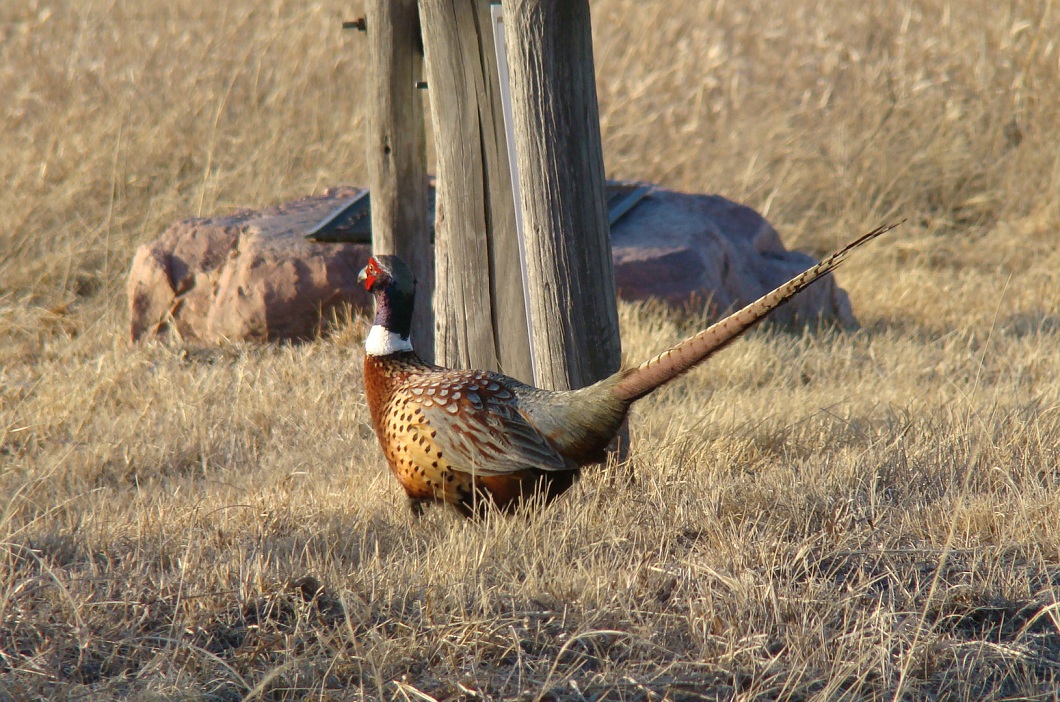
A strutting common pheasant rooster was along the road in Wamaduze Valley (isn’t that a distinct name of historic derivation). Territorial red-winged blackbirds were prevalent at many places and numerous at more than one place. Rough-legged buzzards were obvious. There was even a common pheasant that added some color to the scene.

Many meadow expanses were filled with water topped with ice that will soon melt. These places will be hay meadows later this year.

We two bird-watchers were excited upon seeing two vividly blue birds atop some fence posts in the valley. They were soon identified as mountain bluebirds. Neither of us had seen them for a long time. The last reported record of this species in the county was in 2009 at Merritt Reservoir. That is a historic matter. To actually to see these two birds togetherly active in Cherry county supersedes many things.

A bunch of birds were notably active along the North Loup River in the Brownlee vicinity. Mallards were flying around. Red-winged blackbirds were busy in moving north or selecting a territory for the season. Migratory common mergansers were lingering as the flowing river was a haven.

During our transit of more than 20 miles along the road, there was only one pickup loaded with a big round bale, and then, later, two other vehicles east of Brownlee.

We tried to visit Rat and Beaver Lake WMA but the road was too muddy, rutted and not very suitable for vehicular travel. County ranchers have to deal with this reality every day, but we experienced a single effort and turned around. Ranchers deal with these conditions know much more on how to successfully deal with any travel issues. We gave up since the pending route was so tentative even while 4x4 travel was available. It was a vivid reality associated with country life.

Northward along Highway 83 upon our travel back to the city, and just a relatively short distance south of the Y, a field usually associated with corn, many geese had congregated on ice covered. There will be no plow on this ground for a particular time.

The overall bird tally for the day was 34 species, with raptors (six species including a vivid view of a beautifully colored ferruginous hawk and a singular American kestrel), waterfowl and flocks of red-winged blackbirds being notably prevalent.

It was a quite nice drive that can be appreciated any day. Our Sunday outing was a fine time to look around for the birds of the pending spring. Various landscape features of the hard surface Brownlee Road are a certain treasure of Cherry county. Any time spent along this route is an opportunity to appreciate a special sand hills setting.

22 October 2016

An Autumn Ride in the Country

A knock on the front door was the start for a Sunday ride along the Niobrara River. The outing was not much of a jaunt beyond Valentine. It was however, another visit to the distinctive Vanderploeg ranch with its great wetland where the water always flows, next to the well-known Schlagel Creek and elsewhere among places of history.

After an appreciated brief visit with Marvin Vanderploeg at his residence - which is a tribute to the enjoyment of birds - Gordon Warrick drove onward along the country trail in the valley of the L’Eau Qui Court, to use a historic name. There was no travel along any sort of hard-surface so there was a complete lack of stop signs, traffic lights or any other vehicles. The pace was slow and right pace, with regular intermittent pauses – key turned off and most times the transmission moved to the park position later - to get a better look at some birds of a sort.

A first pause to get a good look - using binoculars and a spotting scope - at a grayish bird atop a pine, initially noticed because of a glance towards the sky-scape. It was a Townsend’s Solitaire, which had not been seen for years by either of us; was also a new addition to the great variety of wild birds that appreciate the wild land habitats of this ranch.

The plant-free marsh water along the lowland of the valley next to the river was a haven for several sorts of waterfowl. Prominent were the three juvenile Trumpeter Swan raised during the past summer season, Vanderploeg said. Migrants included Green-winged Teal, with many Mallards typical for the season also present. Out vantage point was a distinctively unusual and slight promontory on the south side of the valley flat.

A bit later, four adult swans were vivid in white on a place they found suitable along the Niobrara riverway.

With two bird-men with biological interests in the cab of a pickup, the discussion along the way included words about the local land and the ongoing tree management, the attention taken to create this place of unique heritage, plants of various types and other pertinent natural history miscellany. A particular personal conjecture was being able to throw a fly-line into Schlagel creek, and perhaps fish out a trout to enjoy for a short time, before it would be placed back into the cold, flowing, piscatorial waters. That would be a magnanimous story of its own accord.

Trees were a prominent feature. Oaks had leaves of many colors. Among the mix of flora were other sorts of plant species of lesser extent. It was a cloudy day, but at some time when light and sky combined to create a picturesque view, that created the right time for a photograph by a Canon camera.

During the slowly drive, there were other typical wild birds of the fall. They included a wonderful variety of Western Meadowlark on the uplands. The few wonderfully colored Eastern Bluebird could not be ignored, so weren't.

Among the arboreal setting on the river terrace there were glimpses of the distinctive White-breasted Nuthatch and the always cheery sound of the Black-capped Chickadee. The quiet meant prominent avian sounds were heard, which helped to be certain about the identity of some species of another. We heard the always vociferous flicker among the woods!

An especially exciting sighting were three Red Crossbill perched atop the snags of a deciduous tree, by the Schlagel. During this highlight time, the trio kept their place for a relatively long time of multiple minutes, which when it comes to determining an identity derived by bird action. There was enough of an interlude to get a good look and derive a proper name, especially since their crossed bills - used to extract pine cone seeds - were obvious. Neither of us would be willing to make any effort on which subspecies was present, as there are at least a dozen to consider. This occurrence provided a view, which among this place’s chronicles, is another addition to the known bird history.

The day’s tally was 29 species of birds. This is the largest number of species denoted during a single day survey of wild birds at the Vanderploeg, Niobrara property, based upon a comparison for a multitude of details for other dates, going back to the early weeks of 2000.

During the drive across this land it was obvious how this is a special place. We were able on our Sunday sojourn to appreciate - due to a landowner’s hospitality – so many nice, dinky scenes due to the continual efforts of active conservation. A multitude of land-scape features amidst the valley, are always there though only relatively slightly known. There will hopefully be another time when the mixture of land and sun will express, once again, more vivid views, with, perhaps some time spent on contributing some work time to help a bit with the efforts done to make this such an important example of private land conservation measures.

This is a compilation of the day’s complete avian tally, as noted in variable numbers during the midday record keeping: Canada Goose, 7 standing on a river sandbar; Trumpeter Swan; Wood Duck; Mallard; Green-winged Teal; Common Pheasant; Pied-billed Grebe at the marsh; a single Great Blue Heron; Bald Eagle, soaring above the land; Cooper's Hawk; Red-tailed Hawk; Ring-billed Gull, more than 20 with some sort of a larger gull in a seasonal drab plumage which, as it flew away westward, meant no identification was not possible; Belted Kingfisher as so easily known by its distinctive call; Downy Woodpecker; Northern Flicker with its primary feather feature having a reddish tinge; Blue Jay which is blatantly expressive; American Crow; Horned Lark about the upland grassland; Black-capped Chickadee; White-breasted Nuthatch; Eastern Bluebird along the upland fence boundary; the appreciated Townsend's Solitaire; American Robin; Orange-crowned Warbler so subtle in the river-side foliage; Audubon's Warbler (a.k.a. yellow-rumped warbler); Song Sparrow; Western Meadowlark represented by about 15 birds on the upland on the ranch, with another dozen eastward along the Schlagel Creek Road; Red Crossbill; and, American Goldfinch.

There were some little brown birds that preferred to flit rather than sit, so any opportunity for identification was futile.

13 February 2013

Birdly Details and Pictures From Clear Lake, Lakeland

As a bit of blue among the dunes of Lakeland, Clear Lake has a history of bird use which dates to centuries in the past. The prairie on the hills attracted many species, but the waters were a distinctive attraction.

Geese would gather, and perhaps each year there would be goslings. Ducks would dunk their bills after a tasteful tidbit or dive for a bit of tasty plant. There were swans, grebes and other sorts of aquatic fowl unknown by any known chronicles.

It was not until 1915, nearly a century in the past, that the Franklin's Gull and Forester's Tern were noted in mid-June by a regional survey by U.S. government officials. Then in the mid-1980s, Canada Geese, those obvious and ubiquitous fowl were noted by a state survey of geese.

In July 1996, following years of change that had been wrought upon the lake district of southern Brown county, about a dozen different sorts of summer birds were recorded, representing a typical occurrence of summer-time bird.. None of them were, however, waterfowl upon the lake's waters, and especially surprising was that there were no ducks observed during a quick visit. The known tally conveys the occurrence of about a dozen species mostly present at upland habitats.

An ongoing interest in birds prevails at Clear Lake, most recently by wonderfully evocative photographs. These are some indicative pictures of seasonal residents in recent years, and as taken by attentive observers at the lakeside.


Pictures courtesy of Bruce Beebout. Taken at Clear Lake and the local area.


Adult Bald Eagle.


Ring-necked Pheasant at AGA Marsh WMA.


Great Blue Herons.


Barn Swallows.


Trumpeter Swans.


Wild Turkeys.


Upland Sandpiper.


Pictures courtesy of Pat Connor, taken at Clear Lake.


Blue-winged Teal.


Mallard eggs.


A gathering of American White Pelican.

There are also written records of bird observations, which though current not known, might perhaps be further considered, and convey another unique indication of the avian legacy for this lake.

Especially significant now, is how various birds will respond to the improved situation at Clear Lake, following the removal of an unwanted, invasive fish species. There will be dramatic differences, based upon known responses associated with another "rough-fish" removal effort in Nebraska. If aquatic vegetation thrives, it will be a food source attractive to different sorts of many sorts of fowl, and there might be surprise occurrences.

At least 173 different species of birds are known to occur among the Lakeland District of southwest Brown county, predominantly west and northward from Clear Lake.

The pictures included in this post are Copyright protected material of the respective photographer.

20 January 2013

Birding and the Paranoid Perspective of People

After another checkup last night [July 14, 2005] by law officers in Lincoln, there came back reminiscences of other similar events of the past two years while birding. Each interrogation was apparently brought about by someone noticing my presence at a locale. Since they did not know what my real activity was, they called in the officials to check out what they figured was illegal.

Each time I was watching birds.

The first recall is from Spring Lake Park, in April 2003 at Omaha. Was there a terrorist on the loose?

During an outing about the wonderful park, my pencil was lost. When going back to the truck to get something to keep bird notes with, I noticed a police cruiser coming to stop at my truck parked at the swimming pool entry at Spring Lake park. The officer said they had a call concerning someone with a gun in the park. The had been looking around to find me for some time — though less than an hour. He said that I would suppose would they would get the call because of my gunstock mounted spotting scope being carried around. I mentioned my bird watching and showed the visit list. Then showed him how the scope worked. The officer finally got a look through and then asked if the black truck was my truck. After my yes, he got back in this cruiser and called to inform others that the so-called "guy with a gun," the proverbial "shootist" was a bird watcher with a spotting scope, or something to that effect. I got another pencil, made some survey notes on the parking place and then went back into the ancient woods for some more looking around.

The interesting aspect of this confrontation, was three days later. I was pulled over for so-called "loud pipes" on my ride, a classic aged, and flat-black paint Chevrolet pickup. This instance — a seeming ruse — included a whole series of things. But it was quite grand to see the officer poke at my spotting scope with his batons. I had been looking at birds at Carter Lake and was pulled over — siren and lights going on behind — on North 16th Street, north Omaha. Another couple of days later, I was followed again by some other officials, they were simple University guys behind me in Elmwood Park.

Birder Enforcement

Got going on a Friday a.m. in December 2004 on the highway to Omaha land. First visit — from out-of-town — was to Carter Lake to get the Cackling goose to add. Then a quick check of N.P. Dodge and Hummel parks. A short stop at Nathans lake — NRD property — led to another time of law enforcement action. My route was to drive down a trail along the drainage ditch and parked and looked about from there. This was a place where I had been several times previously. Birding was slow. But the situation quickly changed.

First it was the Washington county sheriff that was there within 15 minutes of my arrival. A call was placed by a nearby resident. Then when I was ready to go, the sheriff had arrived right behind my vehicle. When he noticed I was looking to move, the sheriff car lights came on. I got out and walked towards his car. The first thing sheriff told me was to get my hands out of my pockets. The officer asked for details of identification and vehicle registration. Then the usual many questions. Who are you? Why are you here? Who do you work for on this? A radio-call had already been placed for backup. Soon the guy and gal FWS enforcers from the nearby wildlife refuge arrived to get into the scene. The Feds did not own the property yet but were supposedly helping with management. Helping with enforcing rules seems more the case from my view of the moment. There were no signs saying: Area Beyond This Sign Closed.

There came questions, some repeated. I explained abut getting access through a discussion with the NRD guy and receiving a map of the area. The subsequent wait included idle chit-chat about birds and the new road. There was no mention of the removed willows or the complete lack of parking places which there had once been present.

The guy asked if he could look inside and I said ok since the door was hanging open anyway. Then when I approached him to point out the gunstock scope he first told me to back away. I then showed him the scope stock and what it was and then he looked inside. and was able to proceed. The glove compartment was opened, something which I would have thought required a warrant. The cop going to open the driver side back door but that was locked. He walked around and tried to look through the darkened windows.

Both enforcers reps asked several times if I was hunting. "I don't hunt" was the repeated and standard answer. The FWS guy suggested I could bird at nearby Boyer Chute NWR but I explained my aversion to that scene of regulation if not on the boring trails. Eventually my freedom to roam returned. Elapsed time until I could go was 15-20 minutes in the sun, keeping my hands out of the bib-overall pockets.

It was only later I gave thanks for the door being locked. Repeat that again and I give thanks once more.

Swifting With Lincoln Law

Since the end of May 2005, many evenings have been spent looking about urbane Lincoln for chimney swifts and the places where they habitate. There was one evening where a law enforcement official, call them a cop for short, stopped to check if my situation was okay. I was dandy so they left with little fanfare while my spot along mainstreet did not change.

Then came Thursday, July 15, 2005, in the evening. Swifts were out and so there I was. Some chimneys under review just did not have any action in the aerial space. My bicycle trek continued onward to more fruitful realms. It went past two big chimneys just west of the center of Nebraska law. There was nothing there at the places with a structure of 4.5x4.5 bricks. Then came the realization that my writing instrument was missing. Checking out the route did not help to find it. So ... visit the nearby convenience store. That would be south on 13th street.

While in the hood, my route changed in order to bike around nearby. There was a wonderful big chimney on the back of an apartment on south 15th street. It was 8 blocks north of main street and looked to be a grand spot for chimney swifts. In wheeling around, a grand spot was found that presented a view of seven chimneys. Each looked nice for the black bugeaters. So I stopped there, drinking a pop in the evening of a torrid day, after 8 p.m.

Swifts were doing their antics in the sky. They zipped into some of the chimneys. A new pencil wrote fine for keeping notes to document the swift nesting locales. My spot was behind all the residences, near a dumpster placed at the public alley.

Swiftian notes aside, it was real dusk and I noticed a cop car park in the east end of the alley, at 15th street. Then the cop came around. She said hi twice, something to establish what they would probably call rapport. Apparently my first reply was not enough.

Then came the typical confrontation and questions. Apparently someone was paranoid about a guy with a bike lurking about. I must have been a thief scooping out targets for illegal activities.

A law enforcement official will ask the same questions. Conformation norms apply ... just answer the queries. What are you doing? Why are you here? Who do you work for to do this? Then, where do you work? Do you have some identification.

An id is always required. My activity was to see what chimneys were being used by swifts. That meant about as much as visiting with a rock. Then the alternative answer was that bird watching was what was going on. That brought about a certain sense of realization. Kinda-like an oh. They seem to think OK at that time.

The caller had also reported the miscreant — me — had a flask. My answer to that should have said they were delusional. My things did include a plastic coke bottle, thrown away in the dumpster.

It was nice to be able to ask the officer if she had seen the article in the newspaper on Monday. That brought a look of duh! Then more asking. Officers need to know. What is in the bag? Binoculars were in the black bag hanging from the handle-bar. Then they wrote in a small notebook ... noting address and phone number, but the latter does not apply.

Then arrived the big man-cop. His car was also parked in the alley, blocking traffic. He walked a bit to join his comrade, but said nothing while there. After the interrogation, they both walked off in the dusk on an urbane alley. The neighborhood was one of the most decrepit and least-goodly appearing places visited in the star city.

My route to depart was biking up a sidewalk, getting addresses for the places watched, and then onward. The cops had to explain to someone there what was going on.

My goings were home to chill and have some ice-cream and appreciate the evenings findings. Several new chimneys were added to my documentation of places used by swifts. And it was quite nice to be able to watch seven chimneys at once. My project does include pictures, so maybe I should visit again, this time with some camera that would be suitable.

It was a nice thing that the swifts cooperated. They had already gone to their residence of the night so there were no vital observations missed.

This weekday was the most enforced outing of my 30-evening affair with the lovely swifts in the skies of developed Salt valley.

I look forward to further instances! Perhaps I should prepare a handout, with some details.

What would happen if out in the city — on a bicycle — without any identification. Is that a requirement for birding in this modern era of homeland security and certain limitations on birding activity?

Perhaps more could be said, but it is time to go swifting in urban Lincoln. Young birds should be about, and there has yet to be a sweet sighting of the fledglings about their chimney. There is a parking garage in the Haymarket that provides a fine perspective of some substantial chimneys. Loitering to watch swifts, there I go.

Originally posted Friday, July 15, 2005 on the NEBirds online forum. Also in the August 2005, Lueshens Birders Newsletter. Pages 75-78.