Showing posts with label tree removal. Show all posts

03 September 2013

OPPD Response to Tree Clearing Concerns

This email was the response received to multiple concerns regarding the tree clearing at the Northwest Pond Natural Wildlife Area at Levi Carter Park, and as conveyed to a representative of Omaha Public Power District at their downtown Omaha office. Among the questions asked were: 1) Who did OPPD contact at Omaha Parks and Recreation Department prior to the tree clearing?; 2) What is the specific legal mandate that allows OPPD to remove park trees?; 3) Why didn't the tree contractor remove all of the tree debris from the natural wildlife area work site?; 4) Why did the contractors take several limbs and shove them into two animal burrows; 5) Why was tree debris thrown into the pond?; 6) How come Omaha Forestry staff had to remove the debris left at the site?; 7) How does OPPD tree removal consider the potential presence of bird nests and/or young; and 8) How will OPPD mitigate for the trees cleared at the natural wildlife area. The response is presented in its entirety, and verbatim as received August 22, 2013.

"We appreciate your concern regarding tree trimming work done at Levi Carter Park. OPPD management and Forestry personnel also value the many benefits trees bring to our communities and the wildlife that benefits from trees. Since 1989, OPPD has provided approximately $1.08 million to fund OPPD’s Tree Promotion Program in our 13-county area, resulting in the planting of rightly 115,600 trees and shrubs. That program also helps educate the public about the value, selection, placement and welfare of trees.

"Many service outages and interruptions are caused by tree limbs that fall into power lines, causing damage to wires, short circuits and other problems. That creates potential damage for customers and customer’s property, as well as disruption of home and business operations. In 2012, trees caused 10 percent of the outages on OPPD’s system. OPPD proactively works hard to prevent such interruptions.

"Reliability is a key component of OPPD’s mission, which is to provide affordable, reliable and environmentally sensitive energy service to our customers.

"OPPD’s Vegetation Management Program is committed to controlling vegetation growth within power line rights-of-way to maintain the safe and reliable operation of the electric system. This minimizes adverse impacts on the environment. As part of the program, OPPD trims trees around power lines on a three- to five-year cycle. If birds are nesting in the area at the time trimming is scheduled, work is delayed.

"Additionally, federal, regional and electric industry regulations and standards require minimum safety clearances to ensure vegetation doesn’t come into contact with high-voltage overhead transmission lines. If vegetation located in the transmission right-of-way is not compatible with the safe operation of the system, it can result in widespread electric power outages or unsafe conditions for the public.

"Easement rights allow OPPD to enter the easement area to trim or remove vegetation and to trim trees adjacent to the right-of-way to eliminate danger trees that could potentially fall within 15 feet of the conductor. Right-of-way widths depend primarily on the size of the power line and typically range from 50 to 200 feet.

"As for the recent work at Levi Carter Park, an OPPD tree contractor worked this area last week. City of Omaha was notified and permission granted to remove brush and undesirable trees as needed. The contractor cleaned up after their work, and returned to pick up some logs they had to leave temporarily. The logs in the water have been there for quite some time, possibly years, and were not part of the recent trimming.

"Again, thank you for your concern."

Sincerely,
John Buckley
Manager T&D Integrated Work Management

18 August 2013

Trees Destroyed at Levi Carter Park Natural Area

Signs posted by City of Omaha officials only recently indicated public property adjacent to Levi Carter Park as a "natural wildlife area," and yet, within five weeks afterwards, the first action at the area was complete removal of many valuable trees.

Every tree, especially the willows, along the majority of the south side of the pond were cleared during the past week. Only one tree remained on a portion of the eastern side which was also cut-back.

The removal was done by a tree removal company which trims and obviously remove trees along powerlines, based upon a contract with the Omaha Public Power District.

The trees were cleared since some one had the opinion that they were too tall for the overhead powerline, though there had been no known issue or concern in this regard.

The area would have benefited from some selective trimming, but entire removal or more than a dozen trees is simply absurd and a travesty.

A natural area doesn't mean clear-cutting of the native vegetation, especially without any consideration of the property designation, and without any known notification or consultation with park management. The trees had provided nice habitat and also provided a natural visual barrier for traffic along adjacent Carter Boulevard.

On Saturday morning the 17th, there were limbs, portions of branches and other debris strewn about, with some within the pond water. To add insult to injury, some of the sawn limbs had been purposely shoved into two animal burrows.

About ten trips were required to move the debris elsewhere, and that was a pile to the south, within the park, and across the boulevard. This was necessary in an attempt to ensure eventual removal.

Obviously the men that cleared the area couldn't finish the job suitably with a proper, and thorough, cleanup! It was instead, a half-done effort by the company. Tree destruction gets lots of directed effort, but cleanup seems to be an arduous chore?

A couple of pieces of trash were also moved so they would get picked up, as was done by mid-afternoon. One of them was a window sash which had been along the train tracks, but was thrown from there, and into the adjacent grass. Were railroad men involved?

There is a known track record for trash removal from Union Pacific Railroad property here. It has been one of neglect, since the city had to remove trash from an adjacent parcel, because the railroad didn't make the effort. The only thing the railroad dealt with was the bill.

Disconcerting here during the past weeks has been the dead vegetation due to personnel from the Union Pacific Railroad spraying herbicide on the park property, adjacent to their limited right-of-way. There were also at least two saplings which had been destroyed through the use of some equipment to push at them until they broke over.

Illegal spraying was done several feet onto the city property, and adjacent to where the natural wildlife area sign is posted. It appears that the over-zealous railroad workers had an especial issue with the thistle growth here.

After the effort to get this bit of green-space recognized as city property, then to get illegal motor vehicles excluded, and then have it given recognition as a natural habitat in mid-July, to see the area cleared was more than disappointing.

This tree-cutting raises a greater issue... What might happen next? How will the area be managed in a manner which reflects its character and designation? Further degradation or encroachment needs to be prevented.

Tree debris left in the natural area pond by the Omaha Public Power District contractor.

The south side of the natural area pond showing where the most extensive tree destruction occurred.

Stump remnants, indicating the size of the destroyed trees.

Dead vegetation due to spraying done associated with the Union Pacific Railroad right-of-way.

Perspective showing where the tree clear-cutting occurred.

Pile of tree debris personally removed from the area.

12 April 2013

Evaulation of Dundee Business District Trees

Article and photographs copyright 2013 J.E. Ducey. All rights reserved.

An evaluation of trees to be destroyed in the Dundee business district found that many of the tress are in fine condition.

The review was done the morning of April 12th, with the assistance of Dr. David M. Sutherland, emeritus professor of botany at the University of Nebraska at Omaha. Each tree was closely looked at to determine its condition.

Even before looking at the trees to be removed, Dr. Sutherland noted the few ash trees west of Pitch, and commented that they might be prone to injury by the emerald ash borer.

Across the street, the last tree on the west end of the area of interest, looked healthy, but not attractive due to extensive pruning. The next tree east, another locust was "not terribly healthy looking," Dr. Sutherland commented.

The next few locusts have been confined within a small growth area, surrounded by bricks and cement ... obviously a limiting situation.

A larger area of soil would be helpful for the survival of trees in this sort of urban setting.

At the intersection of 50th Street and Underwood Avenue, the trees looked fine, as we observed. One tree northward along 50th Street has had a lot of branches trimmed away, and one broken off, probably by a large vehicle.

This tree was "sad looking with its lower branches removed," Dr. Sutherland commented.

A linden on the south side of ABs, looked healthy, and was thriving at its spot where there was more dirt.

The tree outside the doors to Beer and Loathing, should not have been so confined by bricks. It is a prime example of constricting a tree's potential.

Continuing eastward in the morning, there was a local television station interviewing a proponent of the so-called improvement project.

Prominent onward near 49th Street were four large maple trees.

"Maple trees are not a good tree for neighborhoods," Sutherland said. There were four such trees here which were old and damaged. They "do not look good."

Older maple tree are prone to losing limbs, which might fall upon people or property during the weatherly storms typical of this area.

On the south side of Underwood Avenue, three or four trees, including a couple of ginkos, were in a nice condition, growing among an ample amount of dirt, associated with the lawn of a house. There was nothing to indicate that they were not healthy, were too old, or damaged in any manner.

North along 49th Street, the younger linden trees, looked "just fine."

By the end of our tree walk, the buzz saws were working along 49th Street, northward of Underwood Avenue.

Since all of these trees will soon be gone, the next questions might be:

  1. What sort of trees will be planted to replace the trees removed; and
  2. How many trees will be planted to replace the trees removed?
  3. Will the spots where replacement trees will be placed have the same sort of constricting brick and concrete features?

As the tree removal company finishes their work, why do they use blowers to move their debris onto adjacent property? It should be hauled away, not left behind for someone else to clean up!

Also, why did a company truck have to obstruct pedestrians trying to walk along the sidewalk? This is not only inconsiderate, but also illegal.


The only trees destroyed on Friday morning were those along North 49th Street.

Commentary continues after the Thursday evening gathering at 50th Street and Underwood Avenue.

Television station interview pending on Friday morning.

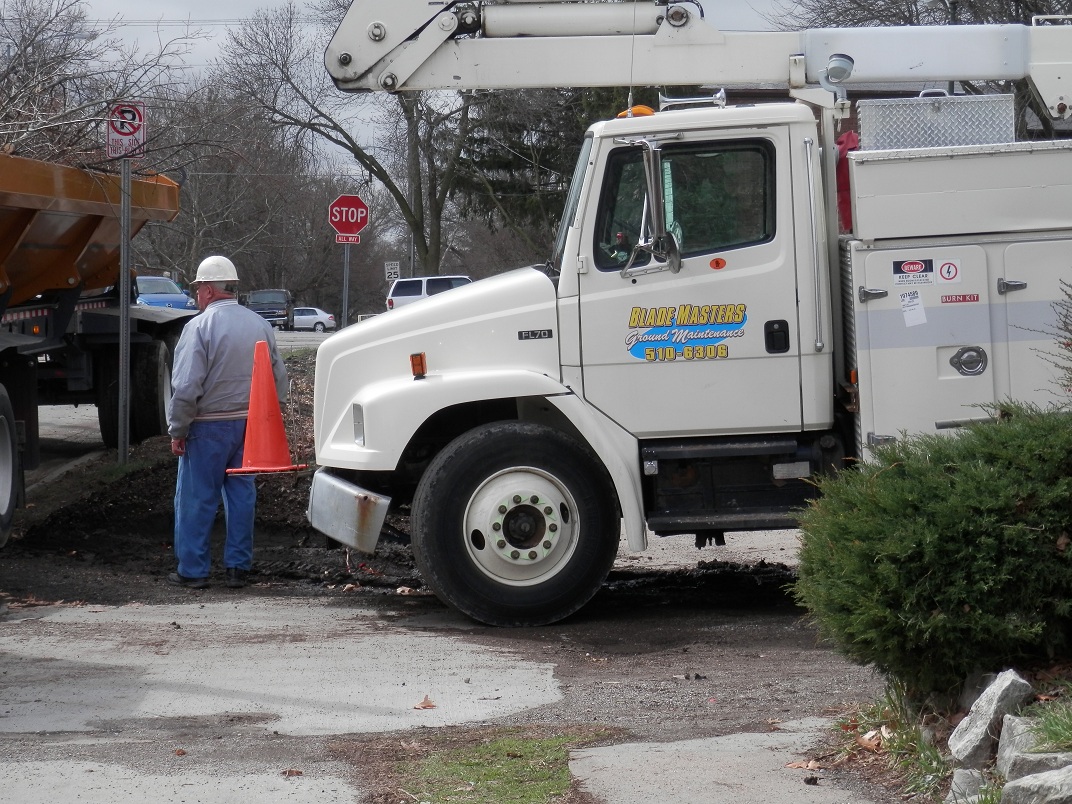
This is where the truck of the tree contractor was blocking the sidewalk along 49th Street, later in the morning on the 12th.


08 October 2012

Contractor Fined for Tree Clearing Activity

A contractor clearing trees for the city of Lincoln, has paid a fine levied by the U.S. Fish and Wildlife Service.

After receiving a citation in late summer for removal of trees which contained bird nests, the fine of $525 was recently paid, according to John T. Brooks, in the law enforcement division of the federal agency.

Details on specifically what the contractor was cited for, would not be provided by the agency. There were also no details available on the number of nests affected and whether they were being used by birds when the tree clearing activity occurred.

Active bird nests and eggs are protected by provisions of the Migratory Bird Treaty Act.

When the tree clearing took place, it was reported by a local resident to personnel at the Nebraska Game and Parks Commission.

The complaint was then referred to a law enforcement agent of the federal agency, said Joel Jorgensen, the nongame biologist with the state agency. A state law protecting bird nests and eggs did apply, but the stage agency referred the event to the federal agency "allowing them to take the lead" while cooperating with the federal action.

"Based upon my knowledge of the site, it has been a known rookery" for Great Blue Herons, Jorgensen said. He was not certain whether there were active nests at the time of the complaint.

The area where the tree clearing occurred was along the Platte River, at a city of Lincoln wellfield site, along the bank of the river, in the eastern Saunders County vicinity.

26 January 2012

Tree Removal First Step for Omaha Projects

For two projects underway in city of Omaha parks, the first step has been tree removal.

Along Happy Hollow Creek, on the east side of Memorial Park, the channel is going to be stabilized using tons of rock that will be dumped on the banks. Dozens of trees were being removed first.

Levi Carter Park

Massive and ancient cottonwoods were taken down in Levi Carter Park. The area will be used as a large "spoil pile" for earthen material to be dredged from the lake, to increase its depth. Not sure what the Red-bellied Woodpecker in the immediate area thought about the loss of what had formerly been foraging habitat, or even possibly its roost and nest.

Note the size of the tree trunk, in comparison to the equipment which caused its destruction.

View of some fowl as seen from Wavecrest Park

A variety of 12-15 species of waterfowl have been typical each day during the recent weeks. The bird use continues despite some periods of cold and just a small area of water that is not ice-covered.