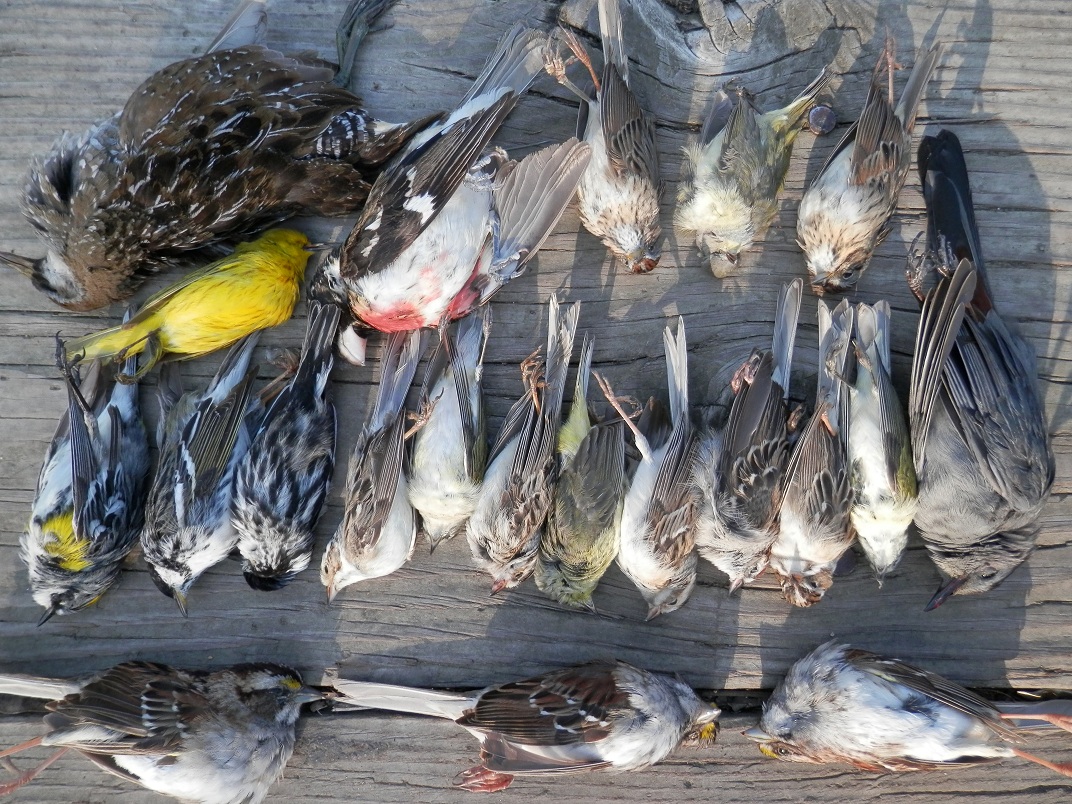
Building collisions, and particularly collisions with windows, are a major anthropogenic threat to birds, with rough estimates of between 100 million and 1 billion birds killed annually in the United States. However, no current U.S. estimates are based on systematic analysis of multiple data sources. We reviewed the published literature and acquired unpublished datasets to systematically quantify bird–building collision mortality and species-specific vulnerability. Based on 23 studies, we estimate that between 365 and 988 million birds (median = 599 million) are killed annually by building collisions in the U.S., with roughly 56% of mortality at low-rises, 44% at residences, and [less-than] 1% at high-rises. Based on [more-than] 92,000 fatality records, and after controlling for population abundance and range overlap with study sites, we identified several species that are disproportionately vulnerable to collisions at all building types. In addition, several species listed as national Birds of Conservation Concern due to their declining populations were identified to be highly vulnerable to building collisions, including Golden-winged Warbler (Vermivora chrysoptera), Painted Bunting (Passerina ciris), Canada Warbler (Cardellina canadensis), Wood Thrush (Hylocichla mustelina), Kentucky Warbler (Geothlypis formosa), and Worm-eating Warbler (Helmitheros vermivorum). The identification of these five migratory species with geographic ranges limited to eastern and central North America reflects seasonal and regional biases in the currently available building-collision data. Most sampling has occurred during migration and in the eastern U.S. Further research across seasons and in underrepresented regions is needed to reduce this bias. Nonetheless, we provide quantitative evidence to support the conclusion that building collisions are second only to feral and free-ranging pet cats, which are estimated to kill roughly four times as many birds each year, as the largest source of direct human-caused mortality for U.S. birds.
Showing posts with label wildbird mortality. Show all posts
Showing posts with label wildbird mortality. Show all posts
16 April 2014
Findings on Bird-Building Collisions Issued
Information from my personal database of bird-building collisions in Omaha and Lincoln, Nebraska, were used in the evaluation, published in Condor in February, 2014. This is the article abstract.
25 September 2013
New Way of Killing Birds at D.C Capitol
The Washington Globe says: We are surprised to find yesterday how many little birds have fallen victims to Mr. Cruchett's large lantern on the dome of the capitol, and to the wires that support it. We understand that near fifty beautiful birds of different sorts, and of various plumage, were found dead yesterday morning. Started up in the night from their resting places in the square, they are, probably drawn to the light and dashed themselves to death against the lantern or wires.
New way of killing birds. May 17, 1848. Bradford Reporter 8(49): 2.Annapolis Lighthouse Hazardous for Spring Migrants
We learn from Captain Roake, keeper of the light house at Thomas's Point, that in the height of a heavy gust of wind which occurred several hours before day on the 26th ult. a very numerous flock of birds, embracing many varieties, attracted by the light, flew against the lantern and building with so much violence as instantly to kill and stun hundreds of them. The Captain and his band thus taken unawares, were for a moment no little astonished, but quickly perceiving the cause of their surprise, recovered their presence of mind, and proceeded deliberately to select from amongst the dead and disabled assailants, such as they knew, from experience, would make a good broil, or could be converted into delectable pies. The flock consisted of wood cocks, red birds, yellow birds, Indian hens, swallows, owls, and other kind unknown to our informant.
Attack on Castle Roake. May 18, 1841. Gettysburg Star and Republican 12(8): 3. From the Annapolis Republican. Also June 3, 1841 in the Edgefield Advertiser 6(18): 1.13 September 2013
Powerlines Kill Heron at Levi Carter Park
A dead Great Blue Heron was found on the mown grass west of the swings at the former beach area at Levi Carter Park. The carcass was found directly beneath the multiple powerlines on Friday morning, September 13, 2013.

It was a "fresh" carcass, as park maintenance staff had not yet removed it, and there was no prevalent bug scavenger activity noticed.

Rather than the carcass getting thrown into the trash as a means of disposal, it was instead placed among the nearby, shoreline vegetation of Carter Lake as a means of returning it to the world of nature in a more suitable manner.
This is the second instance of this sort within the same section of powerline corridor. A Canada Goose had been previously found no more than one hundred yards to the west. It also died within moments after it was seen hitting a strung line.
10 September 2013
Hiding Wind Turbine Bird Slaughter
How bad is the slaughter, really? What tricks does the wind industry use to hide it?
Contributed by Jim Wiegand.A “green energy” wildlife genocide is depopulating wildlife habitats across the world where vital species once found refuge. Wind turbines have invaded these habitats and are devastating bird and bat species.
Rather than avoiding these critical habitats or taking steps to minimize impacts on important species, the heavily subsidized wind industry is responding by producing faulty, misleading and even fraudulent documents to hide the serious and growing mortality. This situation has continued for years but has been shielded by state and federal agencies and other supporters of wind power.
Having studied these installations and their wildlife impacts for years, I can say without reservation that most of what people hear and read about the wind industry’s benefits and environmental costs is false. However, buried in thousands of pages of wind industry documents are data, omissions and calculations that tell a wind turbine mortality story that is far different from what is portrayed in industry press releases, mainstream news stories and official government reports.
I have frequently said the wind industry is hiding over 90% of the bird and bat mortality caused by their turbines. This statement is supported by the industry’s own data and reasonable adjustments for its manipulations. These calculations will help people understand how the industry is using its studies to hide millions of fatalities; they will also help local residents and officials understand “wind farm” impacts and their role in species extinctions that could soon exact an irreversible toll in many regions.
My analysis focuses on two North American wind resource areas that are well known for killing raptors, other birds and bats: Altamont Pass in southern California and Wolfe Island in eastern Lake Erie, on the Ontario-New York border. While studies prepared for these two wind resource are quite different, both were designed to hide mortality. Indeed, hiding mortality is an industry-wide practice, and it is easy to discredit any mortality or cumulative impact study produced by wind energy developers.
The Altamont Pass Wind Resource Area (APRWA) provides an excellent introduction to this problem. Its environmental impacts have been well publicized, and the wind industry wants to replace small older 50- and 100-kilowatt turbines with huge 2.5-megawatt turbines that it claims are safer. This claim is without merit. Industry studies used to promote the plan are deeply flawed and the much larger 2.3 MW class turbines will add more than twice the deadly rotor sweep to Altamont along with much faster blade tip speeds.

Probably more studies have been conducted in Altamont Pass than at any other wind farm in the world. Unfortunately, however, the wind industry has used that information and lessons from the public relations firestorms those studies ignited to develop clever methods for hiding bird and bat mortality impacts.
One of the most effective methods is limiting searches for dead and injured wildlife to progressively smaller areas around increasingly larger turbines — thereby omitting increasing numbers of fatalities as larger turbines catapult birds and bats further, often into grass, brush and wooded areas.
For the relatively small 50-100 kW turbines at Altamont, roughly 85% of fatalities can be found within a 50-meter search radius, which suggests that this radius is appropriate if the missing 15% are accounted for. But even with these turbines, industry-paid researchers are able to hide Altamont’s true mortality figures by employing improper study methodologies, raw data manipulation and inaccurate methods for estimating annual death tolls.
All wind turbine mortality studies find bodies. It is how carcass counts are conducted and interpreted that renders the process faulty or fraudulent – while also enabling the wind energy industry to claim it has satisfied commitments to reduce bird and bat mortality, and thereby justify installing much larger (and potentially deadlier) wind turbines. Comparing earlier and more recent studies illustrates how this is done.

In a 1998-2003 study, raptor carcasses were found in searches conducted about six weeks apart. Analysts then developed and applied numerical factors designed to account for the fact that on-the-ground teams were likely to find only a certain percentage of all dead and injured birds and bats; some wounded individuals would crawl off and die elsewhere; and coyotes, ravens and other scavengers would remove and eat many turbine victims. Applying those factors to actual carcass counts, researchers calculated that Altamont turbines were killing 116 golden eagles per year (an average of 10.8 times the actual carcass count per year) Wind turbine mortality for red-tail hawks, burrowing owls and American kestrels were likewise estimated using factors of 7 to 28 times actual body counts.
The study demonstrated that Altamont wind turbines were having a devastating impact on Diablo Range populations of raptors and other birds. It explained why many nests were no longer occupied and why fewer and fewer of these species were seen in succeeding years around the Bay area foothills. As a result of this impact the wind industry realized it had to reduce the death tolls dramatically – or at least make it appear that the tolls were decreasing to minimize public outrage.
In 2012, Altamont Pass turbine operators released the results of their 2005-2010 study. They claimed they had achieved substantial reductions in raptor and other bird mortalities, and that part of this reduction resulted from the industry replacing small older turbines with much larger new units. The claim raised questions and eyebrows among knowledgeable bird researchers, who know that mortality searches at Altamont are still finding an increased number of bodies amid the turbines. They also know there are many ways to manipulate mortality studies to achieve the desired outcome.
For instance, industry-paid researchers arbitrarily reduced their golden eagle death estimating factor to one-fifth of their previous (10.8) body-to-carcass ratio (down to 2.2); otherwise their estimated mortality would have been an intolerable 200 eagles per year. They slashed mortality factors for the other raptors (originally 7 to 28 times actual body counts) to between 2.2 and 7.6 times. This was done even though turbine size, blade length and area swept by the bird-butchering blades had skyrocketed at Altamont.
The only way these changes make sense or can be justified is by recognizing that these bird populations have already been decimated so many times that the species are now rapidly declining in the area, and this wind facility is killing off a higher percentage of the smaller remaining population. Other realities are also involved, however.
On the largest turbines, researchers continue to use an undersized 75-meter search radius, even though the much larger turbines are known to catapult birds and bats much further from turbine towers. They may also be attributing mortality from the large turbines to the smaller ones nearby (see Figure 1). While the smaller 75-meter search area is generally fine for the 50-100 kW turbines, since some 85% of all fatalities are found within that search radius, the search radius must be much wider (200-250 meters) for the 2.5-MW turbines, to achieve valid results.
In addition, hundreds of carcasses were eliminated from mortality estimates, because they were picked up by wind farm personnel ahead of searchers looking for high priority species like eagles and hawks.
Researchers are also assuming higher search efficiencies; that is, a suddenly increased ability to spot bird carcasses. But the improved search efficiency rates are themselves based on studies that cannot possibly be considered credible. They used dead pigeons, gulls and ravens, whose white and black feathers make them easy to spot around turbines – instead of the primary species, whose camouflaged bodies are hard to see.
For example, a study intended to determine how many bird carcasses are removed by scavengers used Japanese quail bodies that were too big for Altamont’s most prolific scavengers (gulls, ravens and crows) to remove. This made it appear that scavengers are eating few of the turbine fatalities, which again lowers mortality calculations. In addition, an equally clever and far more sinister tactic is also being employed.
Instead of daily searches over a period of several weeks, mortality studies employ occasional searches conducted only every 30 to 90 days. This virtually ensures that small birds and bats are removed and/or eaten. Studies from across the country indicate that nearly 90% of small carcasses vanish in the first two weeks, and 97-100% are gone within 30 days. This is especially true for Altamont Pass, where thousands of gulls patrol for food. It also explains why Altamont searchers found only 21 bat carcasses, when probably thousands were consumed during their six-year study.
The 2005-2010 data from Altamont recorded an average of 372 small carcasses per year. However, by applying a .85 search area factor, a small bird searcher efficiency rate of 38-40% (based on other studies) and a 97% (.03 remaining) removal rate after 36 days of scavenger activity reveals that the annual death toll for small birds at Altamont is actually much closer to 73,000 to 76,840 for its current 500 MW of installed capacity.
This is why daily searches are so important. It is also explains why they have been avoided. With each passing day, the mortality data become less reliable and without a body, searcher efficiency and scavenger removal rates mean nothing if all the carcasses of a species vanish. There is no justification for 30-90 day search intervals when scavenger removal for small birds and bats are known to be 100% within 21 days at some wind turbine locations and without a body there is no data to extrapolate.
In short, the methods used at Altamont (and other wind energy facilities) violate scientific integrity principles. But they are perfect for hiding true mortality counts. The 24 hour search intervals are critical for reliable data, even mortality studies going back decades on communication towers used daily searches for the most reliable carcass data.
However, the U.S. Fish and Wildlife Service, California Fish and Wildlife Department, and supposed bird protection groups have given the wind industry carte blanche to write its own study criteria and kill countless protected birds and bats. That is something they have never done for any other industry. Wind energy gets a pass, because it is supposedly reducing America’s “carbon footprint,” these groups do not want to sully the wind industry’s eco-friendly reputation, and the industry in turn provides generous contributions to environmental groups and politicians that support wind energy.
The 48-hour Study
Altamont Pass researchers are well aware that they are missing thousands of birds and bats in their mortality studies. That is why they insist on using 30-90 day search intervals when looking for carcasses. They want these carcasses to disappear.
This conclusion is supported by a four-month study conducted at Altamont Pass several years ago.
Areas around roughly 24 MW of Altamont Pass turbines were searched using 48-hour search intervals. This 48-hour window is important, because thousands of gulls and other scavengers patrol the Altamont wind turbines looking for easy meals around the turbines (and often get killed themselves).
Searchers looking in undersized 40 meter search areas found 70 small bird carcasses. After adjusting for these undersized search areas, injured birds (which will die but are not counted by the wind industry) and carcass removal, I rounded the four-month total to a conservative total of 100 small birds. At first blush, this appears to be a tolerable bird kill (unless it is compared to prosecutions for the accidental deaths of 28 common birds in oil and gas facilities over an entire state during an entire year).
However, once these 100 birds are used to calculate mortality counts for Altamont's total installed capacity (2008) of 580 MW and a full twelve months, the small bird kill rate soars to 7,250 per year. Combining this body count with a reasonable searcher detection rate of 40% and a credible scavenger removal rate of 30% over two days results in an estimated total of 25,900 small birds per year! If the scavenger rate is boosted to an equally plausible rate of 60% over a two-day period, small bird mortality jumps to 29,500.
That’s 925 to 1,050 times more birds than resulted in the federal prosecution of seven oil companies in North Dakota in 2011 with no investigation or prosecution of wind companies. It is also ten to eleven times more small birds than the 2,700 fatalities that Altamont operators admitted killing per year, based on their “eco-friendly” research methods during the period when the 48 hour study was conducted.
Considering the critical analysis presented in this article, it seems very reasonable to conclude that new studies employing proper search areas, trained dogs, 24-hour search intervals and no culling of birds by wind energy employees would produce far greater totals – easily exceeding 25,900 small birds per year, plus thousands of bats, raptors, and other birds.
There can be no doubt that the Altamont mortality is far greater than what is being reported. In my opinion, Altamont pass is actually killing 50,000-100,000 birds and bats per year and has been for decades. And that is only the tip of the proverbial iceberg of wind turbine mortality, considering that more than 40,000 turbines are now operating in the United States, many of them in or near important bird and bat habitats. As Paul Driessen, Mark Duchamp and others have concluded, based on careful bird and bat mortality studies in Spain and Germany, it is highly likely that US wind turbines are killing between 13 million and 39 million birds and bats every year — including hundreds of bald and golden eagles, thousands of hawks, falcons, owls and other raptors, and dozens of extremely rare whooping cranes!
No wonder the taxpayer and consumer subsidized wind industry is so intent on rigging its mortality methodology and making sure that no meaningful or accurate studies are conducted. They would raise such a public outcry that nearly all of the 40,000 turbines would be shut down. Considering the trivial amount of electricity they produce (less than 2% of all US electricity output) and the vanishingly small amount of carbon dioxide they reduce, even a nearly total wind turbine shutdown would be justified and would hardly be noticed.
My next article will explain how studies of Wolfe Island’s 86 wind turbines are also concealing most of the bird and bat mortalities that occur there each year. Those numbers could easily be in the range of 200-300 bird and bat fatalities per MW per year — when the wind industry is reporting just 8.2 per MW at Wolfe Island.
References
Altamont Pass Wind Resource Area Bird Fatality Study, Bird Years 2005–2010, Prepared for Alameda County Community Development Agency, November 2012. Prepared by ICF International
http://www.altamontsrc.org/alt_doc/m21_2010_altamont_bird_fatality_report.pdf
ICF Jones & Stokes, Draft Altamont Pass Wind Resource Area 48-Hour Search Interval Bird Fatality Study, June 2009. M32. (ICF J&S 00904.08.) Sacramento, CA. Prepared for: Altamont County Community Development Agency, Hayward, CA. http://www.altamontsrc.org/alt_doc/m32_apwra_draft_48_hour_search_interval_kb_study.pdf
Smallwood, K. S., and C. G. Thelander, Developing Methods to Reduce Bird Fatalities in the Altamont Wind Resource Area, Final Report by BioResource Consultants to the California Energy Commission, Public Interest Energy Research – Environmental Area, Contract No. 500-01-019 (L. Spiegel, Project Manager), 2004. http://altamontsrc.org/alt_doc/cec_final_report_08_11_04.pdf
Insignia Environmental, 2008/2009_Annual Report for the Buena Vista Avian and Bat Monitoring Project. September 4, 2009 Prepared for Contra Costa County, Martinez, CA. http://www.altamontsrc.org/alt_rl.php
POST-CONSTRUCTION AVIAN AND BAT IMPACT ASSESSMENT OF THE UNIVERSITY OF DELAWARE WIND TURBINE IN LEWES, DE: May 2012. Jeffrey Buler, Kyle Horton, & Greg Shriver. Department of Entomology and Wildlife Ecology University of Delaware http://www.ceoe.udel.edu/LewesTurbine/documents/lewes_turbine_interim_report_2012.pdf
Longcore T, Rich C, Mineau P, MacDonald B, Bert DG, et al. (2012) An Estimate of Avian Mortality at Communication Towers in the United States and Canada. PLoS ONE 7(4): e34025. doi:10.1371/journal.pone.0034025 http://www.plosone.org/article/info:doi/10.1371/journal.pone.0034025
Videos
03 June 2013
May Bird-Window Strikes at East Omaha
May 2013 has been the deadliest of any for this month in the past six years, with at least 106 occurrences of bird-window strikes recorded. There were certainly more than the number recorded.
- ¶ May 2008: 102 records on 25 dates of occurrence, representing 35 species
- ¶ May 2009: 66 records on 25 dates, representing 29 species
- ¶ May 2010: 36 records on 17 dates, representing 19 species
- ¶ May 2011: 60 records on 16 dates, representing 26 species
- ¶ May 2012: 101 records on 26 dates, representing 23 species
- ¶ May 2013: 106 records on 23 dates of occurrence, representing 31 species
- ¶ May 2009: 66 records on 25 dates, representing 29 species
There has generally been a somewhat similar effort in 2008 and 2009, as well as 2012 and 2013, whereas 2010-2011 were lackadaisical in comparison. The present year, at least two days were missed due to rainy conditions, and another due to being out of the area. So a survey was done on more days than the given extent indicates, but there were dates with no records as no carcasses or disabled birds were found, which is nothing unusual.
The tally includes three records determined by National Park Service staff at the Curtis Park Service Building on the west bank of the Missouri River.
One reason for the increase includes the addition of the glass hazard at the Zesto Building, just south of TD Ameritade Park. Construction of this structure was completed late enough last year, so as to not be a hazard during the spring migration. Another new building hazard now known is the Rasmussen Center at Creighton University.
It is obvious that the urban Omaha landscape is becoming more hazardous for migratory birds. When construction of the Gavilon building along Capitol Avenue is finished, it will be an additional danger, especially because of its reflective glass facade on the north side. This will increase autumn bird-window strikes, with the spring-time situation yet to be determined.
Overall, for the river city, there are bird-window strike details known regarding 100 species and from 455 days as of the end of May, 2013. The following is a summary of the May occurrences.
The extent of Common Yellowthroats being involved in window strikes continues to be significant. This year's number was less than previously denoted, but the hazard is prevalent. In 2012, there were a dozen females disabled after hitting a glass facade (five at the Holland Performing Arts Center and four at the Qwest Center Omaha).. The tally in 2013 was seven, four which were at the CenturyLink Center. This record does not include dead birds.
There were significantly more strike occurrences associated with the Clay-Colored Sparrow, with about two-thirds more than any previous year.
New additions to this month's record were the Summer Tanager and Orchard Oriole.
All of the species indicated (59), except for the House Sparrow are protected by the Migratory Bird Treaty Act, which in the case of bird-window strikes, is not enforced by federal regulatory agency, the Fish and Wildlife Service.
| Bird Species | May 2008 | May 2009 | May 2010 | May 2011 | May 2012 | May 2013 |
| Mallard | - - | 1 | - - | - - | - - | - - |
| Virginia Rail | - - | 1 | - - | - - | - - | 2 |
| Sora | 5 | 2 | - - | - - | - - | 1 |
| American Coot | - - | - - | - - | 1 | - - | - - |
| Wilson's Phalarope | - - | - - | 1 | - - | - - | - - |
| Mourning Dove | 1 | 4 | 1 | 2 | - - | 1 |
| Yellow-billed Cuckoo | - - | 1 | 1 | 1 | 1 | - - |
| Common Nighthawk | - - | - - | - - | 2 | - - | - - |
| Ruby-throated Hummingbird | - - | - - | - - | - - | 1 | - - |
| Red-headed Woodpecker | - - | 1 | 1 | - - | - - | 1 |
| Hairy Woodpecker | 1 | - - | - - | - - | - - | - - |
| Olive-sided Flycatcher | 1 | - - | - - | - - | - - | - - |
| Eastern Wood-Pewee | 3 | - - | - - | - - | 1 | - - |
| Willow Flycatcher | 3 | - - | - - | 1 | 1 | - - |
| Least Flycatcher | 1 | 1 | - - | - - | - - | 3 |
| Eastern Kingbird | 1 | - - | - - | - - | - - | 1 |
| Warbling Vireo | 2 | - - | - - | - - | - - | 1 |
| Red-eyed Vireo | 1 | - - | - - | 1 | - - | 2 |
| House Wren | - - | - - | 1 | - - | - - | 2 |
| Sedge Wren | - - | - - | - - | 1 | - - | - - |
| Marsh Wren | - - | - - | - - | 1 | - - | - - |
| Swainson's Thrush | 2 | 1 | 1 | 2 | 3 | - - |
| American Robin | 2 | 1 | - - | 2 | - - | 1 |
| Gray Catbird | 2 | 3 | 2 | 2 | 6 | 7 |
| Brown Thrasher | - - | - - | 1 | - - | 1 | 1 |
| Cedar Waxwing | - - | - - | - - | - - | 1 | - - |
| Tennessee Warbler | 13 | 3 | 1 | 4 | 18 | 7 |
| Orange-crowned Warbler | - - | 2 | - - | 1 | 1 | 3 |
| Nashville Warbler | 3 | 1 | 1 | - - | - - | 1 |
| Northern Parula | - - | - - | - - | - - | 1 | - - |
| Yellow Warbler | 4 | - - | - - | 1 | 1 | 3 |
| Chestnut-sided Warbler | 1 | - - | - - | - - | - - | - - |
| Yellow-rumped Warbler | 2 | - - | - - | - - | - - | 3 |
| Palm Warbler | 2 | - - | - - | - - | - - | - - |
| Blackpoll Warbler | - - | - - | - - | - - | 1 | 2 |
| Black-and-white Warbler | 1 | 1 | - - | - - | - - | - - |
| American Redstart | 2 | - - | - - | - - | - - | 1 |
| Worm-eating Warbler | 1 | - - | - - | - - | - - | - - |
| Ovenbird | 7 | 1 | 2 | 3 | 2 | 7 |
| Northern Waterthrush | - - | 1 | - - | - - | - - | - - |
| Louisiana Waterthrush | 1 | - - | - - | - - | - - | 1 |
| Mourning Warbler | 1 | - - | - - | 1 | - - | 1 |
| Common Yellowthroat | 14 | 3 | 2 | 9 | 25 | 16 |
| Summer Tanager | - - | - - | - - | - - | - - | 1 |
| Chipping Sparrow | 1 | 2 | - - | - - | - - | - - |
| Clay-colored Sparrow | 4 | 6 | 3 | 4 | 3 | 15 |
| Grasshopper Sparrow | - - | 3 | 2 | 1 | - - | - - |
| Lincoln's Sparrow | 2 | 4 | 1 | 7 | 2 | 5 |
| Swamp Sparrow | - - | 1 | - - | - - | - - | - - |
| White-throated Sparrow | 3 | 1 | 4 | 1 | 3 | 5 |
| Rose-breasted Grosbeak | 2 | 4 | 5 | 2 | 7 | 2 |
| Blue Grosbeak | 1 | - - | - - | 1 | - - | - - |
| Indigo Bunting | 5 | 7 | 3 | 4 | 9 | 5 |
| Dickcissel | - - | - - | - - | 1 | - - | - - |
| Red-winged Blackbird | - - | - - | - - | - - | 1 | - - |
| Yellow-headed Blackbird | - - | 1 | - - | - - | - - | - - |
| Common Grackle | 2 | 2 | - - | 1 | 9 | - - |
| Orchard Oriole | - - | - - | - - | - - | - - | 1 |
| Baltimore Oriole | 2 | 4 | 3 | - - | 2 | 2 |
| House Sparrow | - - | 1 | - - | - - | - - | - - |
It should be noted that no financial assistance, nor any other sort of help has been provided to support this extensive and long-term survey effort. Also, no birding local conservation group has indicated any interest whatsoever in the results of this research and the extensive avian mortality, nor offered to help improve conditions.
29 May 2013
Tanager Window-Strike Species No. 100 at Omaha
A dead Summer Tanager at the Omaha-Douglas Civic Center is the 100th species found in association with known window-bird strikes in eastern Omaha. The carcass of a first year male, despite being found soggy and forlorn on the west side of the building, at the south end in a corner of the plaza, was nonetheless colorful with subtle hues of red and yellow, with features of its plumage instantly indicative. Based upon its degraded condition, the fatality probably occurred May 27th, though it was not found until the 28th. The former bit of wildbird life was placed into my personal bird-carrier bag, hung on the bicycle frame, and later disposed of at a natural place, rather than getting tossed, indifferently into some container full of human's trash.
 |
The first hours of Monday morning were too rainy, based upon rain drops on the roof and radar perspective, for the usual survey as done along a regular route, via numerous and nearly continuous rotations of bicycle pedals; excluding the downhill parts of the route. This is the second recent morning where a survey was not done, due to the current rainy and stormy cycle of weather.
Also found Tuesday morning were a couple of Least Flycatchers at the CenturyLink Center Omaha (one soggy dead carcass and one disabled bird moved to a safer space). A soggy Tennessee Warbler and female Baltimore Oriole, both lingering carcasses, were at the west side of the Omaha Public Power District Energy Plaza, a few feet south of the buildings' west entrance. The latter two were probably also from the 27th.
This morning's outing was not very smooth because of an especially obvious defect of my transportation. A side of the rear wheel rim of the bicycle split, so when the tire had correct pressure, a metallic bulge meant the brake pad hit the brake pad, causing the wheel to jump and then jerk when using the rear brake. Nothing was smooth and it was also noisy, and a complete bother. Add to this, that when walking, the tire would often stop revolving when it got stuck at the four-inch long bulge, which only stuck out about a quarter of an inch which was however enough to cause the wheel to not turn and drag along the surface, whether it was sidewalk, grass or mud on this Tuesday. The whole situation was a negative diversion, resulting in many words better left ignored for the day!
The situation was profoundly obvious in a negative manner, just a short time later, while going about Carter Lake and Levi Carter Park on another morning bird survey, because winds were finally light in the early a.m. Despite the vexing mechanics, it was nice to prominently see a live Scarlet Tanager along the southeast shoreline of the lake, its red-and-black plumage obvious, among the arboreal realm. This was a new addition to the species recorded among the spaces at this place.
Later, back at the house after an unknown multitude of pedals on a muggy morning where blue skies eventually replaced the clouds, and after removing the wheel, removing the tire and tube, some prying efforts were tried with a tool. The attempt to force the metal back into proper alignment was unsuccessful, though it did seem that the rim lines were suitably aligned. Once the tire, under pressure and back in place on the bicycle frame, and the wheel was turned to determine it if was suitable for riding, it became obvious real soon that there was no improvement. The only result was dirty fingers, that had to be scrubbed clean at the kitchen sink.
It's time, again, for the well-worn Giant — that would be the model type — to get taken to the Walnut Hill bicycle shop for installation of a new rim. This had been planned to get done in a few days, because of at least five broken spokes, but the newly found break has moved forward the day to get the ride repaired. Now more than 25 years old, the frame and handlebars of this essential and omnipresent feature of so-many city travels is likely the only remaining original parts.
There will be many more rides upon its two wheels (which still needs new handle grips, a front tire, and a seat). Perhaps, maybe, in the future there might will be a new cycle, one of them with the big wheels, fewer gears, a really comfortable seat and smooth in all of its operations, and most importantly, without the need for repairs!
While walking back from delivering the bicycle, a small plastic bag of recyclable cans and plastic was picked from along the dirty Omaha Streets. Another was also filled to overflowing on the walk back — along a different route — to pick up the bicycle once the repair was completed.

Plastic trash removed from Omaha streets so it could be recycled.
22 May 2013
Highly Reflective Glass Being Used at Gavilon Building
A highly reflective exterior glass is currently being installed on the north side of the Gavilon building under construction along Capitol Avenue in downtown Omaha. During several recent early morning visits, the reflective character of the glass was readily obvious as objects associated with the nearby city-scape, including small pigeons atop a building across the street, could be clearly seen, though they were only a reflection of a some associated place.
Reflective glass is known to create a hazardous situation for migratory birds, especially when landscaping features are included adjacent or nearby. What may appear as vegetative growth, as apparent upon the glass surface is actually a danger. Birds will think there is tree foliage available to land within, and then, instead, strike the glass and either be killed or temporarily disabled.
"To help minimize collision risks, we plan to incorporate low to mid-reflective, tinted glass with gradient frit detail or solid glazing," said Robert Jones, chief administrative officer of the Gavilon Group, L.L.C. in a previous story.
Despite claims to the contrary, the type of glass being used thus far on the upper extent of the north exterior will likely create another hazard for migratory wildbirds in downtown Omaha. It is not yet apparent the type of glass to be used on the lower level.
Three emails were sent to about this matter to the company president during the past week There was no reply.
It would be expected that bird mortality may occur as soon as this autumn, during the fall migration season, as the exterior, glass facade on the north side of the building should apparently be completely constructed by then.
Reflective glass condition as seen on May 14.

Reflective glass condition as seen on May 21.

20 May 2013
Bird Window-strike Number 1500 in Douglas County
Window-strike number 1500, based upon personally gathered records,was found the morning of May 19, 2013 at the CenturyLink Center Omaha, Douglas County. It was a male Common Yellowthroat at the north-facing entry near the south end of the west side of this building. While processing details of the scene, including the particulars for a disabled waterthrush less than three feet distant, another impact upon the glass was subtly heard and within a couple of moments, there was another stricken yellowthroat. A female yellowthroat landed within 24 inches of where the male bird was lying dead. The second yellowthroat was disabled at the time, so was moved to a safe place to facilitate recovery, and upon checking about 30 minutes later, it was gone, hopefully to a better place? While the waterthrush was also later recovering, and while making its way, it got chased by a predominant American Robin, apparently because the larger bird had its territory and did not want any intruders. The confrontation certainly made recovery more stressful for the waterthrush.
Male Common Yellowthroat fatality at the CenturyLink Center Omaha.

Disabled Louisiana Waterthrush at the CenturyLink Center Omaha.

Disabled female Common Yellowthroat at the CenturyLink Center Omaha.
Elsewhere during the early morning, another yellowthroat mortality was found at the south wall of the Holland Performing Arts Center, just west of the fourth column from the east. It was also a female that had been making its way northward to find a mate, lay some eggs and raise some young. That intent was drastically ended.
There have been 162 known window-strikes associated with the Common Yellowthroat in eastern Omaha. The overall tally of this endeavor indicates that the only species "impacted more" has been the Lincoln's Sparrow, with 165 instances. Next atop the tally is the Purple Martin, with 98, and then the Nashville Warbler with more than 85 instances, if numbers might be of interest?
During the morning outing this disabled Red-eyed Vireo was noted at the Central Park Plaza. The bird subsequently died. Notice how the bird is obviously suffering due to it hitting glass of the north tower.
Wind Energy Comments Promote Wealth Not Environment
A personal perspective recently presented about wind-energy is simplistic in numerous ways. The view, given by a letter to the Public Pulse in the local newspaper on May 16th, does however accurately convey the position of the writer, Richard Holland.
The letter has a primary emphasis that wind-energy development could promote the "opportunity for increased wealth" that would be advantageous. There was the staggering suggestion that 2-3000 wind turbines should be placed within Nebraska.
This perspective is so dramatically short-sighted that it is but a misguided promotion piece.
There was nothing said to refer to the impacts of wind-turbine development. How may wildbirds might get killed by the turbines? How much wildlife habitat might be destroyed by turbine installation? How many miles of associated powerline will mar the landscape in order to connect a turbine facility to the grid?
And more importantly, why should tax-payers be required to pay subsidies for wind energy development? This is especially a ruse, needed to money from many to line the pockets of a few. Extensive development would not "be beneficial to every Nebraskan," despite what Holland might convey.
Perhaps if Holland wanted to do more than sign checks and write letters to the editor, he could get involved with making the Holland Performing Arts Center in downtown Omaha a bird-safe building. The glass-walled building for which he was a primary benefactor, is a well-known hazard for migratory birds, with more than a hundred instances recorded. There would certainly be more, but facility staff find the carcasses and dispose of them to ensure that they are not recorded. The Omaha Performing Arts Society has done nothing to revise the glass facade, as explained repeatedly, because it would mar the buildings features and would have an excessive cost.
Holland also uses his wealth to donate to Bold Nebraska, which also has a driven effort for wind energy development, without any apparent consideration of negative aspects.
Both the letter writer and organization need to broaden their perspective. Nebraskans have the will to act, but why should they act in a manner which is neither economically or environmentally suitable.
A recent bird fatality at the Holland Performing Arts Center. May 19, 2013. | The most recent bird fatality at the Holland Performing Arts Center. May 19, 2013. These are both female Common Yellowthroats. |


17 May 2013
Trashing Wildbirds at CenturyLink Center Omaha
Bird mortality continues to occur at the CenturyLink Center Omaha, especially in the past few days of this May, 2013.
A response to the mortality is indicative.
Within the past week, there have been four instances of bird carcasses being found in different trash receptacles along the west facade of the building. The known records, obvious without "sifting" through the trash, are:
- 11 May: Yellow Warbler throw into a trash receptacle at the southern extent of the west side (as reported previously, and with a picture)
- 15 May: female Indigo Bunting, near the southern extent of the west wall
- 16 May: a male Common Yellowthroat and a Gray Catbird found in two different trash receptacles on the morning of May 17th. Both of these birds had apparently been killed by striking the glass on the previous date, the carcasses were seen, and then and then disposed of to ensure they were not present at any future time, including the survey the next morning.
Rather than address the issue, and despite any letters sent by the U.S. Fish and Wildlife Service to assist in reducing mortality of wildbirds, it is certainly much easier to just throw carcasses into the trash.
 An additional Common Yellowthroat carcass found the morning of May 16th, at the west side of the CentryLink Center Omaha. |
Security staff associated with the Qwest Center Omaha were observed throwing bird carcasses into trash receptacles at this building, in both September and October 2009.
Oriole Suffering
One of the worst instances of a bird suffering from a window-strike at this building was obvious early on the morning of May 16th. An Orchard Oriole, was found south of the southern most convention center entry, east of the north-facing entry on the west side of the building. There was not only blood dripping from its beak, but a few other drops nearby. This bird could not be rescued or taken to a safer space, because it flew away. Its prospects for survival seemed dismal, but its fate is not known.

This is only the second instance of an Orchard Oriole being a victim of a window-strike in eastern Omaha, in the period from May 2008.
A video clip shows the suffering condition of bird after striking glass at the most dangerous building for migratory birds in eastern Omaha.
15 May 2013
Additional Mid-May Bird-Window Strikes at Omaha
There were many more migratory wildbirds killed or disabled due to striking glass facades around eastern Omaha as they undertake the gauntlet along the Missouri River valley. Habitat places are treasures, but hazardous places are more prevalent.
This is a list of the species, the building and appropriate notes for instances observed early in the morning on May 14, 2013. Especially notable records are shown in bold text.
- Clay-colored Sparrow: Rasmussen Center, Creighton University - disabled after hitting glass above solid, main entry door on the west end of the south side; seen to happen at 6:10 a.m. The is first known strike at this recently constructed building, though there was an expectation of their occurrence, due to the extent of glass facade on the structures south side, as initially obvious as shown on architectural renderings.
- Common Yellowthroat: TDAmeritrade Park - disabled male on south side, directly north of 12th Street; the second known instance of a strike at this facility, and the previous one was also a Common Yellowthroat. Surveys have been basically limited to its southwest corner and southern extent where glass is prevalent.
- Clay-colored Sparrow: Qwest/CenturyLink Center Omaha - carcass at south side of south convention center entry, east of the north-facing entryway.
- Nashville Warbler: Qwest/CenturyLink Center Walkway - carcass on the north side of the east end, about 25 feet from center entryway. Records only from 2013, and then three either on May 12th or 14th.
- Lincoln's Sparrow: Holland Performing Arts Center - carcass on the south side of the central courtyard, at the western side of the east section.
- Yellow Warbler: Gottschalk Freedom Center (an Omaha World-Herald corporation building) - carcass on the west side, at the third section from the north.
- House Wren: Omaha Public Power District Energy Plaza - carcass on the west side, just north of the entryway; only the third spring record thus far in six years.
- Clay-colored Sparrow: Law Building - carcass on the north side, and the second section from the west
- Clay-colored Sparrow: Law Building - carcass on the north side, and the third section from the west; the two carcasses about four feet apart
- White-throated Sparrow: Omaha-Douglas Civic Center - carcass on the south side of the atrium, at the east side of the doorway
- White-throated Sparrow: Omaha-Douglas Civic Center - carcass on the north side of the atrium, at the east side of the doorway
- Gray Catbird: Woodmen Tower Skywalk - disabled on the north side of walkway, towards the west portion, in street next to sidewalk.
- Red-headed Woodpecker: World Building - carcass on the west side, and the north corner; only the fourth record in six years, with each occurrence at a different building. The last known occurrence for this distinctive species was in 2010. This morning is was a redhead dead on the sidewalk, again.
- Virginia Rail: Brandeis Parking Garage - carcass on the north side, about in the middle, just east of vehicle driveways.
- Brown Thrasher: Kutak-Rock Building - carcass on the west side, in the northern one-fourth; latest spring record during period of surveys.
- Virginia Rail: DLR Group Building - carcass on the north side, in the middle near the fourth column from the east; the second strike instance known from this building in Aksarben Village, with other being a decrepit carcass of a passerine noted in May 2011. Fatalities here were expected based upon exterior features shown by architectural renderings for this recent construction. Only the fourth overall occurrence for this commercial/residential district, which has not visited very often, being "outside" the usual route. This was also the first record for this rail, which has not been from downtown Omaha. However, a report in the last couple of weeks indicated one struck some building in the vicinity of 72nd and Dodge street, as the disabled bird was filmed, and its identity subsequently confirmed by a local birder.
By adding the known strike occurrence for the past six years, Julian Date number 134 is the deadliest, thus far for spring, with 28 records. For day 133, there are 123 in comparison. Additional deadly dates could occur yet this May period.
There have been 58 known strikes thus far this year, with forty of them in three days is appalling!!!
There are possibly also additional records for the Curtis Park Service Building at the riverfront, where records in the past have been kept by staff of the National Park Service office. The actual status of the current extent of strikes here is not currently known.
 |  The two sparrows are pictured where found on the north side of the Law Building. |
 |  This catbird could not even hold its head up straight. |
Note the bird's tongue sticking out because of the impact. | |

May 15th
The pattern of numerous strike occurrences continued, with ten denoted, including one at a different building, and another instance found upon a return to the CenturyLink Center west facade.
- Common Yellowthroat: Zesto Building: Lids Locker Room - carcass on the east side of the building, in the glass section south of the entryway
- Indigo Bunting: Qwest/CenturyLink Center Omaha - disabled male on the west side, at the corner
- Common Yellowthroat: Qwest/CenturyLink Center Omaha - disabled male on the west side, just south of the northmost entry
- Indigo Bunting: Qwest/CenturyLink Center Omaha - carcass of a female in the trash receptacle at the south corner of the southmost convention century entry
- Clay-colored Sparrow: 1200 Landmark Center - carcass on the north side of the east building, third section of glass from the east
- Ovenbird: 1200 Landmark Center - carcass at the south side of the atrium, west of the entryway
- Clay-colored Sparrow: Union Pacific Center - disabled on the north side, about 15 feet east of the entry
- Ovenbird: Kutak-Rock Building - disabled on the west side, about 25 feet from south corner
- Lincoln's Sparrow: Omaha World-Herald Paper Storage Facility - carcass at the middle of the south side
- Common Yellowthroat: Qwest/CenturyLink Center Omaha - disabled male on the west side, at the north corner; found later, and in same place as Indigo Bunting earlier
 |  |
 |  |
 |  The dangerous east facade of the Zesto Building in north downtown, designed with a reflective glass exterior, known to be hazardous to migratory wildbirds. |
 Note how the tip of this bird's upper bill was bent by the impact. | |
The average is more than 12 strikes daily, during the past four days.
14 May 2013
Deadliest May Morning for Spring Window Strikes
 Dead Yellow-rumped Warbler at the Zesto Building, i.e. Blatt Beer and Table. |
Monday morning, May 13th, was the deadliest spring morning for bird migrants through east Omaha. There were 18 known window-strikes at eleven different buildings.
These are the species found, the locality and notes... There were likely other fatalities in the vicinity, but not every potential building was visited.
- Yellow-rumped Warbler: Zesto Building: Blatt Beer and Table - carcass on the east side, by the second from south doorway
- Clay-colored Sparrow: Qwest/CenturyLink Center Omaha - carcass just north of the main convention center entryway
- Rose-breasted Grosbeak: Qwest/CenturyLink Center Omaha - carcass of a male at the eastern portion of the north-facing entryway at the south extent of the west side
- House Wren - Qwest/CenturyLink Center Omaha: disabled at the western portion of the north-facing entryway at the south extent of the west side
- White-throated Sparrow: 1200 Landmark Center - carcass on the north side of the eastern building, in the middle extent
- White-throated Sparrow: 1200 Landmark Center - carcass on the north side of the tower, at the eastern corner
- Lincoln's Sparrow: 1200 Landmark Center - carcass at the east side of the north doorway into the atrium
- Gray Catbird: 1200 Landmark Center - disabled bird at the west-facing wall, east of the south entryway into the atrium; bird dead within five minutes
- Clay-colored Sparrow: Central Park Plaza - disabled outside the south-facing glass at Starbucks, at the north tower; bird taken and released elsewhere
- Clay-colored Sparrow: Central Park Plaza - disabled at the western plaza area of the south tower; bird taken and released elsewhere
- Clay-colored Sparrow: Union Pacific Center - carcass along the west side, a couple of yards from its south end
- Red-eyed Vireo: Gottschalk Freedom Center - carcass on the west side, by the fourth section of glass from the south end
- Clay-colored Sparrow: Zorinsky Federal Building - carcass on the west side, at the second section from the north end
- Sora: First National Tower - carcass on the east side of the main tower, at the northern extent of the steps, adjacent to the public sidewalk
- Tennessee Warbler: Omaha Public Power District Energy Plaza - carcass on the north side, at the first section from the west corner
- Clay-colored Sparrow: Law Building - carcass on the east side at the northern section of glass
- White-throated Sparrow: Law Building - carcass on the north side at the second section of glass from the west corner; a live one acting confused prominent on the west side of the building
- Lincoln's Sparrow: Omaha-Douglas Civic Center - carcass on the north side, just east of the doors into the atrium
 Dead Rose-breasted Grosbeak at the CenturyLink Center. |
 Dead Sora the the First National Bank Tower. |
Group portrait of many of the bird fatalities/carcasses from May 12th and 13th, 2013.