13 June 2009

Traditions of Sewing Shown by Newly Created Bird-skin Parka in Alaska

An ancient skill of garment-making was recently resurrected when a bird-skin parka was sewn in Alaska.

Using skills of her ancestors, Lydia Apatiki of St. Lawrence Island gathered many Crested Auklets and a few Parakeet Auklets and used their skins to make a parka in a manner similar to the traditions for native people of the Arctic.

Her efforts were a modern example of a garment-making which dates back numerous decades in history when different species of predominant local birds were captured, and their skins used to provide a distinct and warm garment for the frigid weather of the great north lands.

Garments from Unalaska, ca. late 1780s, when the area was a Russian territory.

Historic narratives for explorations to Alaska, indicate examples of when bird-skin garments were noted during historic times:

  • Samgoonoodha Harbour - 1778 - jackets of the men are made of the skins of the Uril and Arjen, the former is a kind of water raven; uril the cormorant, the arjen the oldsquaw
  • Samgoonoodha - 6/28/1778 - undergarment made of bird skins dressed with the feathers on and neatly sewn together, with the feathered side worn next to the skin; the garment noted was mended and patched; this is also from a journal from the Cook expedition
  • Island of Nawanalaska - 10/26/1778 - dress consists of a bird-skin frock; Samwell journal

Arctic explorations of the early 1850s provide further documentation of the use of bird skins.

  • Michalaski - 1851 - crested auk, Phaleris cristatella; Esquimaux about Kotzebue Sound and Port Clarence use the small orange-coloured plates at the base of the bill for ornamenting their waterproof frocks
  • Nuvuk - 1854 - dressed bird skins are used in making coats

Many decades later, other historic details indicate how skins of the local bird life were used to create garments. There are three examples of bird-skin parkas in the National Museum of the American Indian, and each of them were accessioned in 1923 and can be viewed in detail online (select Browse - St. Lawrence Island Yupik).

Birdskin parka: this garment is from the St. Lawrence Island Yupik, and was donated by Thea Heye. Skins of the crested auklet were used for most of the parka, with pigeon guillemot skins used to adorn the shoulders, according to details given with a description for the object (shown at right).
Birdskin parka: also from the St. Lawrence Island Yupik, and Arnold Liebes was the collector of this garment made from cormorant skins.
Birdskin parka: a third example from the St. Lawrence Island Yupik; comprised of skins from the long-tailed duck, or oldsquaw as it has also been called. Museum notes indicate the fowl were "traditionally captured with nets or bolas." There was a note included that indicated the skins were the best "in autumn after they have shed and regrown their feathers." Farrar Burn was the collector/seller of this item. The trim on the cuffs were made of dog skin, according to the museum notations.

Lydia Apatiki, of the St. Lawrence Island Yupik culture in northern Alaska, sewed a modern day version because she was "inspired to sew bird skin parkas while working in a kindergarten class ten years ago during Yupik day in the village of Gambell," where she lived, according to details provided by the Alaska Native Heritage Center. "That day, all the children and teachers were wearing traditional regalia and talking about the customs and memories associated" with their apparel, according to Heritage Center information. "Lydia could not remember anybody making a bird skin parka for a long time, so she asked her aunt, Adeline Aningayou, for guidance" to create a bird parka for her grandson.

Catching auks using a long-handled net, at Peteravik, Ellesmere Land, in 1855.

The bird skins were collected at St. Lawrence Island, a seasonal home for a multitude of auklets which nest and rear their young among the rocky escarpments. Her male relatives helped to collect the birds. "Perched on steep cliffs and gripping short handled nets, the men caught the birds as they flew overhead," according to the museum display. "They took their catch back to the village where Lydia and her female relatives skinned the birds and turned the skins outside to dry."

Lydia prepared the bird skins at the Alaska Native Heritage Center in Anchorage, publicly preparing the skins and sewing the skins together to create a modern version of a bird-skin parka. The process included washing the skins to prepare them for sewing.

When the garment was sewn together, white rabbit was used for the inside of the park, according to the information given with the display of the garment she made for the Alaska Native Heritage Center. Parakeet Auklets skins were used to "decorate" the chest of the parka, and to trim the back of the hood.

A grant from the Ford Foundation supported Apatiki when she created the parka for the Alaska Native Heritage Center.

The center has taken "extraordinary measures" to keep the bird-skin parka conserved, said Scott Neel, curator of collections and exhibits at the center. A mannequin and stand - as well as a climate-controlled case - were purchased to suitably display the unique parka.

Lydia Apatiki preparing a bird skin for use in the distinctive parka she created.

Lydia Apatiki and the finished bird-skin parka. Both pictures courtesy of the Alaska Native Heritage Center, and used with their gracious permission.

"We are very please to have this piece here at the Center to show our visitors an important part of Alaska Native culture that has been revived," Neel said.

12 June 2009

Preparations Underway for 2009 Osprey Reintroduction Project

Efforts are underway in preparation for "Wings Over Water," the second year of an osprey reintroduction project along the Missouri National Recreation River in South Dakota and Nebraska.

"Nesting pairs of ospreys have returned to the Coeur d’Alene Lake Basin and some are now incubating eggs," said Jane Fink the osprey release coordinator and biologist with Birds of Prey Northwest (BOPNW), a primary partner involved in a four-year project to reintroduce a viable population of Ospreys along the river.

Nests in northern Idaho are currently being closely monitored.

The the shores and shallow waters of the Coeur d’Alene Lake basin has "the largest nesting osprey (Pandion haliaetus), population west of the Rockies," Fink explained. "We choose nest sites that are accessible by boat or utility truck, and always leave one chick remaining in the nest." Young are taken from the nest when they are the appropriate age, or just about six weeks of age and prior to fledging.

Collection of the chicks is expected in mid-July, Fink said. "We collect from power poles, nesting platforms over water, and bridges."

The captive young will be held for observations and medical checks at the Birds of Prey Northwest raptor facility at Coeur d'Alene, prior to being flown to Yankton, South Dakota. Last year, the jet of the governor of Idaho was used to move the birds, Fink wrote in a lengthy article on the project, published in the South Dakota Conservation Digest.

The osprey will be placed into separate hack boxes grouped on the release towers - located on Corps of Engineers property at Lake Yankton, by Gavins Point Dam - upon arrival and allowed to acclimate for ten days to two weeks.

"Upon achieving the appropriate developmental age, they will be released in groups of five and tracked through the month of August and early September," Fink said. This year, a few ospreys as well as two birds held over from last year’s project will receive satellite transmitters to monitor their migration routes and wintering areas after fledging.

There were 18 ospreys released last season.

"The young birds will likely migrate south in early September, where they will overwinter until reaching sexual maturity at two years of age. Upon their return it is hoped they will establish nesting territories along the Missouri River in South Dakota, Nebraska, and Iowa.

This project is being funded by the South Dakota Game, Fish, and Parks Department, Fink said, in cooperation with the Army Corps of Engineers. Several biologists, including project leader Dr. Wayne Melquist of the Idaho Cooperative Fish and Wildlife Research Unit and from Birds of Prey NW assist in collection of the young each year. BOPNW is responsible for their care prior to transport to South Dakota and is a primary partner. University of Idaho, Idaho Fish & Game, and the Coeur d’Alene Tribe are secondary partners.

Fink said the project welcomes volunteers "interested in tracking and observing the young osprey as they learn to fish, soar, and negotiate fish-stealing bald eagles!" Volunteers helped to construct the release towers last year.

11 June 2009

Canvasback Award Received by Congressman Dingell for Efforts for Waterfowl

Congressman John Dingell of Michigan has been recognized by the North American Waterfowl Management Plan Commission for his decades of contributions to waterfowl conservation.

Dingell received the International Canvasback Award on June 10 during a meeting of the commission.

"For me, this work protecting our planet is truly a labor of love. Conservationists have been some of my best friends in my Congressional career," Dingell said. "Of course the greatest reward of all is seeing our land; our water and our air get the protections they deserve. The people at the Plan Committee, U.S. Fish and Wildlife, and Ducks Unlimited, they are wonderful partners in the conservation movement and they all provide a valuable service to our world."

"The many contributions of Congressman John Dingell to waterfowl conservation are legion and a testament to his dedication to preserving our natural world," said Rowan Gould, acting director of the U.S. Fish and Wildlife Service. "During his 53 years in the U.S. House of Representatives, Congressman Dingell has demonstrated time and time again that he is a champion of wildlife conservation and natural resource management."

"Congressman Dingell has served nearly 40 years as a member of the Migratory Bird Conservation Commission, identifying and approving wetland conservation projects in the United States, Canada and Mexico that best serve the needs of North American waterfowl and other wildlife, " according to a statement by the Fish and Wildlife Service.

"During his tenure in Congress, Congressman Dingell has provided leadership in efforts to pass landmark legislation such as the National Wildlife Refuge Administration Act and the Clean Water Act. He is also a founding member of the Congressional Sportsmen’s Caucus and Congressional Wildlife Refuge Caucus. Congressman Dingell was the catalyst for the creation of the first wildlife refuge that spanned national borders – the Detroit River International Wildlife Refuge."

"The success of the North American Waterfowl Management Plan is directly tied to the contributions of our dedicated partners," said Paul Schmidt, co-chair of the Plan Committee and the Service’s Assistant Director for Migratory Birds. "With his tireless support for wetlands and waterfowl conservation, Congressman Dingell has certainly proven himself to be one of our most valuable partners."

"The International Canvasback Award recognizes individuals, corporations or organizations that have made substantial contributions over a long period to the implementation and continuation of the Plan throughout North America."

Dingell was nominated for the award by Ducks Unlimited, Inc.

"The North American Waterfowl Management Plan is an international strategy for conserving migratory waterfowl throughout the continent," according to the Fish and Wildlife Service. "The Plan's goal is to return waterfowl populations to their 1970s levels by conserving wetland and upland habitat. Canada and the United States signed the plan in 1986; Mexico joined in 1994.

This article was published first at the Blogger News Network.

10 June 2009

Nahanni Reserve Expansion Announced by Canadian Government

The Canadian government has announced a massive expansion of the Nahanni National Park Reserve to over 30,000 square kilometers in the Northwest Territories province.

Map of the the Nahanni National Park Reserve. Courtesy of Parks Canada.

"Nahanni is one of the Crown jewels of our incredible system of national parks and it is with pride that I take part in the greatest conservation achievement in a generation," said the Honourable Jim Prentice, Canada's Environment Minister and Minister responsible for Parks Canada. "Enshrining this magnificent area in legislation, under the Canada National Parks Act, is a gift to future generations that will ensure Nahanni National Park Reserve is managed according to the most stringent conservation standards."

"The expansion will make Nahanni six times its current size, and the third largest park in Canada," according to officials. "It will protect over 30,000 square kilometres (a little less than the size of Vancouver Island), which is approximately 91% of the Greater Nahanni Ecosystem in the Dehcho region. It will enhance Nahanni’s UNESCO World Heritage Site designation as a protected area and will now include much of the South Nahanni River watershed."

The expansion is also expected to benefit opportunities for tourism.

"Nahanni National Park Reserve is important to the culture of the Dehcho First Nations. The expanded boundary will ensure Nahanni continues to be revered as a place of mystery, spirituality and healing," said the Honourable Chuck Strahl, Minister of Indian Affairs and Northern Development and Federal Interlocutor for Métis and Non-Status Indians. "We are very pleased to have reached this remarkable achievement through strong collaboration with Dehcho First Nations, and with the support of the Government of the Northwest Territories."

Ram Plateau landscape at Nahanni. Picture by Mike Beedell. Both photographs courtesy of CPAWS.

"This landmark conservation achievement will enhance the ecological integrity of Nahanni for generations to come by protecting large areas of vital habitat for several key species currently listed as Species of Special Concern" according to Parks Canada. "Specifically this means the protection of habitat and ranges for:

  • about 500 grizzly bears – more bears than are found in Banff and Jasper national parks combined;
  • two herds of the northern mountain population of woodland caribou including migration routes and calving, rutting and wintering grounds;
  • alpine species including Dall’s sheep and mountain goats;
  • important trumpeter swan nesting areas; and
  • entire bull trout stream systems.

"Even when we don't walk on the land, our spirit is walking the land," said J. Antoine, Nahanni Expansion Working Group. "This work has taken many years, many people working with passion and dedication. We must always remember the words of our Elders, "take care of the land and the land will take care of us."

"The Nahanni personifies the spectacular nature of the Northwest Territories landscape," Premier Floyd K. Roland said. "It is a region that holds great cultural and traditional value to the people of the NWT and represents our spirit, beauty and potential to travellers from around the world. The size and nature of this expansion highlights our shared commitment, as Northerners to protect and sustain the value and wonder of our region for the future."

"The Nahanni is the jewel of Canada’s Boreal forest, and one of the world’s greatest wilderness treasures. Canada has shown true global leadership by protecting it," said Eric Hébert-Daly, national executive director of the Canadian Parks and Wilderness Society.

"Nahanni’s new boundary includes the highest mountains and largest ice fields in the Northwest Territories. Protecting many of the tributaries to the South Nahanni River, it encompasses the entire watersheds of Caribou River, Clearwater Creek, Cathedral Creek, Rabbitkettle River, Meilleur River, Irvine Creek, Ram River and more."

In comparison, Banff, Jasper, Yoho and Kootenay Parks in the Rocky Mountains of Canada together protect 20,235 km2. Yellowstone National Park in the United States protects 8,983 km2.

Nahanni North Karst landscape. Photograph by Harvey Locke.

The Nahanni National Park Preserve had previously included an area of 4,766 km2 along the lower reaches of the South Nahanni and Flat Rivers.

"The announcement of final boundaries comes nearly two years after Prime Minister Harper and former Environment Minister John Baird promised a massive expansion of the park, crowning years of collective work by CPAWS, local First Nations and many others to convince the federal government to permanently protect this iconic wilderness area," according to CPAWS.

"The original Nahanni National Park Reserve was set aside in 1972 to protect the river from possible hydro-electric development. The river at its heart — the South Nahanni — has since developed a reputation as one of the top paddling rivers in the world, and in 1978 UNESCO named the park the first natural World Heritage Site."

"The Nahanni lies within Canada’s Boreal region, home to the world’s largest remaining wilderness forest, and a prime source of oxygen and freshwater. The Nahanni is also an integral part of a wildlife corridor known as 'Yellowstone to Yukon' that stretches from Yellowstone Park, in Wyoming, Montana and Idaho, through Alberta and British Columbia to the Yukon Territory."

09 June 2009

Protection Sought for Tern Threatened by Population Control Proposal

The Center for Biological Diversity has requested protection of the western Gull-billed Tern under the Federal Endangered Species Act.

A 41-page, detailed scientific petition requesting that the Western Gull-billed Tern, (Gelochelidon nilotica vanrossemi; or, alternately Sterna nilotica vanrossemi; also known as Van Rossem’s Gull-billed Tern) be listed as a threatened or endangered species was filed June 3 with the U.S. Fish and Wildlife Service.

"The western gull-billed tern is endangered and needs the same protections afforded the snowy plover and least tern." said Tierra Curry, a conservation biologist with the Center for Biological Diversity. "The Center strongly supports the conservation of all three of these endangered birds."

"The western gull-billed tern has only two breeding sites in the United States," according to the organization. "At one of them, San Diego Bay National Wildlife Refuge, it is immediately threatened by a Fish and Wildlife Service plan to reduce its population by destroying eggs. The control effort is intended to protect two other endangered seabirds: the western snowy plover and the California least tern. "

The Refuge issued a draft environmental assessment on its proposal to destroy the eggs in more than 40 percent of the gull-billed terns’ nests by coating them in corn oil or by other methods. The public comment period for the assessment ended on May 22, 2009.

"The western gull-billed tern is less abundant," according to the Center, "and has fewer breeding sites, than the two listed endangered seabird species, and does not pose a significant rangewide threat to either of them."

"It is the job of Fish and Wildlife Service to protect this rare tern, not to push it closer to extinction," said Curry.

"Other threats to the gull-billed tern include falling water levels and pollution at the Salton Sea, predation, human intrusion at nesting locations, and the killing of adults to prevent collisions with naval aircraft in San Diego Bay," according to the Center.

"In Mexico, where the western gull-billed tern has 12 breeding sites, it is threatened by habitat development and disturbance, flooding, and the killing of foraging adults at commercial shrimp farms.

"In the United States and Mexico, there are roughly 1,000 to 2,000 western gull-billed terns, 5,000 snowy plovers, and 14,000 California least terns," according to the Center. "On the Bay Refuge, there are roughly 100 adult gull-billed terns, four adult plovers, and 160 adult least terns. Western gull-billed terns do prey on plover and least tern chicks, but they are not the only threat facing these species and they themselves are highly endangered."

The U.S. Fish and Wildlife Service has 90 days to respond to the petition.

08 June 2009

Naturalists Note New Harmony Avifauna in 1832-1833

The importance of the journals of Maximilian Alexander Philip, Prince of Wied for historic ornithology have been apparent ever since having read a modern translation for the Nebraska region of the 1832-1834 travels that was published by William J. Orr and Joseph C. Porter in 1983. There were so many notes about the bird life prevalent along the Missouri River. With continued delving into this topic, next read was the loosely translated version by Reuben Gold Thwaites, done more than a century ago. There was lots of information on birds along the entire route of the travels, that provided an idea of occurrence, but obviously lacked many details, as indicated by a modern version. Finally, last year the authoritative translation for a third of the journey was issued by Joslyn Museum in Omaha, which has the original journals in its collection (The North American Journals of Prince Maximilian of Wied; volume I, May 1832-April 1833, as edited by Stephen S. Witte and Marsha V. Gallagher, with numerous other contributors). The new edition is done in the thorough manner of modern translations, with copious footnotes and interpretations by a variety of experts. This version present daily bird notes and other fine details that are especially suited to an analysis of species noted where and when during the overland voyage of the Prince and his compatriots. Volume contains the following information from one particular area, where the numerous observations make it readily possible to develop a list of noted species. Future editions will provide similar opportunities, and once the third volume is available, the immense value of the natural history information that can be derived from a close study of the texts, will be readily obvious and notably significant for the breadth and extent of pertinent details. The journals can certainly be recognized as one of the premier sources to study when researching historic ornithology for North American during its period of western expansion.
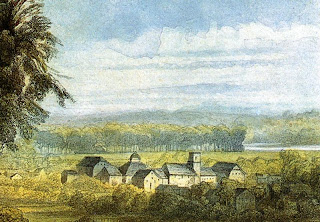
View of New Harmony. By Karl Bodmer.

Copious notes on the winter season birds that occurred among the environs about New Harmony were scribed by Prince Maximilian, age 50, during his western travels as soon as he arrived at this enclave on the Wabash River, at the western edge of Indiana. Maximilian, and his two compatriots, Karl Bodmer the illustrator, and David Dreidoppel the hunter, were to reside here for a months during the winter of 1832-1833.

It was an obviously fine choice on the western frontier. Residents included Thomas Say, with his distinct and unique history for studies of natural history in the west, including an exploration along the Missouri River with Stephen Long in 1819-1820. He had arrived at New Harmony in 1825 and continued his scholarly studies.

Also, there was Charles-Alexandre Lesueur — originally from France — and a naturalist and illustrator whom also arrived in 1825.

With the usual practice of a daily journal entry, Prince Maximilian wrote in the first pertinent entry of his tagebush, or journal, the details given for 19 October 1832: "At the edge of the forest, one very soon reaches the rather sightly, friendly town of New Harmony on the level land on the bank of the Wabash." The entry also mentioned something about the some birds noted by the members of the party that were walking, specifically the parakeets seen by Bodmer.

The party stored their baggage at the inn, which was apparently where they were to stay during subsequent days.

In his first journal paragraph for the place, Mr. Say was mentioned. Say then visited Maximilian twice the next day — and sent the Prince some wine — obviously as a welcoming gesture when a resident has a new visitor on the scene who shows an intense interest in similar subjects. Maximilian wrote that Say was a "well known and highly regarded as a writer on natural history."

Say and Maximilian went to visit Lesueur on 21 October: "His studio, a hall on one side of the empty church, is most curious. Directly before the entrance there is a view of New Harmony, painted after the manner of a theater setting that, with curtains, forms, so to speak, a small theatre. ... On the pillars beside this small theatrical-perspectival view hang natural history objects: on one side, a Grus Americana and an Ardea herodias; on the other, hunting equipment. On the walls, all kinds of instruments, natural history objects on benches, tables, and chairs. There a squirrel was just being stuffed. Here there are rows of enormous Unio from the Ohio, Wabash, and Mississippi; there, beautiful bird skins. Elsewhere the owner's drawing and painting equipment and the various cartons he had accumulated on his journeys around the world and on the Mississippi and other North American river. We richly enjoyed looking over the sketches of various kinds. The collections of small views of the Ohio and Mississippi was lightly sketched in pencil."

Maximilian visited Say again the next day, giving particular attention to interesting plants in his garden, which he maintained on property of William Maclure, the owner of the village site.

The two accomplished naturalists made their first foray afield together on 24 October, going on a short hike to the nearby hills, and walking along the colorful Wabash river. The Prince shot a cardinal, noted blackbirds, and was out-witted by a large bird of prey.

It was a difficult time for these men, as they were afflicted by ailments. Maximilian was continuing his treatment for a sickness. Bodmer was taking medicine. Say was also in a sickly manner.

Several scenes were captivating for Karl Bodmer at this late-autumn time in the western wilds. Maximilian wrote in his journal for the day, that Bodmer had "made several preliminary sketches of several forest scenes with vines."

Layout of New Harmony. In 1834; from travels of Lesueur.

Watercolors rendered for the vicinity include:

  • Confluence of the Fox River and the Wabash
  • Mouth of the Fox River
  • Fox River near New Harmony
  • Wabash near New Harmony
  • Cutoff River, Branch of the Wabash
  • depictions of New Harmony

Some of these watercolors included the colorful Carolina Parakeet in the depicted scene, with the Bald Eagle and Wood Duck also shown.

New Harmony was owned by a wealthy Scot, Mr. Maclure, who lived in Mexico, and had established a library, printing press, and engraving and printing shop, Maximilian explained. There were about 600 residents at the time, and "is pleasant and built in a rather regular manner with broad, unpaved streets," according to his journal entry on 29 October.

Maximilian visited Maclure's orchard several times during the months of his visit from latter October 1832 to mid-March 1833.

An especially notable outing, in a birdly sense, was November 1st when Maximilian walked along the banks of the Wabash.

"I often stood and listened attentively for various birds, while urubus soared in wide circles high above the forest; far away, at the edge of the cornfields, one heard the shrill cry of the wary crows, only one of which we had been able to bag during our entire stay in America. The forest resounded with the tapping of the woodpeckers: Picus auratus, carolinus, pubescens, varius, and others; their calls very closely resemble those of German woodpeckers. But close to us, tits were climbing and pecking: Parus bicolor and atricapillus, the nuthatch (Sitta carolinensis) with the black crown, and the small brown creepers (Certhia), which I added to our bird collection. Several other small birds were fluttering in the very crowns of the trees, which my bird shot could not reach. The heat was great. At twelve thirty we had a temperature of 16 1/2oR (69.1oF), in the shade."

Maximilian returned home fatigued, he wrote, having just recovered from his disposition. There were several others in the same condition, he noted in his journal. Any maladies did not stop Maximilian, Lesueur and Say from climbing to the local pinnacle of a building which had been a church. Then they went to Lesueur's house and viewed his "superb collection of drawings of mollusks, frogs and mammals... ."

During this time, Karl Bodmer was out and about on forays to view the local scenes, and depict them in sketches. The hunter David Dreidoppel went in pursuit of animal's that became carcasses for the natural history collection.

Outings to the local natural haunts and visits to the residents of the naturalist's continued to be the theme for subsequent days. Say was known to regularly work in his little house in his garden.

Maximilian's journal provides the exquisite details of the visits and conversations. On November 7th, he visited Say in the afternoon, and Lesueur in the evening to see his sketches. The diary is most interesting with its naturalist prose.

An entry for 27 November wrote about the westward journey of three days by Karl Bodmer to the prairie lands: "At about noon Mr. Bodmer and Mr. Twigg (General) returned from Albion, a small town on the boundary of the so-called prairies of Illinois. These regions are only half-open, and everywhere fringes of forest can be seen in the distance. ... They saw the wide circle of fire when the prairie was burning. Also, there are various bird species not found in the forests: during the migratory season, for example, the great white crane (whooping crane), Grus americana, a splendid bird. Furthermore, the prairie hen (Tetrao cupido), which can be obtained in large number, however, only when there is snow, and none of which they shot. In addition, Falco furcatus, the beautiful white-and-black kite. Mr. Bodmer shot a large earless owl (Strix nebulosa), and the beautiful rust-red squirrel ... Mr. Bodmer had drawn some very nice sketches, including the head of a white heron. They brought back various seeds as well. On the way back, they lodged for the night in a house about 4 miles from Harmony, where they were told that during the migration season there were swans, geese, ducks, and cranes in such numbers that one could not hear gunfire because of all the clamor."

On 29 November, the words were: "Walk with Mr. Say in the direction of the prairies at two o'clock. At the entrance to the forest, we found a pretty little nest of the red-eyed flycatcher, Wils. We saw several small birds, especially Fringilla hudsonia and Fringilla canadensis as well as the small winter wren, the nuthatch, and other titmice creeping around on the fallen trunks. Several woodpeckers." Lesueur was sick. While Bodmer was out making a sketch of the Fox River, "in a true wilderness area, and wild ducks, especially Anas sponsa and Mergus cucullatus."

In early December, Maximilian noted for each day the birds noted when they were observed or collected. On the 2nd, Dreidoppel shot a "Loxia cardinalis, a Sitta carolinensis, a Sylvia sialis, and a Fring. Hudsonia. ... Russel the hunter brought a turkey hen and a young Ardea herodias. I made a short excursion and found only Picus auratus, pubescens, Parus bicolor, and Fringilla hudsonia."

The next day, only a "nice colorful duck, a crow, a bluebird, and a snowbird" were noted during a stroll with Say, after their initial visit. There was a raw wind blowing. The Prince spent the evening with Lesueur, and noted that he got to see some interesting copperplates.

Maximilian received a number of books on the 4th from Maximilian for reading, a preferable pastime on the tempestuous days of early winter.

On December 5, with Bodmer and Maximilian on the Wabash in a boat, going past Cutoff Island and Fox Island, the Prince was impressed with the setting: "In this romantic wilderness, forcing my way through dense cane beneath the tall trunks and climbing over countless fallen trees, I scoured the tall, wild forest almost until evening. Here I found especially many woodpeckers and brown creepers (Certhia familiaris), Sitta canadensis, as well as titmice, cardinals (Loxia carolinensis), several finches, and winter wrens (Troglodytes hyemalis), and shot several of these. The urubus often hovered above me, something one immediately notices from their passing shadows. There were numerous woodpeckers of all kinds here, in particular Picus auratus, carolinus, and pubescens, but especially the large, beautiful Picus pileatus, which is very large and black as a crow, with several beautiful white markings and a blood-red crest, which one readily recognizes at a distance. I shot three of these beautiful birds since they are not very shy. When the sun had set, we got into our boat again and, with no little difficulty, rowed up the Wabash against the current toward New Harmony."

The daily events unfold in the prose of the Prince. Notable would be an outing to some local haunt. Perhaps it was an evening at Say's house, once and again. Or just walking in the local nature, appreciating the parakeets or stalking a duck.

December 18: "In the afternoon, walk up along the Wabash in the tall forest. Here there were all kinds of woodpeckers: Picus pileatus, auratus, carolinus, villosus, pubescens, but no erythrocephalus, which are never seen here this time of year. In addition, Sitta carolinensis, Fringilla hudsonia and canadensis. Parus bicolor and atricapillus, Muscicapa coronata, and also a tiny bird, as well as Troglodytes and several large birds of prey opposite me."

Christmas Eve was "welcomed with heavy charges of powder by the young people on the streets of Harmony. ... Only by drinking, hunting, singing, and dancing does the wild and somewhat course population of this area celebrate the most solemn festivals of Christendom. In the evening Mr. Lesueur visited us. His foot has grown worse again; he can scarcely walk."

On the day of the holiday, a crowd of local people and others from nearby Albion gathered in the evening at the house to celebrate. "Our landlord frequently brings some of these strange guests up to us to show them the strange, marvelous creatures and their zoological collection." Maximilian — spending the interlude at his temporary home — continued: "... underneath me a wild dance had been raging since nightfall, with the large drum and several violins and pipes or flageolets creating an uninterrupted music that resounded in the ears, because the huge hollow kettledrum, too, did not remain silent for one moment."

Confluence of the Fox and Wabash Rivers. By Karl Bodmer; note the Carolina Parakeets shown among the branches of the Plantanus (Sycamore) tree.

The next day, the Prince was about toward noon, visiting Say and Lesueur, then walked to the Wabash. Towards the end of the year, Maximilian and unnamed helpers worked to prepare crates of natural history specimens for shipping to New Orleans, and then onward to the estate in Europe.

On New Years eve, the German spent the time in with Say: "That evening, the last one of the year, I spent in pleasant conversation at the home of Mr. Say."

On the first day of the next year, the three naturalists' must have compared their maladies. Maximilian's stomach was out of order. Lasueur and Say both complained about a certain indisposition. The Prince did take a walk and noted the Anas clangula on the Cutoff River.

The evening was more time for naturalist talking: "Spent the evening at the home of Mr. Say, that is, the last evening of that year and the first one of the new year."

Maximilian was out the next morning, along the Fox River and near Turkey Island making natural history observations, which was a feature of nearly every day for his party at the Wabash.

The evening of January 2nd, was spent having an "interesting conversation about natural history" with Lesueur and Say. Now that would have been one more of the many fascinating talks on the western frontier, considering the men involved. Topics mentioned in the Prince's diary included turtles, the geologic formation in the region, as well as the strange weather and "the fact that at this temperature almost all people experience deviations from their usual healthy condition and unpleasant feelings in the viscera. The atmosphere seems to have been very unhealthy during the past year, for even injuries, as many persons assured me, were far more difficult to heal."

January 8: "... found a whole flock of parakeets, which flew about with a loud cooing call and perched on the high, white branches of the Platanus trees. They darted about as swiftly as an arrow but soon disappeared in the tall forest. The bright green flock afforded a most delightful sight."

January 13: "In the afternoon I went out and set a mousetrap. It was extraordinarily wet in the tall grass and the withered plants. A beautiful female kite (probably Circus cyaneus) skimmed past me. A flock of Alauda magna Linn. was perched on isolated tall trees but did not let us get close to them. I saw two prairie hens, which made a wide sweep for the tall timber. The small birds included Loxia cardinalis, Fringilla hyemalis, Sitta carolinensis, Parus (both species), and several woodpeckers. The weather is mild; the snow will mostly disappear during the night. Visit that evening from Mr. Say."

January 25: "Early today Dreidoppel and I left Harmony to shoot some parakeets (Psitt. carolinensis). We crossed the Wabash and immediately saw two splendid Aquila leucocephala but could not get close to them. They hovered over the river looking for fish. Dreidoppel shot the agile Troglodytes ludovicianus. From there we went to Long Pond, which is connected to the Fox River.

"Dreidoppel first found flights of parakeets, of which he killed fourteen, sometimes several of them with one shot. Then they came towards me, and I also shot three of them. These most delightful creatures are not at all timid and alight immediately after they have been shot at. When winged, they very quickly become tame."

On February 23rd, Maximilian drew up a bird calendar, or list of birds in Harmony, noted during the previous four months of his stay. The species were in categories for: 1) resident birds throughout the entire winter, 2) still present in November, 3) individual birds in November, 4) in the second half of January, 5) returned in February, 6) those species that appeared again in Harmony at the beginning of March.

Though his site list was prepared, there were more days that followed with ongoing opportunities to watch and perhaps collect by shooting, additional examples of the local avifauna.

February 25, during a walk in the afternoon by Maximilian and Dreidoppel: "We saw few birds, just woodpeckers, titmice, and nuthatches. On the Cutoff River, I watched a flock of Anas rufitorques for a long time as they dived near a sandbar with willows, where the water was shallow, but they did not come within range. In the orchard I found large numbers of bluebirds. ... That afternoon I received a live Strix asio, a nice rust-red little horned owl that, when perched, resembled a ball with ears."

March 6: "Dreidoppel and I went out and, with Duclos' icebound boat, broke through the ice, which was 2 1/2 inches thick, a task that detained us for half an hour. Dreidoppel went up along the Wabash; I went downstream. I shot a wild dove (Columba migratoria) and, farther on, an especially fine wood duck. High in the sky, three flights of cranes headed northeast. Skeins of wild geese and ducks over the Wabash. Duclos, who had concealed himself, shot a female mallard. Today several small birds let their songs be heard at noon, when it was pleasantly warm.

"After lunch I entered Mr. Maclure's orchard, where Achilles was pruning the apple trees. There I saw bluebirds and robins. Mr. Lesueur returned from hunting; had shot a duck, which he did not get. Last evening young Duclos shot a wild goose (Anser canadensis). I spoke for a few minutes with Mr. Say and obtained some interesting bits of information from him."

Maximilian and his entourage left New Harmony on March 16th.

New Harmony Places

About New Harmony on the Wabash, there were a number of geographic places where the naturalists and hunters noted birds. Mentioned in the narrative by the Prince are the confluence of the Fox and Wabash rivers, Maclure's orchard, Fox Island Wabash Island, Cutoff river and Cutoff hills, Long Pond, Owen's orchard, Turkey Island and obviously locally near New Harmony.

Bodmer's vivid paintings stylistically convey a profound few of places much appreciated during their extended stay.

Birds of Historic New Harmony

A compilation of the assorted sightings and notations given by the journal of Maximilian comprises more than 550 separate records, with a vast majority based upon a sighting made on a particular day's outing or derived from a journal entry that alludes to carcasses brought back by Dreidoppel or other hunters.

The species list includes more than 70 species, with each noted to a variable extent. Waterfowl were commonly observed, as New Harmony was sited along the Wabash River, and the Fox River, with a variety of habitats so suitable for these fowl.

Greater White-fronted Goose - 2
Brant - 1
Canada Goose - 14
Trumpeter Swan - 1
Wood Duck - 13
Mallard - 17
Blue-winged Teal - 1
Northern Pintail - 2
Garganey - 1
Green-winged Teal - 4
Ring-necked Duck - 16
Common Goldeneye - 10
Hooded Merganser - 8
Common Merganser - 7
Red-breasted Merganser - 1
Ruffed Grouse - 2
Greater Prairie-Chicken - 14
Wild Turkey - 27
Northern Bobwhite - 7
Pied-billed Grebe - 2
Great Blue Heron - 3
Turkey Vulture - 18
Osprey - 2
Bald Eagle - 6
Northern Harrier - 3
Sharp-shinned Hawk - 1
Red-shouldered Hawk - 3
Red-tailed Hawk - 7
Golden Eagle - 1
American Kestrel - 4
American Coot - 2
Sandhill Crane - 8
American Woodcock - 1
Mourning Dove - 3
Passenger Pigeon - 5
Carolina Parakeet - 16
Eastern Screech-Owl - 4
Barred Owl - 2
Belted Kingfisher - 7
Red-headed Woodpecker - 3
Red-bellied Woodpecker - 7
Yellow-bellied Sapsucker - 4
Downy Woodpecker - 8
Hairy Woodpecker - 7
Northern Flicker - 10
Pileated Woodpecker - 7
Blue Jay - 7
American Crow - 17
Black-capped Chickadee - 8
Tufted Titmouse - 12
White-breasted Nuthatch - 15
Brown Creeper - 8
Carolina Wren - 4
Winter Wren - 7
Golden-crowned Kinglet - 2
Eastern Bluebird - 18
American Robin - 5
Yellow-rumped Warbler - 4
Eastern Towhee - 5
American Tree Sparrow - 8
Song Sparrow - 3
White-throated Sparrow - 5
Dark-eyed Junco - 20
Northern Cardinal - 19
Red-winged Blackbird - 4
Eastern Meadowlark - 3
Rusty Blackbird - 5
Common Grackle - 3
Baltimore Oriole - 1
Purple Finch - 1
American Goldfinch - 2

It is also appropriate to include the Whooping Crane, based on a local specimen record.

Species noted most often were the Wild Turkey, 27 known instances; Dark-eyed Junco or snowbird, 20; Northern Cardinal, 19; Turkey Vulture which were most often noted as the "urubus," 18; Eastern Bluebird, 18; American Crow, 17; Mallard, 17; the colorful and vivacious Carolina Parakeet, 16, with numerous specimens collected as well as a bird with an injured wing that was kept as a captive for a few days until it died suddenly in the evening, "undoubtedly it had burned itself by the fire, because these birds have very sensitive beaks," Maximilian wrote in his journal; Ring-necked Duck, 16; White-breasted Nuthatch, 15; Greater Prairie-Chicken, 14; Canada Goose, 14; Wood Duck, 13; Tufted Titmouse, 12; Northern Flicker, 10; and, Common Goldeneye, 10.

There are a number of records where the identity of a specific species cannot be realized, as the designation generically referred to ducks, geese, hawk, merganser, owl, shorebird, or finch which in most instances could have actually been a species of sparrow, and many mentions of woodpeckers with none of the details required for a valid identification. There were also entries - classified as unidentified birds or Passeriformes species - which mentioned "several other birds" in some cases singing their morning song.

With the visit extending in early March, the first bird movements of late winter and early spring provided additional, notable species.

These bird records reveal an essential importance of New Harmony for studies of natural history during a decade from ca. 1825 to to 1834, based upon the so notable writings of Say, illustations of Leseuer and journal entries of Maximilian. The history for the place should always have this topic as a prevalent feature because its synergy was unique but readily apparent in the published history for the period. There is no other place comparable or having such a unique meld or people focused on furthering an understanding of the outdoors and its flora and fauna. There could be a complete tome written on the subject and this place during this particular time, as other expeditionists also visited, impressed with the setting and the men focused on natural history studies. Each recorded effort is essential.

This brief view of the historic ornithology is but one simple view of a grand, topical effort so worthy of celebrating, and most appreciated when the writer's words — the original, precious writings available from a variety of sources — are read with focused enjoyment and then studied to understand what they convey more than 15 decades after being written.

Numerous Bird Deaths in May From Building Strikes at Omaha

A tally of bird strikes for downtown Omaha during the month of May 2009 shows a continued death of many birds, with a notable prominence of the Qwest Center Omaha as it continues to have the greatest number of known mortality. Variability in migratory flights meant there were fewer or no bird deaths at some prominent locations where extensive instances of mortality occurred last year during May.

White-throated Sparrow. Harper Center, Creighton University; 5 May 2009.

Documentation of the bird strikes found this spring season started at the end of April - notably at Creighton University on Easter weekend - with subsequent surveys via bicycle well underway at the start of May. There was a particular intent to get a good coverage of bird strike instances for the month, so a look about was done each day, except for one weekend when the opportunity to visit the Niobrara River valley just had to be taken. Only a very few number of strikes might have been missed since it was a weekend, and there is little or no cleanup around buildings on these mornings, so carcasses might have remained until being noted on Monday morning.

A daily tally shows the difference for the days of the month this spring in comparison to last spring.

There were 29 species represented in the 65 instances of dead bird carcasses found during May 2009 on the sidewalks amongst the urban built-environment on the lowland west of the Missouri River channel. The only species included in the tally that is not protected by the Migratory Bird Treaty Act was a single female House Sparrow found as an inert carcass in the plaza between the towers of the Central Park Plaza.

The different species that struck the glass of downtown Omaha buildings in 2009, but not found in the survey region among the river city buildings in 2008 were:

  • Mallard: surprisingly, one was dormant on the sidewalk on the west side, north end of the Qwest Center; it was able to fly away when approached
  • Virginia Rail: a carcass was found at the corner upon the block of the First National Tower
  • Yellow-billed Cuckoo: a May record, where the security guard at the Holland Center wondered what was going one, while my attention was being given to photographing the occurrence of this bird
  • Red-headed Woodpecker: a carcass along the curb
  • Orange-crowned Warbler: found during May, whilst it has been previously noted during other months
  • Nashville Warbler: found during May, whilst it has been noted during other months
  • Northern Waterthrush: a late season migrant
  • Grasshopper Sparrow: not noted last year during May
  • Meadowlark: only the head was seen, and this bit of a bird carcass continued to languish on the sidewalk for several days
  • Yellow-headed Blackbird: noted by a brief but definitive glimpse of this characteristic bird which struck the glass at the Holland Center courtyard

There had been 35 species documented during the same month in 2008, based upon 101 records.

During the two spring migratory seasons, there were profound differences. There were days - when based upon findings in 2008 - that many instances of dead birds might have occurred, but this was not the case. It seems that unknown conditions during the migratory season made a difference. The actual particulars - including wind and other climatic factors - are not known well enough to analyze.

This spring season had a fewer number of migratory species, indicated not only by a fewer number of bird strike examples, but also by general observations of species by bird-watchers in local areas where these people tend to occur. This was also the case at the Elmwood-Memorial Park environs based on regular surveys which followed a consistent route and method of noting what birds were present.

It was also a month of differences in the occurrence of bird strikes. Compared to 2008, there were fewer locales where strikes occurred, as shown by the given records, each which was documented by a photograph of the situation.

Julian Date

May 2008

May 2009

122

5

-

123

NS

1

124

NS

4

125

NS

5

126

NS

2

127

3

2

128

-

1

129

2

1

130

-

3

131

10

-

132

2

3

133

3

2

134

6

-

135

1

2

136

1

NS

137

1

NS

138

3

7

139

7

2

140

2

4

141

5

2

142

4

3

143

1

1

144

4

2

145

2

7

146

5

3

147

10

1

148

2

1

149

1

-

150

11

2

151

3

4

152

8

-

NS - no survey done


Building

May 2008

May 2009

1200 Landmark Center

14

5

1405 Harney Street

1

-

17th and Harney Street

1

-

All Makes Office Equipment Company

1

-

American National Bank

4

-

Central Park Plaza

8

5

Durham Research Center

-

2

First National Bank Building

2

-

First National Data Center

-

1

First National Tower

1

6

Gottschalk Freedom Center

8

-

Harper Center, Creighton University

-

2

Holland Center for Performing Arts

9

3

Kutak Rock - Omaha Building

-

1

Nebraska State Office Building

1

-

Omaha Public Power District Energy Plaza

-

1

Omaha World-Herald Building

5

1

Qwest Center Omaha

33

29

Slowdown Lounge

-

1

Union Pacific Center

9

4

Woodmen Park

-

1

Woodmen Tower Skywalk

-

1

Zorinsky Federal Building

2

-


Yellow-billed Cuckoo. Holland Center for Performing Arts, 25 May 2009.

A readily prominent and obvious detail is the continued number of birds which are struck dead at the Qwest Center Omaha, with 33 in 2008 compared to 29 in 2009. This is not a significant difference. This building continues to be the deadliest place for migratory birds at the Omaha riverfront.

The Qwest Center Omaha is managed by the Metropolitan Entertainment and Convention Authority. Roger Dixon is the director. The organization continues to do nothing about the many birds which die - are struck dead - meet their mortality - etc. at this place of glass which is the west wall of the structure. There is an obvious indifference to the demise of so many birds! Again and again a bird is struck dead, and this has been happening ever since construction of the building was finished.

Summary of Species Noted
in May 2008 and May 2009

Bird Species

May 2008

May 2009

Mallard

-

1

Virginia Rail

-

1

Sora

5

1

Mourning Dove

1

4

Yellow-billed Cuckoo

-

1

Red-headed Woodpecker

-

1

Hairy Woodpecker

1

-

Olive-sided Flycatcher

1

-

Eastern Wood-Pewee

3

-

Willow Flycatcher

3

-

Least Flycatcher

1

1

Eastern Kingbird

1

-

Warbling Vireo

2

-

Red-eyed Vireo

1

-

Swainson's Thrush

2

1

American Robin

2

1

Gray Catbird

2

3

Tennessee Warbler

13

3

Orange-crowned Warbler

-

2

Nashville Warbler

3

1

Yellow Warbler

4

-

Chestnut-sided Warbler

1

-

Yellow-rumped Warbler

2

-

Palm Warbler

2

-

Black-and-white Warbler

1

1

American Redstart

2

-

Worm-eating Warbler

1

-

Ovenbird

7

1

Northern Waterthrush

-

1

Louisiana Waterthrush

1

-

Mourning Warbler

1

-

Common Yellowthroat

14

3

Chipping Sparrow

1

2

Clay-colored Sparrow

4

6

Grasshopper Sparrow

-

3

Lincoln's Sparrow

2

4

Swamp Sparrow

-

1

White-throated Sparrow

3

1

Rose-breasted Grosbeak

2

4

Blue Grosbeak

1

-

Indigo Bunting

5

7

Yellow-headed Blackbird

-

1

Common Grackle

2

2

Baltimore Oriole

2

4

House Sparrow

-

1

Total:

35

28

Baltimore Orioles were especially indicative of the deaths which occurred during May, as pictorially presented previously.

Also notable in May this year was a significantly larger number of birds struck dead at the First National Tower skyscraper. The north atrium - with its confounding and readily apparent interior landscaping - was the most deadly place, especially at the east end. Because of the profound footprint of this tall and imposing structure, a carcass was found at the corner of the block, apparently after the Virginia Rail struck the building and then careened to end up on the sidewalk where it died. A similar event occurred last May with a Sora found in the street east of the tower. There are also probably other strikes which occur here, though the results are not apparent as the birds fall on upper portions of the structure rather than to the street-level where the results can be seen and noted.

A new locale for birds deaths during May this year was the Durham Research Center I - the north tower along Saddle Creek Road - which has been built in just recently for the University of Nebraska Medical Center. With a dead robin and Mourning Dove, these two instances establish what will certainly be ongoing instances of mortality because of the skywalk and construction with lots of glass and a "see-through" perspective, which is known to be a hazardous situation for birds' movement. The "central commons" for the two towers is enclosed in glass, with no permanent barriers, though there are sunscreens lowered to block the sun - as noted on sunny afternoons - to sometimes provide a visual barrier. The place is not bird-friendly.

Violations of the Migratory Bird Treaty Act

Each of the bird strikes, whether it caused a bird to die or disabled a bird whose ultimate fate is uncertain, is considered a taking under the Migratory Bird Treaty Act. This Act is enforced by the U.S. Fish and Wildlife Service, although in the case of bird strikes associated with buildings in Omaha, this enforcement is selective or nonexistent. The federal agency had a couple of meetings last June with officials at Qwest and the Omaha World-Herald, but there were no apparent results to address the situations causing the documented deaths.

Managers of buildings in the river city are cognizant of the situation, and they still do nothing as well, except perhaps do a better effort at removing the dead bird carcasses so the sight of a bird carcass will not be seen by any building patrons!

Building cleanup often occurs at first light, so any dead birds can also be removed prior to any survey, though the look about occurs before 7 a.m., if not sooner. Any disabled birds can only be determined during a short time after sunup, which is a now number of minutes before 6 a.m., so early in the morning! By 6:30 a.m., disabled bird may have recovered enough to move elsewhere.

Because of quick cleanup practices, the number of known strike occurrences is fewer than the number which actually occur.

Omaha a Profound Place of Bird Deaths

A multitude of birds continue to be killed by the buildings of downtown Omaha. Each bird suffers an agonizing death of suffering as experienced again and again by seeing a bird sitting on the sidewalk, unmoving with its eyes closed, and morose enough to allow a close approach. Their agony is obvious, and the death of a bird, especially such as witnessed with a Baltimore Oriole is excruciating for them and an immensely sad scene to see.

With some attention and concern for the situation, this could be prevented, but there is a cavalier attitude of indifference. The attitude of building managers - as there has been absolutely nothing done to address the bird strike situation - conveys a complete disregard for migratory birds. This is an anathema based on what should be a "green attitude" of environmental concern and working to lessen the impact of the built environment upon the feathered residents of the natural world which in instance after instance meet their demise when they happen to end up among the built environment of downtown Omaha.

Common Yellowthroat. 1200 Landmark Center. 26 May 2009.

Indigo Bunting. Union Pacific Center, 30 May 2009.

Rose-breasted Grosbeak. Woodmen Park skywalk, 31 May 2009.