17 October 2011

Happy Hollow Creek Pollution

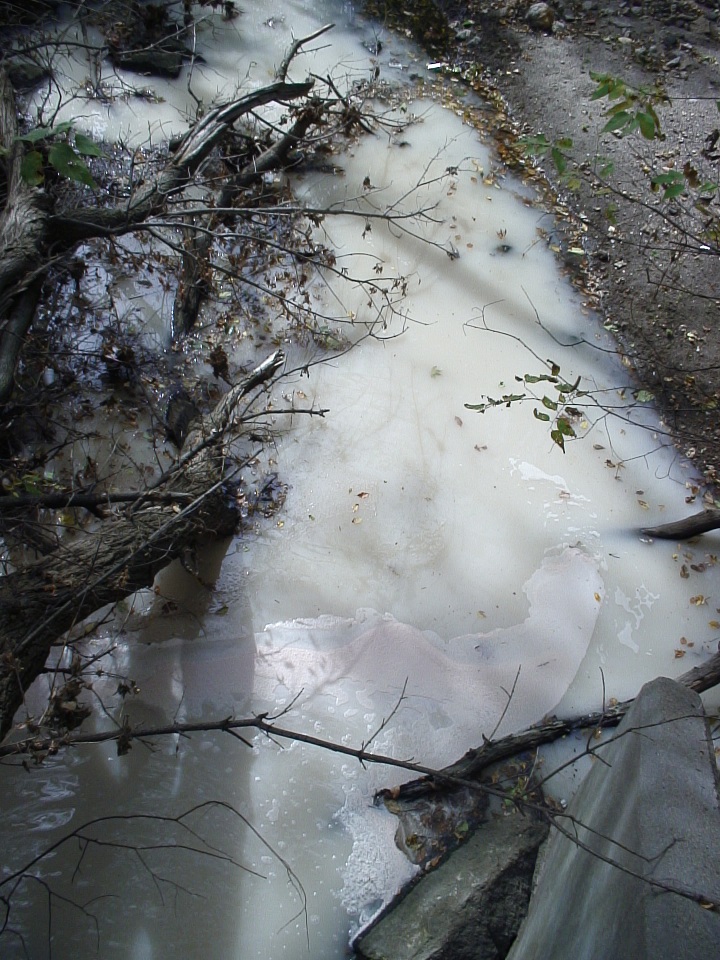
Someone in the Dundee neighborhood of Omaha poured paint into a sewer drain on the Sunday, October 16, 2011. The paint drained away and ended up in Happy Hollow Creek, along the east side of Brownell Talbot school and Memorial Park. This is the second known instance of creek pollution, the other event along Wood Creek, in March 2010.

The following images indicate how the creek water was turned white. Note also the other trash which gets washed into the creekway, because of careless littering.

View looking south from where the water flows from the culvert beneath Underwood Avenue.

Looking towards the north.

The spot where the water leaves the culvert, showing how water inflow had cleared.

There were numerous American Robins along the creek at this locale during this time, and they were trying to take a bath in the flowing water. They had to do so in dirty water, because of some moron in the neighborhood.

Where the robins were trying to cleanse themselves, showing the milky character of the creek flow.

Detail showing the scum on the water associated with the pollution event.

The polluting paint eventually dissipated, and the creek returned to its normal appearance. The person responsible should be fined and required to do six hours of community service, which would entail cleaning trash from along the creekways of Memorial Park and Elmwood Park.

The Dundee area has the dubious distinction of being a "top neighborhood" in the U.S., yet this pollution event blatantly shows the little concern some people have for the local natural environment. The worst part of this is that the person(s) responsible are oblivious of what they caused.

14 October 2011

Ode to the Chimney Swallow

The Chimney Swallow, written by Edward R. Campbell. From "Poets and Poetry of Vermont" edited by Abby Maria Hemenway and published in 1859.
WHEN the winter melts away,
Flowing into balmy May;
When the buds and blossoms fair
Waft their fragrance on the air;
When the insects, on the breeze,
Dance around the forest-trees;
Then the twittering swallows come,
Speeding on the breath of spring,
Swiftly to their summer home,
And, like restless spirits, roam
On the wing.
 
Few at first — a chosen band,
Vanguards, here to "spy the land;"
Yet, ere fades the morrow's sun,
Thousands take the place of one.
Whence they come, or whither go,
Only swallows ever know;
Mortals only know they're here;
Coming, going, twittering;
Coming, going with the year,
Fleeing, ere comes autumn sear,
On the wing.
 
Whether at the South they rove,
Sporting in the orange grove;
Whether housed in lakes, or fens,
Caverns low, or mountain dens,
Matters not; but, on the wind,
Leaving it to lag behind,
Darting, diving in the air,
On they come, undallying,
Feasting on the insects there;
Void of hope, or fear, or care,
On the wing.
 
Why, O, bird aerial! fly,
Never resting, through the sky?
Pride? E'en Lucifer may go,
Welcome to the earth below!
Art thou an unearthly thing,
Thou with long, black, narrow wing,
Pinions strong, and body slight,
Speeding, speeding, curveting;
Saving in the gloom of night,
Ever in thy ceaseless flight,
On the wing.
 
See! in circuits, broad and high,
Circling less and less they fly;
Then in column, hovering low,
Down the chimney's throat they go;
Clinging to its wall the breast, —
Watching for the dawn, they rest.
Such their life from day to day,
Till, as came they in the spring,
Unobserved they pass away,
Speeding as immortals may,
On the wing.

10 October 2011

Considering a Dundee Church Chimney

While out and about recently looking at places where Chimney Swifts had been known to roost this time of autumn, a dramatic change was noted at Dundee Presbyterian Church at Happy Hollow Boulevard and Underwood Avenue.

On October 4th, it became apparent that what had been an open chimney was capped by a metal contraption and a flue, which completely prevented any swift access.

In looking at previous records for this place, two years ago 297 swifts used this structure as a night's roost. A few days previous to this record, more than a hundred were also present.

In evaluating the situation further, though the chimney was blocked, there were a couple of swifts which flitted past at dusk, apparently evaluating the condition.

Officials with Dundee Presbyterian Church were subsequently been contacted a few times regarding the situation. They were not aware of what they had caused when they put in new heating boilers. No reply has yet been received on how they will consider the change they have caused.

It is very obvious that the chimney being blocked has meant the loss of a prominent roosting site in the Dundee area, forcing the birds to go elsewhere.

Blocking the chimney and forcing the birds to be "adrift in the wilderness" is basically no different than someone putting plywood on each door of the Dundee Presbyterian Church, keeping them from their celebratory sanctuary.

There is nothing different from that happening in comparison to what they did to their birdly neighbors, the Chimney Swifts. They may have not known about the results of their actions, but they are now aware of how they are influencing the local swifts.

While taking these pictures on October 10th, swifts could be readily heard twittering in the airspace, eating bugs which could otherwise be pesky pests for the human residents. The bugeaters are benefiting the other residents, yet the blocking of a chimney - or complete removal in many instances - is one indication of how they get treated in return.

Church Indifferent

The elders of the Dundee Presbyterian Church were indifferent to the fate of the chimney swifts. Nothing will be done to address the change, according to the operations manager of the church. When the latter gentleman was spoken to, he tried to explain that they had landscaping around the building, but that was cut-off as any greenery has nothing to do with a chimney.

At the church sign, it says at the very top: "All Are Welcome." This is obviously not the case and expresses a view of hypocrisy. If you go along with what we want, then come in, but if you are being of our great world, and use our church to celebrate your existence, and new boilers are needed and the chimney gets block, then you are not welcome.

This is the sign which presents one message, though the truth is otherwise. In the upper background is the capped chimney.

During a second stop at the Dundee Presbyterian Church to contact an official on this matter, the people there were over-bearing, and pompous, trying to insist that I do what they wanted, even trying to be forceful. They kept asking what I wanted, as if it was their business, which it is not.

At the Dundee Presbyterian Church, there could be no information found on how the church has any concern for the environment. Nothing on this topic could be found on their website. There was no bicycle rack at their empty shell of a building, with so-called "elders" which have such a myopic view. On Sundays, adjacent streets are packed with vehicles as the members come to a place now known to not welcome all. And the church is trying to work with the city to get additional parking so more vehicles can take over the streets, according to information read while waiting at the place.

Where are the options for green transportation, such as promoting bicycling or car-pooling?

Elders of the Dundee Presbyterian Church did not consider any options to retain their avian visitors. The church is anything but welcoming and may they suffer the fates due to their action and decision.

The Chimney Swifts should be known and appreciated, but at the Dundee Presbyterian Church, just the opposite happens. Hopefully the birds will be elsewhere and may the bugs and insects they had consumed be left behind to bother the church people.

Car of a member of the Dundee Presbyterian Church blocking the handicap access point along the sidewalk. This is a violation of a city ordinance. The person driving this car was not visibly handicapped. Parking pictures taken Sunday morning October 16, 2011.

Cars of church members parked in the bicycle route along the west portion of Happy Hollow Boulevard. Note how the lane ends. There is a block section along the east side of the Dundee Presbyterian Church where there is no marked lane, probably so the church could have parking.

Another view of the parking situation. The markings in the street seem to indicate there had once been markings for the bicycle route, but they were removed, undoubtedly at the request of someone not wanting the lane there.

Illegal Parking Depicted

Members of the Dundee Presbyterian church continue to show obvious disregard for other people in the community. Upon visiting the church area on October 23rd, the following two instances of vehicles blocking the handicap access for the sidewalks were noted. The two vehicles were also causing an impediment to pedestrians and bicyclists using the sidewalk.

A city of Omaha ordinance prohibits the parking of vehicles either blocking the sidewalk and/or blocking these street level access points along the sidewalks.

Both vehicles shown could have been ticketed by law enforcement officials.

This is another example from October 31, 2011.

08 October 2011

Pipeline Projects Impacting Wetlands Require Permits

Projects of various sorts which occur within jurisdictional wetlands within Nebraska require a permit from the U.S. Corps of Engineers and a state agency.

In the case of the proposed Keystone XL pipeline through Nebraska, any impacts to wetlands - including lakes, marshes and meadows - would be regulated by Section 404 provisions of the Clean Water Act, as well as Title 117 regulations defined by the state.

According to a conversation with a representative of the Corps on October 7, TransCanada has not applied for a permit in Nebraska.

A permit would be required, the agency representative said.

The KXL pipeline corridor would go through numerous wetlands - especially in western and southern Holt County - based upon known details of its route.

A typical permit process includes an application which defines the acres of wetlands being impacted by a project, what mitigation will occur, a monitoring plan to ensure the created wetlands are suitably replaced the "lost" wetlands.

Nationwide permits can be issued. An individual permit process can also be utilized by the regulatory agency. this type of permit normally includes a 15-30 day period where the public can provide pertinent comments regarding many criteria for a thorough evaluation.

A permit would be required for each state through which the pipeline would pass, the Corps' representative indicted during the phone conversation.

In the case of Title 117 regulations in Nebraska, any mitigation efforts for "isolated wetlands" would be voluntary and not legally enforceable as there is no pertinent legal statute, according to a representative of the Nebraska Department of Environmental Quality.

Legal mandates in other plains states is not known.

The review process for a particular Corps permit review may extend for many months, due to the requirements which must be fulfilled before any work can be done.

07 October 2011

Flooded Corn-fields Ephemeral Habitat on Missouri River Flats

What is typically corn fields south of Bellevue was flooded in late summer and early autumn of 2011, the year of the great Missouri River flood. Standing water were wetlands utilized by various species of birds as the conditions were suitable for them to reside and feed.

It wasn't until mid-September that any bird use features were determined for the flat land along the east and west sides of Harlan Lewis Drive. This area is on the north side of the Big Papillion Creek. On the south side of the creek are the well-known La Platte Bottoms, a locale which has not been accessible for months due government-enforced road closures.

When the aberrant wetlands were first noted, there was an extensive amount of standing water being used by different sorts of fowl. It was early in the autumnal migration season. Blue-winged Teal were the most prevalent this day, along with numbers of swallows and a few other unusual species such as the Yellow-headed Blackbird.


There were just a few subsequent visits reported for this place. Overall there were 27 species denoted as indicated by a summary of available records contributed by a two or three area bird-watchers and as determined from personal visits. Other observers are known to have also visited the locale, but their observations were not reported.

Common Name

9/17/2011

9/28/2011

10/1/2011

10/5/2011

Wood Duck

- -

- -

- -

8

Gadwall

2

- -

- -

- -

Mallard

26

- -

- -

2

Blue-winged Teal

235

- -

- -

7

Northern Shoveler

- -

- -

50

8

Northern Pintail

- -

- -

3

- -

Pied-billed Grebe

6

- -

3

- -

Great Blue Heron

5

1

- -

- -

Osprey

- -

- -

- -

2

American Golden-Plover

- -

45

- -

- -

Killdeer

8

- -

65

55

Lesser Yellowlegs

- -

10

2

- -

Pectoral Sandpiper

30

11

3

- -

Stilt Sandpiper

- -

2

2

- -

Long-billed Dowitcher

- -

15

- -

- -

Franklin's Gull

1

- -

- -

- -

Ring-billed Gull

1

- -

- -

- -

Belted Kingfisher

1

- -

- -

- -

Northern Rough-winged Swallow

100

- -

- -

- -

Barn Swallow

100

400

200

40

Marsh Wren

- -

- -

1

- -

American Robin

- -

- -

- -

35

European Starling

- -

- -

- -

350

Red-winged Blackbird

100

- -

- -

20

Yellow-headed Blackbird

6

- -

2

- -

Common Grackle

- -

- -

- -

100

Brown-headed Cowbird

30

- -

- -

- -

These records indicate the avian use of ephemeral habitat resulting from flood conditions at lowlands along the Missouri River in eastern Nebraska.

On the last visit noted, a rapidly shrinking extent of standing water remained. There was a large extent of barren and dry ground. The influence of the flood waters was rapidly diminishing. Killdeer were still abundant. Few waterfowl were about and their numbers was dramatically exceeded by the swarming starlings and grackles.

The highlight of an evening visit was two Osprey. One carried a fish as it looked for a handy spot to eat an evening's meal. A second Osprey was still looking for a fish of some sort stranded among the few bits of remaining water.

There will be plenty of frogs left without any water in the pending days as the unsually dry and warm weather conditions continue.

There is little if any information to report on how flood waters created conditions suitable elsewhere which may have been used by migratory birds. The impact of the great flood has been a tragedy for many people along the river, yet it should also be noted that other results of the situation can also be considered. The riverine flows unsurpassed in the past few years have provided a variety of habitat in many places for Missouri River birdlife, perhaps representing the situation once prevalent when the river was not channelized.

Stormwater Project Underway at Elmwood Park

Work has started on the stormwater project being done at Elmwood Park. The primary focus now is repairing where the water empties into Wood Creek.

Tree removal is underway where the bioretention gardens are to be placed in the swale on the east end of the southern portion of the golf course.

The stormwater drain is being replaced at the lower extent of the project. The hill is to be reestablished. There will be 84 tons of large rock riprap placed where the water empties into the creek.

The errant tree limbs shown in the creek were being removed by construction personnel during a site visit on October 5th.

This work is being done for $8.1 million, as financed by the City of Omaha.

04 October 2011

West Table Playa Wetlands Pictorial

Scattered among the agland of western Custer county, there are many small playa wetlands which provide ephemeral habitat for migratory birds. The usefulness of these places varies upon precipitation, with ample water during wet times and no water when it is dry and hot, causing the water to dissipate.

Recent weather in central Nebraska has been notably warmer than usual, with no precipitation for weeks. The playa wetlands have been shrinking, and there are few places with remaining water.

The following images pictorially convey the condition of some of the recognized playas.

August Views

These photographs are courtesy of Ed and Maxine Wehling, local residents.

Cool Playa

Griffiths Playa

Johnson Playa

Overnight Playa

Wehling Playa East

Wehling Playa South

Wehling Playa West

October Views

During a morning outing on October 2nd, these pictures were taken of a couple of the playas visited.

Hostick Playa

Cemetery Playa

Wetland Extent

This image indicates the extent of wetlands in an area west of Merna, as designated by the U.S. Fish and Wildlife Service.