Showing posts with label architectural design. Show all posts

20 May 2014

Pending Buildings Include Features Hazardous to Birds

Two proposed building projects proposed for downtown Omaha would include structures with features known to be dangerous to migratory birds. Both projects are in the same vicinity of several other buildings where there have been numerous bird-window collisions.

Especially hazardous would be the mixed-use Shamrock Development slated for the block northwest of 10th and Capitol Avenue. There would be multiple buildings, many with glass being used as the exterior walls. An area of retail would include a courtyard area surrounded by multiple structures. The entire extent of landscaping is not known, though street-side trees are shown in the architectural rendering.

Courtesy image

The Lanoha Development would be built at 14th and Dodge Street. An architectural rendering shows an extensive use of glass for the exterior walls.

Courtesy image

This building would be prominently hazardous as it is located directly south of the First National Park, with its numerous trees and other green-space that attract various birds.

It seems apparent that bird-safe building options have not been considered in the architectural design for either project.

15 October 2013

Omaha's Zesto Building Conveys Design Problems and Causes

The relatively recently built Zesto building in North Downtown is gaining prominence for its significance associated with bird-window strikes.

The weekend of October 12-13 was especially revealing. Primarily the east facade — but newly realized for the north facade — the structure had at least seven window strikes on Saturday (four) and Sunday (three). There were certainly other strikes. Rainy weather on the morning of October 14th, limited survey efforts due to the wet conditions for a route which is usually traversed via a bicycle.

Birds were obviously active in the landscaping associated with the west parking lot of the CenturyLink Center, and on the north side of TDAmeritrade Park. They could be seen flying among the trees and ground vegetation, early in the morning.


A portion of the northern treescape at the west parking lot of the CenturyLink Center, with the Zesto building in the background.


Tree and ground vegetation on the south side of TDAmeritrade Park, which is directly north of the Zesto Building, on 12th Street.

Some of them hit the outer glass of the three businesses at this location: Zesto (at the south end of the building, and which is currently closed for the season), Blatts Beer and Table, and Lids Locker Room.

Most of the strikes occurred because of the glass exterior of Lids Locker Room, which is deadly to migratory birds.

Within a few days of mid-October, at least a dozen strikes occurred, as shown by the available records, derived from site visits on each day indicated from October 5th to October 13th. Weather during the most recent weekend was especially hazardous, as clear skies, slight winds and dearth of storms meant that many birds moved south in association with their autumnal migration.

  • 278: 3
  • 279: 1
  • 281: 1
  • 285: 4
  • 286 (October 13th): 3

During the Saturday visit, while appropriately dealing with the triage of the birds already dead or injured on the sidewalk along the east side of the building, another bird bounced off the glass and, thankfully, was able to continue its flight onward back to the trees at the CenturyLink parking lot.

Once notes were written, the mornings' route continued on both Saturday and Sunday. There may have been other disabling strikes that happened, but there were other hazardous buildings to survey in downtown Omaha, along the riverfront and bluffs of the great migratory flightway associated with the Missouri River.

The species noted during 2013 at the Zesto building have, thus far, been the: Orange-crowned Warbler (one which was moved away from the sidewalk to beneath a tree and upon the few square feet of mulch, so it could die on a natural surface); Yellow-rumped Warbler (one), Mourning Warbler (one), Common Yellowthroat (five, which have mostly been female birds), Clay-colored Sparrow (three); Lincoln's Sparrow (seven, including some which hit the glass and suffer for quite a time upon the sidewalk as they recover); White-throated Sparrow (one); and, Dark-eyed Junco (one).


Pictures showing bird strike victims and the setting at the Zesto Building in North Downtown.


There was only one window-strike noted at this building during the autumn of 2012, in September. Six strikes are known to have occurred in May 2013. Add in an additional occurrence on September 11, 2013 to indicate the tally of suffering wrought by the architectural features of this place.

Dangerous Architecture by Design

Owners of the Zesto building are probably not aware of how dangerous their building is for appreciated migratory birds. Nothing has been done to address this intentionally built structure, which can now be known for its well recognized facet of causing bird deaths, as well as for other lesser features.

The obvious threats associated with this building were originally conveyed to its architect's before the plans began to become a structure. Some of the first strikes were indicated to the agency, so they are aware of the results.

Several obvious changes wrought the demise of so many birds in North Downtown. They include:

  1. Clearing of the historic setting for urban redevelopment which has changed the urban habitat;
  2. Requirements by planning officials of the City of Omaha which require landscaping features, as supported by advocacy groups such as Omaha by Design, for example;
  3. Building architecture which include prominent glass facades, instead of the more "passive" wall features, such as brick, used for historic construction;
  4. Failure of building architects to actively consider bird-safe designs;
  5. Construction of numerous buildings with associated plantings which attract birds to a hazardous environment;
  6. Failure of building owners to suitably address problems at places where bird strikes occur and have been repeatedly documented;
  7. Failure of the U.S. Fish and Wildlife Service to enforce the Migratory Bird Treaty Act, wherein every bird strike is considered a taking of a protected species; and
  8. An obvious lack of intention in multiple instances by building owners to show any concern for conservation of wildbirds associated with the Missouri River valley. This is especially the case at the CenturyLink Center and TdAmeritrade Park managed by the Metropolitan Entertainment and Convention Authority, at the 1200 Landmark Center, the Curtis Federal Building which has offices of the United States National Park Service, the Gottschalk Freedom Center associated with the Omaha World-Herald, Central Park Plaza, actions by the an unctuous official associated with the First National Bank tower, Union Pacific Center which is the home to a company which has millions of dollars in profit throughout the year and would would seem to be sufficient to provide funds to establish a bird-safe building, Holland Performing Arts Center, Zorinsky Federal Building which has federal offices and whose building management ignore the mandate of a "sister" agency of the United States of America government, Omaha-Douglas Civic Center, Law Building, etc.

Steps can be taken to reduce the incessant and illegal "taking" of wildbirds. There are a multitude of options, obvious to any knowledgeable and tendentious observer. This includes especially blinds which would be relatively inexpensive and not mar the static display of merchandise which no one might look at during the overnight and early morning hours.

Wildbirds are dying and suffering for unnecessary reasons in north downtown, and well as in the greater downtown area! Every building owner where they occur is responsible!

28 October 2011

Architects Propose Buildings With Bird Hazards

Architects for proposed Omaha buildings continue to present designs with features known to be hazardous to migratory birds. The latest three concepts each future glass extensive exteriors which are not bird-safe and are known to cause repeated bird deaths.

The three proposals just offered to the city of Omaha would be the alternatives for a site on the north edge of downtown, north and westward from 10th and Capitol Avenue. The development would include several buildings on a multi-block site.

The following images depict the primary buildings for the mixed-use development. The primary feature which is a known bird hazard is the extensive glass facade among landscaping plantings. Interior lighting which is not screened will also be problematic.

Buckingham Company

This rendering appears to also feature "green roofs" and tree plantings above street level, which would create multiple stories of hazards. Birds might also be drawn in the "center corridor" and courtyard due to the presence of vegetation, and then be confused by the glass and reflections, and meet their demise when striking the glass while trying to escape.

Texus Team (Noddle Company)

Extensive lower-level glass provides an open view from tree to tree. In similar situations in many places, when birds try to fly from one plant to the next, the intervening glass is struck. The Noddle Company developed Aksarben Village, where some of the buildings there are known to cause bird strike deaths.

Shamrock Development Inc.

Also features extensive glass and associated landscaping. The height of the hotel structure would contribute to it being dangerous for migratory birds.

There are alternatives to the design components which are not bird safe, and the project developers should be required to submit a plan which incorporates the many safer options available.

Construction may possibly be completed in 2014, depending upon the proposal selected. Whichever one is selected, it will be the cause of bird deaths.

The death of a bird due to incidental taking (i.e., hitting the glass of a building), would be a violation of the Migratory Bird Treaty Act.

31 October 2009

Latest Versions of Buildings Hazardous for Migratory Birds?

Designs for buildings to be constructed or pending construction that have been recently presented indicate ongoing plans for structures that will be hazardous to migratory birds in Omaha and Lincoln, Nebraska.

This is a gallery of the buildings. The renderings readily convey the hazards which commonly cause bird strikes, which in most cases result in the death of the bird!

This building is for the offices of the DLR Architectural firm. The local press publishing an article proclaiming it would be a "green structure" based on the LEED criteria, which, however, does not consider "bird-safe" features. There was no reply received when an inquiry was sent to the company, asking about how the structure would be bird safe.

Perhaps, they are boast about attaining one supposed goal, while ignoring how their place will probably lead to bird deaths.

There is the acclaimed proverb: "Ignorance is bliss," and perhaps this would apply in this instance, and others as presented here.

Notice the extensive use of glass on the north facade, in association with the prominent landscaping.

An unidentifiable carcass of a bird was noted in latter October at the adjacent building, so it is obvious that bird-strikes occur in this vicinity.

In Lincoln, there is a corporate structure also touted for being green, according to press in the local newspaper. Once again, this supposed accolade does not include making the place safe for migratory birds.

This rendering shows the typical, modern and deadly combination of glass and landscaping.

Another new structure is to be built at the University of Nebraska Medical Center. It is an eye institute for people. Once again, note how the design architects do not have any eye for designing a building which will not be a hazard for birds.

This is another rendering that indicates how architects design buildings without any regard for the environment, except that it meets the "holy-grail" of the LEED criteria, which is a biased perspective on what is truly green.

Their ignorance is a sad statement about their efforts for green design, and the buildings they get built are nothing but hazards for birds!

The University of Nebraska-Lincoln continues to erect buildings with readily apparent hazards to birds. The campus of this university is readily known as a deadly place with hundreds of known bird strikes. Campus officials know about the casualties, but their response is nothing short of tepid.

These pictures show what will get placed on the pending "Innovation Campus" on the north end of the current campus, at the former fairgrounds.

There is no innovation apparent in these building designs! More birds will be casualties at the glass structures to be erected. The project manager for this development is the same as for Aksarben Village, where the new buildings were projected as being deleterious for birds, which has been confirmed this autumn.

The newest addition to the "wall of structures" along the riverfront and just to the west at Omaha is a second condominium that will be perched adjacent to the channel of the Missouri River. Another Riverfront Condominium is being built, with the groundbreaking on October 30, 2009.

There is the usual combination of glass, landscaping and location which will be hazardous for birds. The Missouri River is a major corridor for migratory birds, though this fact is basically unknown or ignored by building designers that continue to get buildings with hazards built.

Officials are estatic about the new building, as their are ignorant of how the new buildings continue to impact avifauna.

The mayor of Omaha, Jim Suttle, upon the ground-breaking for the Riverfront condos, proclaimed his "glee" to have another big tower be built and more cranes obvious on the skyline. His comments also stated how there should be more building construction, including how he would like to see the Wallstreet Tower building built in downtown.

The latter building, based on obvious features shown in architectural renderings, will be the Wallstreet Tower of glass. Based on its location just south of the "history park" created by the First National Bank, there will be a multitude of bird strikes since the 33 story building will have an entirely glass exterior.

It is readily obvious that architects are wrapped up in a short-sighted view without any regard to how their "monstrosities" are killing birds!

22 January 2009

Green Considerations of the Omaha Baseball Stadium

The big news event on January 21st in Omaha was the ground-breaking ceremony for a new baseball stadium to be built in north downtown on two former parking lots, which included numerous trees planted just a few short years ago.

Earlier in the week, when checking into the fate of the trees now winter-dormant in two parking lots for the Qwest Center Omaha, I'd heard about the event and knew when to arrive. My primary purpose was not to listen to speeches by city and state officials or representatives of the NCAA or College World Series, or to shake some hands, but to get onto the grounds and count some trees.

This task had already been done - in an approximate manner - using aerial photographs on the county assessor web-site, but there had to be a ground check to get more accuracy. Astride a reliable bicycle I rode eastward on Wednesday afternoon, arriving at least 30 minutes early.

I was immediately taken aback when upon asking - just for hoots - where the bike should be locked. My suggestion to use a nearby tree was nixed as soon as it was spoken. The attendant said: "The tree might get scuffed" which wouldn't be appropriate since they were going to be moved.

OK.

It was a warmish, sunny day to walk about in the immediate zone of the big, white canvas tent erected for the gathering - while patiently waiting for official doings to get underway - and mark the number of trees shown on an aerial photograph showing the landscaped areas within the barricaded construction area. A few documentary photographs were also taken for illustrative purposes.

View of trees in the east parking lot, looking southeast, towards the Qwest Center.

View of trees in the east parking lot, looking to the northeast.

The tally was about 168. These were the tree of concern, even after a few phone calls to determine this earlier in the day, and yesterday, rather than watch political coverage. Additional trees along Webster Street, were outside the construction zone, and were being left to their growing ways.

Speeches, pictures, gabbing among the throng, and other things people do when they gather to celebrate then followed. Lots of people pictures were taken. It was all glorious for the future of the Omaha Baseball Stadium.

It also helped to determine the people attending, and whom to speak with later.

One opportunity was to visit briefly with the administrative director of the Omaha Parks and Recreation Department, and mention to him that some "public" trees might be available to get placed in city parks. It would be a deal to get trees just for the cost of transport?

Public Open House

After the ground-breaking was done with shovels attached to baseball bat handles within a tent that had a big pile of not frozen, loose dirt good for throwing a shovel-full. This happened several times in order to get pictures of the people involved in various ways. And ... other pictures and interviews with the gathered press.

The days' event then moved to the nearby Qwest Center great hall, or the lobby with the big glass that is such a ... well, that is a story for some other day.

Displayed here were more details of interest, especially the architectural renderings for the structure, which will seat 24,000 fans, and open in the spring of 2011.

The cookies were very tasty, and were decorated to look like baseballs. Add in refreshment and peanuts. The main event however, was upstairs on the third floor, but upon getting there by mistake, there were ready to evict anyone without an invitation. Seemingly it was the real soiree - with more than a bag of peanuts - for some of those walking their way from the parking lot than would soon be gone.

Fate of Trees

The executive director of the Metropolitan Entertainment and Convention Authority was also present, so when an opportunity arose after lingering at the proper place, I inquired about the fate of the trees.

The reply? The trees will be reused by transplanting them elsewhere on the grounds of the Qwest Center. When spring arrives, they will be moved to a "staging area" until getting placed elsewhere, such as along Abbott Drive.

There was no intention to destroy them. If any were not going to be used, he agreed that perhaps they could be provided for use in the parks.

This additional detail was shared with the current Parks Department administrator, with a hearty suggestion to establish what might be a beneficial connection.

Bird-Friendly?

During the interim, each architectural rendition got a good once-over to see if there might be situations that would be hazardous to migratory birds. My intent was to see in the stadium was bird-friendly?

Nothing seemed readily apparent, so the question on this topic was posed to a representative of the architectural firm. He was aware of the problem, noting first how the translucent character of glass on the upper half of the stadium. It would allow light to pass, but was opaque to view.

On the ground-level, it seemed there were few apparent situation which seemed to be dangerous by combining transparent glass and nearby landscaping. One particular place was the public entrance at 13th and Cuming Streets. One either side plans indicate trees and glass.

[Cuming Street entrance to the Omaha Baseball Stadium]

View of the Omaha Baseball Stadium at 13th and Cuming Street, showing the combination of landscaping and glass on the right side of the entrance. Images from pictures taken of the material on display at the open house.

[Webster street side of the Omaha Baseball Stadium]

View of the Webster street side of the Omaha Baseball Stadium, showing the combination of glass front for potential retail, and landscape trees.

A questionable aspect is the "vision-glass" meant to allow "people in the vicinity to view the activity in the stadium." This is another feature of the 13th and Cuming Streets entrance, and elsewhere. This would block egress for any birds within the playing field area, that were attempting to leave the area by flying through the entry area, rather than exiting by flying over the structure.

A potential hazard zone was show along Webster Street. Current plans are for a brick wall, but there is intense interest by the local community for a pedestrian-friendly setting that would include retail.

Adding the retail option would mean there would be a block-length stretch of trees and intermittent glass store fronts, creating a hazardous combination for birds. When this was pointed out to the architect, using fritted glass was mentioned as an option to avoid any impacts. It was surprising to hear the term even mentioned, since it is obviously a viable alternative.

This design feature is not currently planned for implementation in the stadium construction.

Since the architectural firm had not reviewed any particular bird-friendly design guidelines, links to this information on the web is going to be provided to them via email.

Aspects of a Green Stadium

With all the press about, effort was taken to inform them of how the trees would be reused and how this detail is valuable news. This was told to the talk-radio program doing a live show, and especially since he was going to interview the very person that provided the authoritative answer to the fate of the many trees.

The potential for a "green" story was also suggested to a newspaper reporter (perhaps as a follow-up story) and one local television station. Each seemed receptive to the telling the public.

The College World Series tradition continues in Omaha, and there is some worthwhile environmental news to also consider as the change in venue got underway.
09 January 2009

Rendering of Building Depicts a Pending Bird Hazard in Omaha

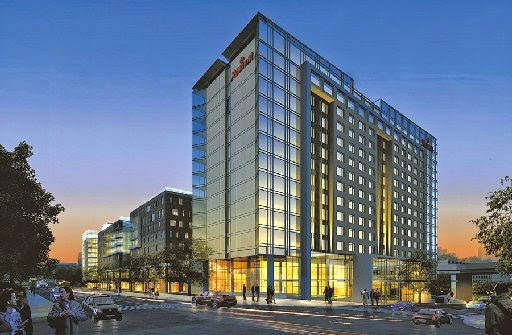
An architectural rendering of building planned for construction in midtown Omaha depicts a building that will is likely be a hazard to migratory birds.

Blue Cross Blue Shield of Nebraska, an insurance company, just announced plans to construct a $98 million, 10-story office building within the mixed-use development at Aksarben village, at the corner of Aksarben Drive and Shirley streets.

Architectural drawing of the Blue Cross Centre, showing the extensive use of glass and landscaping features.

The building design depicts several features that will likely result in bird strikes and subsequent deaths and injuries to numbers of migratory birds, including typical hazards as known from buildings where hundreds of deadly bird strikes have occurred in downtown Omaha.

1) An exterior that is basically comprised of reflective glass, from the ground floor to the top of the structure. The glass is completely within the air-zone of many of the birds that flit through skies of the Missouri River valley flyway.
2) Landscaping that includes trees in close proximity to the structure. The architect's drawing shows trees on three sides. The trees are placed in close proximity to the building, with enough distance that a bird flying from the foliage towards a distracting reflection of greenery, would strike with sufficient force to cause a devastating impact.
3) Close proximity to natural features that are pathways used by migratory birds, including being placed adjacent to the Little Papillion creek, and on a site within a mile southwest of Elmwood Park. More than 180 different species of birds have been recorded as occurring within the park environs, and during their migration, they would be attracted to plant landscaping to the south as they move along during the days when foraging.
4) A widest expanse for the structure for the north and south sides, presenting a maximum exposure to birds moving through in the same directions during migrations.

The rendering also does not indicate any features that are known to help minimize bird-strikes, according to accepted practices for known, bird-friendly designs. This could include use of special types of glass, obstructions to break up reflections, or, perhaps, screening to make reflective surfaces opaque.

Based on the limited details shown in the rendering for the Blue Cross Centre, it is not apparent if there will be plants within the building's lobby or entry area, which would just be an additional threat.

The building may be built with "green" consideration - in this case apparently efficient use of energy - but it is obviously not designed to be bird safe.

In early December, just a few blocks away, there was a community meeting to consider how Omaha can promote a green environment. One topic suggested that should be addressed as a natural resources component was to design buildings that are not hazardous to birds. Two areas being addressed and where bird-friendly design should be considered, were Natural Environment, and Building Construction. Although this effort is just underway, there is no reason buildings can't be built that pose on threat to an integral part of the local environment, the birds.

Architectural drawing of the design for a building that is nearing completion at Arsarben Village, showing the extensive use of glass and landscaping features.

This facet has readily been ignored, based on the building design prepared by Leo A. Daly Co., the same company which was the architect and engineering firm for the Carl T. Curtis National Park Service, Midwest Regional Headquarters along the Omaha Riverfront, where bird strikes are known to occur.

Mortality would be expected to occur when construction is completed in 2011. Visitors to the tall place could expect to see bird carcasses - rugularly during periodic migration season - on the walkway, or over on the grass, although building maintenance personnel will certainly find the feathered remains quickly and throw a once beautiful and vibrant bit of life into the trash for disposal.

The Askarben Village development already has other buildings in its UNO South Campus area and village section with reflective glass exteriors. Once landscaping features - various trees especially - are planted and get some growth, they will attract birds to the area.

These buildings will be hazardous to wild birds migrating through in spring and autumn. And, breeding birds such as mourning doves, common grackles and American robin that would be present in the summer could also get added to the probable tally of fatalities.