 By James Ed. Ducey
On 7 November as the freighter Cosco Busan entered San Francisco Bay, it side-swiped a bridge support, and tore a gash in the ship’s hull, releasing 58,000 gallons of bunker oil.
Seabirds being effected by the oil in the ocean waters include Surf Scoters and Eared Grebes, according to Point Reyes Bird Observatory Conservation Science information. “Other species include Common Murres, Western Grebes, Clark's Grebes, Horned Grebes, Ruddy Ducks, Greater Scaup, Lesser Scaup, White-winged Scoters and Common Loons.”
The Oil Spill Response Team of PRBO is responsible for the logging and processing of birds at the San Francisco Bay Oiled Wildlife Care and Education Center in Cordelia, CA. Numerous people were calling to volunteer, the group reported, but the greatest need was for people to report the occurrence of oiled birds.
Oiled species currently reported by the Farallon Islands National Wildlife Refuge include “Rhinoceros Auklets, Western Grebes, Brown Pelicans, and Western Gulls. Most of the oiled birds have been identified as Common Murres.”
The Farallones National Marine Sanctuary is recognized as one of the most
extraordinary and environmentally sensitive areas in the world.
As of Monday evening, Golden Gate Audubon reported handling “186 oiled birds, including 9 captured and 17 dead,” according to a report on the California birds forum. “Many of the birds remain frustratingly out of reach. The numbers of birds captured or recovered is expected to increase during the coming week.
As of Tuesday, November 13th, this number had increased to 715 live birds are in care at The San Francisco Bay Oiled Wildlife Care Center.
Several birders associated with the Audubon group conducted a survey of oiled birds. They “covered the south shore of Alameda, including Elsie Romer Wildlife Sanctuary, Crown Memorial State Beach, Crab Cove Marine Reserve, and parts of the former Alameda Naval Air Station. About 60 oiled birds were found, “including a few covered nearly from head to toe.”
Pictures documenting the impacted birds, show Western Grebes, Greater Scaup, Surf Scoter, Sanderling, Eared Grebe, Surf Scoter, Ring-billed Gull, and Black-bellied Plover. Other species noted to have been oiled were Horned Grebes, Great Blue Heron, Dunlin, Least Sandpiper, Mew Gull and Western Gulls, they reported on the California Bird forum.
Golden Gate Audubon listed several locales where volunteers were needed to locate and identify impacted birds.
On Saturday, November 10, Audubon's Richardson Bay Sanctuary, the largest marine reserve in San Francisco Bay, was struck by oil from the spill.
Northern Black Sea
The spill fuel oil into the Black Sea at Kerch Strait, occurred on 11 November.
Government estimates provided a figure of 1300 tons, with an estimate of 2000 tons from Greenpeace.
Pictures show birds coated in a black sludge.
“Birds seeking shelter on the shore near the center of the storm were covered in a treacly mixture of oil and seaweed — the first evidence of what one Russian official called an “environmental disaster,” according to news in the St. Petersburg Times.

Krasnodar Territory Governor Alexander Tkachev called the spill an ecological disaster at a meeting of the territorial administration, and as reported by Kommersant. “Thirty thousand birds have died and the number of fish that have died is uncountable,” he noted. “The damage is so great that it is hard to assess. It can be called an ecological catastrophe.” Tkachev said that one of the main causes of the catastrophe in the Strait of Kerch was the foolhardiness of the ships' captains, who “received storm warnings and hoped for luck.”
The main species reported to be affected are Great Cormorant, Common Coot, Great Crested Grebe and Black-necked Grebe,” according to a report by Birdlife International.
The group reports that “two Important Bird Areas (IBAs), nearby, the Kiziltash Bay and the Tamanski and Dinskiy Bays, are under threat. Both are designated primarily for migrating and wintering birds. Up to 50,000 migratory waterfowl and other birds are known to use the sites during migration. Among these are Dalmatian Pelican, listed as vulnerable on the IUCN Red List and White-tailed Eagle.”
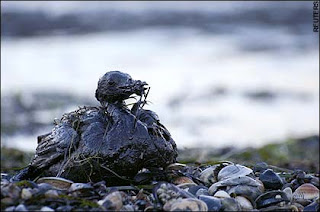
On Tuesday, “scores of birds, weighed down by thick coatings of the fuel oil, hopped weakly along the shore or sat helplessly in the sand,” according to an Associated Press report in the Moscow Times. “Workers with pitchforks and shovels collected vast clumps of oil mixed with sand, seaweed and dead birds. “
The area is a bird migration route for those species flying from Siberia to the Black Sea, and this is the peak migration for red-throated and black-throated Siberian divers, according to the Irish Times.
So far, 50km of Russian coastline is affected by the oil spills.
There has been $3 million allocated to the cleanup process, according to a Russian news report.
Oil affects birds in several ways, according to the Point Reyes Bird Observatory:
- “hypothermia- oil interferes with the waterproofing of their feathers and allows their skin to come in contact with the cold water.
- “starvation-birds beach themselves to avoid the hypothermia and therefore can't feed at sea; or they preen (clean their feathers) so obsessively to try to remove the oil that they do not spend any time feeding.
- “toxicity from ingesting oil during preening."
Web Sites
- International Bird Rescue Research Center
- Kill the Spill

