27 April 2009

Art Contest for Schools Promotes Interest in Bird-Study

Drawing of a Chestnut Collared Longspur by Halle Magid, a 7th grader at Kiewit Middle School, winner of the Best of Show for Middle School. Note the form which includes details of its natural history. Pictures taken by Bill Massengill and courtesy of the Audubon Society of Omaha.

An annual contest to promote student interest in the study of birds and natural history was another great success this year at Omaha. Students in grades kindergarten through 12th from a number of private, public, religious, and home schools in the greater Omaha metro area were involved in the contest sponsored by The Audubon Society of Omaha (ASO), a local chapter of the National Audubon Society.

"This contest is a wonderful way to have students study and draw different birds, and promotes education in their natural history," said Jackie Scholar, the ASO coordinator. "Some of the art teachers feel that birds are good subjects to teach children to be observant and to use detail in drawing and painting. Some of the art teachers also happen to like birds and are passing on their love of birds to their students.

"It was wonderful to see the children’s drawing of birds," Scholar said. "They were so beautiful. Each year we receive a very diverse selection of birds portrayed. This year we had bald eagles, goldfinches, blue jays, peregrine falcons, various hawks, red-headed  and red-bellied woodpeckers, great horned and barn owls, a piping plover, sandhill cranes, a yellow-rumped warbler, a chestnut-collared longspur, a pacific gull, a wood duck, an Eskimo curlew, a white throated sparrow, bluebirds, and red winged blackbirds."

"The students were judged for realism or graphic design or for cartooning," Scholar said. "The media used varied and included watercolor, pastels, oil paints, and colored pencils and collages.

All of the 110 entries were on display at the awards ceremony held April 4 at the gym of Bellevue University. This event "was a wonderful experience for the children and their families," Scholar said. "There was so much excitement."

Winners of the Best of Show awards were:

Emmie Doerr  - Elementary
Halle Magid – Middle School
Ashley L. Hauger – High School

Bald Eagle by Tiffany Griffith, Omaha North High Magnet School; Excellence-Realism award winner.

Oil painting of White-throated Sparrow by Ashley L. Hauger, a senior at Omaha North High Magnet School; winner of the category, Best of Show for High School.

There were several award categories for the grade levels: excellence-realism, merit-realism, merit-graphic design and excellence-cartoon.

Kristie Horn, holding an Eastern Screech-Owl, a special guest at the art contest awards event.

Prizes, according to Scholar, included stuffed birds which emit an accurate bird call when squeezed for the youngsters, books on birds, bird guides at various levels for children in the 10 – 15 yr old groups and for older students, art pads, color pencils, and gift certificates to a local art store. Each entrant receives a certificate of recognition.

Judges this year were local artists or birders, Don Wesling, Jo Bartikowski, Susan Anderson and Clark Pflanz. Loraine Blankenau, Nellie Falzgraf, and Jerry Toll of ASO, also volunteered to help with the contest.

Kristie Horn of Raptor Recovery Nebraska was present at the awards ceremony with an Eastern Screech-Owl that had been raised from a chick, and has not adapted to the wild so it cannot be released.

The Fontenelle Forest Association Gift shop was a source for many of the awards given to the students.

A complete list of winners is presented at the Audubon Society of Omaha website.

"It is a lot of work to have this contest," Scholar said, "but it is very rewarding." She has been coordinating the event for about four years. The number of entries varies each year, with 185 entries in 2008, about 44 in 2007, and 193 in earlier years.

Scholar "absolutely" looks forward to the event again in 2010.

25 April 2009

Wood Duck Depicted by Winner of Junior Duck Stamp Contest

Wood Duck, by Lily Spang.

An acrylic painting of a Wood Duck by Lily Spang, age 16, of Toledo, Ohio is the winner of the 2009-2010 Federal Junior Duck Stamp competition. Her entry was chosen on April 22 by a panel of judges at contest held at the Smithsonian National Postal Museum in Washington, D.C.

"The Junior Duck Stamp Program is a unique effort that for 17 years has celebrated and taught conservation through the arts," said Rowan Gould, Acting Director for the U.S Fish and Wildlife Service. "One of the fathers of the modern conservation movement, Aldo Leopold, put great emphasis on the value of nature observation to conservation efforts. All Junior Duck Stamp artists carry on this tradition by translating their observations to canvas."

Second place was awarded to Abraham Hunter, 15, of Vienna, Illinois with his acrylic painting of a hen and drake common goldeneyes.

Rebekah Nastav, age 18, of Amoret, Missouri took third place for a rendition of two male common goldeneyes.

Entrants were required to depict a "live portrayal of a native North American duck, swan or goose," according to contest entry rules. Entries had been received from each of the 50 states, and the District of Columbia.

"The National Postal Museum is always honored to be associated with the Junior Duck Stamp Program, as this is a vital tool in conserving our nation’s natural resources," said Allen Kane, Director of the National Postal Museum, which was the host for this years’ contest.

The Federal Junior Duck Stamp is sold for $5 by the U.S. Fish and Wildlife Service to stamp collectors, conservationists, and the general public, according to project sponsors. It will be released on June 26, 2009. Proceeds are used to support environmental education efforts and awards for contest winners.

"The first-place winner receives a $5,000 award. The second place winner receives $3,000, the third-place winner receives $2,000, and Conservation Message winner receives $500."

Christopher Voekel, age 8, from New Mexico, was the 2009 Federal Junior Duck Stamp Conservation Message Contest winner, with his entry: "Our environment, our responsibility, our future."


Each of the entries in the 2009 Junior Duck Stamp can be viewed at a web gallery.

24 April 2009

Wetland Funding Supports Continued Conservation of Dakota Habitats

A small portion of a 17,000 acre privately owned grassland/wetland complex in the project area that is perpetually protected via voluntary U.S. Fish and Wildlife Service grassland and wetland conservation easements. In addition, much of the grassland is enrolled in a managed grazing plan with the F.W.S. Partners for Fish and Program. F.W.S. photos.

As spring arrives on the northern plains, a myriad of waterbirds are winging their way northward to places they have considered home for endless generations.

A recent grant from the North American Wetlands Conservation Act - administered by the U.S. Fish and Wildlife Service (FWS) is helping to further conservation efforts to protect these unique and essential wildlife habitats.

The grant provides $770,109 for Phase III of the South Dakota Threatened Habitats project, with $1,635,531 in matching funds. Another $27,167,000 from the Migratory Bird Hunting and Conservation Stamp Act (a.k.a. Duck Stamp) will be used to "voluntarily purchase perpetual wetland and grassland conservation easements from landowners in the project area," according to the information about the project.

"South Dakota continually leads the Nation in sodbusting of native prairie to tillage monoculture," said Kurt Forman, working for the U.S. Fish and Wildlife Service as the South Dakota coordinator for the Partners for Fish and Wildlife. "We average 40,000-50,000 acres of native prairie/wetland complexes that are lost each year and this trend continues to expand westward into formerly secure bird production landscapes."

This project represents "a continued effort to accelerate protection of this threatened landscape by working primarily with family ranchers to ensure a sustainable future," according to the NAWCA grant summary. "A diverse coalition will address these challenges by developing an integrated suite of wetland and grassland conservation tools that will be implemented to benefit the grasslands needed by ranchers and the vital landscape attributes needed by prairie birds.

"Contributions will be combined with grant funds to restore 3,453 grassland acres and 250 wetland acres; enhance 42,062 grassland acres, establish 34 acres of wetlands and enhance and 2,685 wetland acres. This habitat will not only provide direct benefits to more than 7,000 breeding duck pairs, but will also afford critical conservation benefits to the full spectrum of native bird communities dependent on the rapidly disappearing native grasslands and wetlands of central South Dakota. For example, match and grant tracts will provide direct breeding habitat benefits to an estimated 475 willet pairs, 440 marbled godwit pairs, 210 pairs of Sprague’s pipits, 135 pairs of Baird’s sparrows and 2,730 pairs of chestnut-collared longspurs."

Twenty-eight prairie potholes (61 wetland acres) restored on private land by the U.S. F.W.S. Partners for Fish and Wildlife Program in the project area and perpetually protected via a voluntary U.S. F.W.S. wetland conservation easement.

"The project area encompasses the Missouri Coteau of South Dakota and adjacent grassland/wetland landscapes," Forman said. "Specific conservation practices including wetland restorations, native prairie restorations, rotational grazing systems and wetland enhancements will be focused towards the remaining grassland/wetland complexes of the project area.

"Projects are selected by F.W.S. wildlife biologists with an emphasis on those sites that directly contribute to the grassland and wetland habitat objectives defined in the 2005 Prairie Pothole Joint Venture implementation plan." An emphasis is placed on projects best addressing the joint venture habitat objectives and based on the seven evaluation factors:

  • Risk of habitat conversion to tillage and/or drainage
  • Grassland tract size
  • Native prairie condition
  • Breeding pair density
  • Proximity to other protected tracts
  • Cost-benefit relative to other tracts
  • Association with existing or potential conservation easements

The goals of this project are being achieved only through a coopertative effort, Forman noted. "First and foremost I would like to acknowledge the landowners who are willing to share our vision of a sustainable grassland/wetland landscape in the project area.

Other cooperators for this particular grant are the Beadle Conservation District; Hyde County Conservation District: South Dakota Department of Game, Fish and Parks; Ducks Unlimited; 200 private landowners, and the Heartland Chapter of Pheasants Forever.

The remaining grassland ranchers in the project area are often under intense economic and social pressure to convert their prairie to the plow.

An example of sodbusting of native prairie in the project area.

Forman was an author, along with Kenneth F. Higgins and David E. Naugle, of a 2002 article in the scientific journal "Waterbirds" on how changing land use in the northern Great Plains is impacting the conservation of waterbirds: "Wetland and grassland habitats of the northern Great Plains are a primary breeding ground for waterbirds in North America. Native mixed grass prairies that were historically used for cattle grazing have met with changing social and economic pressures that put the remaining 40% of this resource at high risk of tillage."

The paper described:

1) the current state of waning rural societies,
2) characterized impacts of land use change on waterbird habitats, and
3) discussed conservation actions to benefit waterbirds.

"Recent population statistics indicate that a record number of farmers facing low commodity prices are selling their farms and moving to urban centers for employment. Other farmers are shifting from diversified agriculture to monoculture grain farming to take advantage of farm programs that provide incentives to bring marginal land into production. Additional data indicate that concurrent changes in crop types have decreased quality of farmland wildlife habitat while bigger and faster farm equipment and genetically modified crops continue to make farming marginal land less risky. Legislators and administrators should be advised that waterbird habitat loss continues to expand westward. The last chance to sustain the unique grassland-wetland character of the northern Great Plains is to accelerate grassland conservation with short- and long-term stewardship programs and incentives to family ranchers. This philosophy is of vital importance because it also protects wetland habitats that otherwise are vulnerable to drainage when native prairie is converted to cropland. Lastly, and perhaps most importantly, this would conserve our prairie heritage for future generations while preserving the private property rights of landowners."

Grassland protection priority areas for grassland birds. Images courtesy of the F.W.S.

Upland accessibility by breeding duck pairs in the Prairie Pothole region.

"Over 80,000 acres of native prairie have been converted to cropland in the project area from 2005-2007," according to information provided with the grant. "The degree of native prairie loss found within the South Dakota Threatened Habitats project area is by far the highest documented within the PPJV. These large-scale landuse changes continue to rapidly expand westward into formerly secure grassland tracts and prairie wetland complexes that represent much of the last of the best remaining breeding bird habitat."

"Many biologists believe that the ultimate landscape character of the project area will be defined within the next decade," Forman said. "Recent landscape modeling indicates that current rates of habitat loss will lead to a 50% reduction in native prairie acreage in some of the most biologically rich portions of the Threatened Habitats project area within just 34 years. Each acre of grassland and prairie loss will have direct negative impacts on the full spectrum of bird assemblages in the project area."

This project initially started in 2001. Currently, there are over 1.5 million acres of such conservation easements in the PPJV portion of eastern South Dakota.

22 April 2009

Status of Hybrid Birds Currently Unknown for Niobrara River Valley

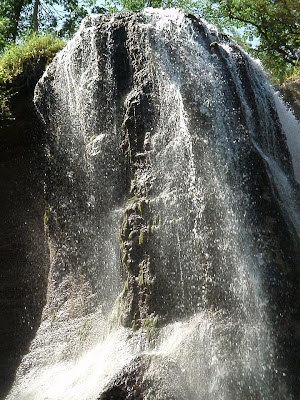
[Smith Falls, Niobrara River Valley, June 2007]

A primary aspect given for attributing unique values to the Niobrara River Valley is its recognition as a biological crossroads. This designation relies on a readily apparent setting of different habitats with distinct associations of flora and fauna.

One of the special features mentioned, is a zone of hybridization for a few species of birds with typically eastern and western distributions, according to statements given by conservation groups and a government website.

The Niobrara Valley is recognized as a biological crossroads for wildlife by the Nebraska Wildlife Federation.

The National Audubon Society and its local chapter in Nebraska, designates the Niobrara Valley Preserve - along the river north of Johnstown - as an Important Birding Area, giving pertinent details in an ornithological summary. Therein is mentioned that eastern and western forms of birds breed, referring to Baltimore and Bullock's orioles, lazuli and indigo buntings, rose-breasted and black-headed grosbeaks. The summary also says that eastern and western wood-pewee's may also hybridize.

The Northern Prairie Lands Trusts website, on their projects and news page, says the Valentine, NE area and the Middle Niobrara River Valley Biologically Unique Landscape, is a zone of hybridization for some eastern and western bird species.

The National Park Service, on a webpage with details about the Niobrara Scenic River, which it administers, says: "Hybridization of eastern and western associated species, such as indigo and lazuli buntings, yellow-shafted and red-shafted flickers, and Baltimore and Bullock's orioles are vivid testament of the biological uniqueness of the Scenic River."

Studies of Hybrid Birds

Hybrid birds have been documented as occurring along the profound Niobrara River, as well as elsewhere south to north on the central Plains, based upon several seminal studies that provide particulars for several species.

An initiative to study hybrid birds on the Great Plains started in 1955, according to comments made by Charles G. Sibley and David A. West in their 1959 article on towhees.

The following species have been known to hybridize, according to just a few articles issued by preeminent ornithological scientific journals. There are some additional details on post A.D. 2000 sightings, that should be presented with this consideration, as the more recent co-mingling of species should be considered along with the original studies.

Baltimore Oriole x Bullock's Oriole

The hybrid zone in the central Great Plains - spanning a 150-200 mile distance west to east - includes the Niobrara Valley from northwest of Bassett to at least the western edge of Cherry county, in the article by Charles G. Sibley and Lester L. Short, Jr., published in 1964, and based on more than 600 specimens collected between 1954-1957. William Youngworth noted both species at Fort Niobrara NWR in the mid-1950s. When Short published an additional paper on the distribution of species on the Great Plains in 1961, the Niobrara River in Keya Paha county was given as a region where these two species both occurred. He also included the eastern portion of the river valley in Cherry County.

Spotted Towhee x Eastern Towhee

Most of the 487 specimens evaluated for this research were obtained in Nebraska during 1954-1957. Determination of the "hybrid index" was based on a "back-spotting index" with Spencer, Bassett and Valentine particular places where birds were collected for eventual, focused evaluation. The article in the Auk, extensively discussed biotic features of the Niobrara Valley. The Spotted Towhee "influence" was said to extend eastward into Holt County.

There are no known modern records available for the Niobrara Valley that indicate where both species occur at the same locality, lending credence to species' hybrids.

Rose-breasted Grosbeak x Black-headed Grosbeak

"Pure" species - based mostly upon measurements of certain characteristics of specimens - were noted in Cherry county and eastward, with hybrids found in the Holt County area. This evaluation was conducted from 1955-1957 by researchers from Cornell University in Nebraska, as well as South Dakota and Colorado. A figure showing the zone where hybrid occurs, extends the furthest west along the Niobrara Valley, to a short distance west of Bassett.

William Youngworth noted both of these grosbeaks at Fort Niobrara in his 1955 paper on birds of the Quicourt valley, which is a historic name given for the Niobrara river. Lester Short, Jr., then noted them along the Niobrara River in Keya Paha county during the same year. Recent records indicate both species occur in the immediate vicinity of Valentine, at Anderson Bridge WMA in central cherry County, as well at private property along the river south of Nenzel.

Indigo Bunting x Lazuli Bunting

The first instance of hybrids of these two species was recorded by Youngworth, when a oddly marked male specimen was collected June 1, 1932. He noted in his brief article published in the Wilson Bulletin: "The country bordering the swift Niobrara River in Cherry County is ideal for the summer home of grosbeaks and buntings." These two bunting species were also noted as occurring at Fort Niobrara NWR in 1955, by the same bird watcher.

The article by Sibley and Short published in 1959, was based upon specimens gathered during 1955-1957. Valentine was recognized as an especially interesting locale, with "pure" species present at the same immediate locale as hybrids. Hybrids were also noted at Spencer.

The most recent study along the Niobrara, looked at these two species near Niobrara, at Valentine and south of Chadron in 1969. Hybridization was noted in the vicinity of Chadron.

"We conclude: (1) That massive convergence and introgression is not occurring among the Passerina of the Great Plains. (2) The species appear to have diverged to a point where hybrids and mixed-pairs are at a selective disadvantage. (3) The two forms minimize ecological competition through the maintenance of non-overlapping, interspecific territories. - Stephen T. Emlen, James D. Rising and William T. Thompson

There have been additional, recent concurrence elsewhere in the region, particularly the sandhills, but not in the confines of the river valley.

Northern Flicker - red-shafted and yellow-shafted forms

Extensive details have been published on hybridization among flickers with different colored featheration, but as the two forms - red-shafted and yellow-shafted - are now designated as a single species, the mingling of these two species which have different color characteristics is not a valid example of hybridization. This occurrence does, nonetheless, have its own distinctive biotic interest.

Two sets of additional species have also been included as having the potential for there being hybrids in the river valley.

Western Wood Pewee x Eastern Wood Pewee

There is no actual scientific research paper that gives any particulars that these two species actually hybridize in northern Nebraska. Particular locales where both have been known to occur is shown in recent years by sightings in Cherry County at Anderson Bridge WMA, the Valentine City Park, and at Fort Niobrara NWR.

Scarlet Tanager x Western Tanager

There is no known documentation of inter-specific breeding along the Niobrara by these two species. They both occurred at Fort Niobrara NWR in 1955, according to Youngworth in his article on species of the vicinity.

Current Status

It has been more than five decades — with the exception of the buntings where it has been forty years — since rigorous and authoritative studies have been done on the occurrence and distribution of hybrid birds in the central Niobrara River Valley. There is no known source of current information on this topic, based upon contacts with several regional authorities familiar with bird occurrence in the Nebraska, as well as several detailed searches of web-based information.

There are no modern details on bird hybrids and also a readily apparent lack of knowledge of the current distribution of most birds - not only species which may hybridize - along the Niobrara River in northern Nebraska. Despite surveys such as the detailed work during the early 1980s for the Niobrara Valley Preserve, when The Nature Conservancy bought thousands of acres of what had been ranch property.

Numerous site surveys personally conducted in the valley since 2000 have been done at many privately and publicly owned land tracts to get some sense of bird species occurrence, and here are a few other occasional reports from easily accessible places such as Fort Niobrara NWR. None of this information discusses to any useful extent the essential aspects of bird hybridization, although it does indicate to a somewhat limited extent, places where species do co-mingle.

Considering the intense attention being given to how climate change is supposedly influencing the temporal occurrence of many bird species across their normal range of distribution, a "crossroads" where several species mix is a prime region where there should be a detailed evaluation of any flux or alteration in range. Yet, there is no known research being done to evaluate any changes in the occurrence and distribution of avian species along the unique Niobrara River valley where an obvious, and well known mix of several types of plant communities create a floristic crossroads of habitat.

There is a obvious and prevalent need for detailed research to determine the status of bird species recognized for their hybridization in the Niobrara Valley. Also essential is an understanding of the current occurrence and distribution of other species of concern which are changing due to changes in conditions suitable for their existence.

Until there is actual, record-based and current gathering of information on the inter-mingling of different bird species along the Niobrara River, there is no basis to define the valley as a biological crossroads for hybrid birds. Any statement about this needs to be given in the context as being based upon historical conditions. Any claims otherwise are erroneous.

19 April 2009

Whoopers at Playa Wetland Amidst Potential Turbine Project

The occurrence of two adult Whooping Cranes has been confirmed at a playa wetland on the West Table, west of Broken Bow.

The two birds were first noted by Maxine and Ed Wehling on Saturday April 18, at 7:30 p.m. The wetland is just a few miles northwest of the Wehling place.

"Saturday night, Ed and I were driving the wetland playas, looking," Maxine Wehling wrote in an email. "We found the strikingly beautiful whoopers about 7:30 p.m., in the large wetland," that was featured in a story recently written about the central table playas.

"We were thrilled to see them. They are breath-taking to look upon. The one was slightly larger in the body, and would flap it's wings, pick it's feet off the ground, and do a dance of sorts!"

"We called the whooper watch number to report the siting, followed by calls to Ben Wheeler."

The presence of the cranes was confirmed by Wheeler on Sunday morning.

The wetland where the whoopers were noted is the third wetland pictured in the article, and located about five miles northwest of the Wehling place.

Winter Wren Season Wanes at River City Environs

With the fine warmth of spring spreading across the land, another season of cold times for the Winter Wren (Troglodytes troglodytes) will soon be gone again at Omaha, and at another really close place, just to the south along the Missouri River valley.

Graffiti at Shadow Lake, beneath the west end of the pedestrian bridge, indicating the midcity, urban character of the neighborhood park. April 2009. This picture has been digitally changed to enhance the view of the writing and graphics on the wall.

With some particular interest, it has been a season of midtown constants for this vibrant, warm and little wonder of feathered life.

On the first day of October, back in mid-autumn of 2008, there was an online report by someone about their having observed this little bit of avian splendor amongst the natural environs of Fontenelle Forest, east of Bellevue. With this information some particular attention was given to looking at another suitable locale. So, on the same day, there were three noted at the splendid Shadow Lake, Elmwood Park, a primary haven for this bird hereabouts in midtown River City, though 99.99% of the human residents are clueless about this important detail of the valuable natural habitats that are essential places where wild birds can survive.

Due to a particular interest in this species, going back five seasons when it was first seen - personally - in October 2003 at Tobacco Island, down south of Plattsmouth, watching endeavors with an intent to see such a bit of a exuberant bit of feathers, continued forthwith. Times with hearty hikes were needed in autumn 2004, to note that this wren could be found in the Niobrara Valley. This included hikes amongst the valley, down big slopes, and with attention to weather forecasts to avoid being stranded outside during severe winter conditions, for safety sake.

In January 2006, a particular attempt provided some more records of the species along the Northern border of Nebraska, once again at places associated with the Niobrara River. Some of this information was contributed to the Great Backyard Bird Count, though the places submitted were in no way anything similar to a backyard, but given in the manner that the effort to submit information required.

The current winter season, based upon observations influenced by personal mobility and only from an urban place, there were the regular windy gales. Winter snows blew and hefty flakes accumulated, with a result of some few minimal conditions due to by warm waters clear of ice due to subterranean spring-flows. There were frigid temperatures, again and again, where only multiple layers of clothing provided warmth for a watcher, while all the while, a little mite of a bird kept on with its daily routine of moving amongst a winter's place. Their existence was only occasionally noted by an intrepid watcher willing to deal with outdoor conditions.

These were the numbers counted on different dates during the season. Its possible that when they were noted at one of the "irregular" locales — i.e., Happy Hollow Creek and the South Grove — at a time early or late in the season, they may have been migratory wrens temporarily present.

Date

Happy Hollow Creek

Elmwood Park Ravine

Shadow Lake, Elmwood Park

Botany Spring, Wood Creek

Wood Creek, Elmwood Park

South Grove, Wood Creek

2008

10/01

-

1

2

-

-

-

11/09

-

-

-

-

5

-

11/16

-

-

2

-

-

-

11/27

1

-

-

-

-

-

12/11

-

1

2

-

1

-

12/31

-

-

1

1

-

-

2009

01/09

-

-

1

-

-

-

01/15

-

-

1

-

-

-

01/19

-

1

-

1

1

-

02/04

-

-

1

1

-

-

02/06

-

-

1

1

1

-

02/14

-

-

1

-

-

-

03/01

-

1

1

-

-

-

03/13

-

-

1

-

-

-

03/20

-

-

-

-

1

-

03/29

-

-

1

1

-

-

04/03

-

-

1

-

1

-

04/07

1

-

-

-

1

-

04/08

-

-

1

1

-

-

04/14

-

1

1

-

-

1

04/17

-

-

1

-

-

-

04/19

-

-

1

-

-

-

This diminutive wren endured where it found a suitable spot with deadfalls and permanent open water, irregardless of any human influences.

Wetland south of Shadow Lake, where the Winter Wren could often be seen foraging. The view is from on the pedestrian bridge. Picture taken 19 April 2009.

The stability of such an especial perspective of one species of the local avifauna, elicits many wonders to appreciate from some particular place, and unknowingly to other locales where this tiny bird obviously knows what situations are suitable for its survival.

As the 2008-2009 winter season wanes, the Winter Wren has been noted a bunch of times in the bird forum for Nebraska. Notations for the Fontenelle Forest environs, have been conveyed again and again this April. It was a particular focus that when another someone gave this species amongst their list of species of spring, to then go forth again to see a relative at Elmwood Park environs.

The final date of local occurrence is pending for the Winter Wren, as the time of their departure will be known only to their own avian memory. It will not be based on a some particular clock devised by a large primate.

Fly onward little wrens. Thanks for the memories of another winter season!

16 April 2009

Ecotourism in South Africa is Helping to Conserve Birds in South Africa

Ecotourism and education on the value of wild birds is helping to ensure conservation of species and their habitats in South Africa.

"Ecotourism ensures the conservation of birds and their ecosystems because this 'product' is of importance to the owners and visitors to the lodge," said David Letsoalo, based at Kurisa Moya Nature Lodge, and recognized as the top local bird guide in South Africa and an expert on nature in the the Magoebaskloof area. He has been taking birders on outings since 2002 when he was accredited by Birdlife South Africa.

"A large percentage of the visitors to Kurisa Moya Nature Lodge and the Magoebaskloof area are coming specifically because of David's expertise in forest birding," said Lisa Martus, the owner and manager of the lodge. "David recently guided Stephen Moss, of the British Broadcasting Company, who is an experienced birder familiar with birds all over the world. They spent the whole day out birding in the area covering the Woodbush Forest, the Mamabolo Grasslands, Greatheads Mountains and Protea Belt, as well as Kurisa Moya's forst. By the end of the day, Stephen had seen 26 new species. The Guerney's Sugarbird was a big challenge because there were many males calling from inside the Protea bush, but they would not show themselves. Eventually, one came out and displayed itself beautifully. Stephen was thrilled.

"Another highlight recently has been a client who saw the first Flufftail in their life by seeing the Buff-spotted Flufftail on Woodbush Forest Drive. David heard the Flufftail calling, and followed the call for 20 minutes, eventually crawling on their knees in the undergrowth. When they finally saw it, it was a wonderful moment.

"The local people are very interested in David's bird tours and have got used to seeing him in strange places with South African or international guests. He has a Short-clawed Lark site near a village in a cattle-grazing field and young guys have actually stopped poaching the Queleas since he has been coming around more often (they used to use birdlime to catch them on a bush and then would roast them on a stick like small kebabs). David goes to the Turfloop Dam where local cattle herders know him and will update him on what they have seen lately. At Woodbush, Debengeni, Haenertsburg Grasslands etc, he is well known and residents will phone him if they have seen an interesting or unusual bird. David is also a Node Co-ordinator for the Grasslands Node of Eco-schools so he has influenced a lot of those kids to have a more positive attitude towards conservation. One of the kids wrote an essay about how David is his hero and when he grows up he wants to be a bird guide. David gave him a bird book and an old pair of binoculars to encourage him.

"The local black (village) community are mostly bemused but interested in David's profession (can't believe it makes him enough money to be a real job) and the local white community are extremely supportive of David and all want him on their committees (Friends of the Haenertsburg Grassland, Haenertsburg Rotary, Woodbush to Wolkberg, etc.) because he bridges the gap between the various communities as well as the needs of people vs environmental needs."

In their particular region, the "Cape Parrots are growing in numbers, and we also monitor raptors whose numbers have been picking up," Letsoalo said. "Education is an important aspect to improve conditions for birds and educating people about these values. "This is an ongoing process but it has shown results with some of our local learners who do not hunt birds like they used to," Letsoalo said.

The Magoebaskloof region and Limpopo Province areas have some stellar examples of places and habitats of essential importance to native species of birds. Examples, from the Limpopo Province website, include:

Woodbush Forest Drive: "This 14km dirt road is the best forest birding area in the Limpopo Province, if not the country. The Woodbush Forest Drive winds through pristine afro-montane forests, down into semi-deciduous mixed forest along the lower sections of the drive. Cape Parrot, Black-fronted Bush-Shrike, Orange Ground-Thrush, Brown Scrub-Robin, Grey Cuckooshrike, Yellow-streaked Greenbul and Blue-mantled Crested Flycatcher are a few of the specials.
Kudu´s Valley: "This spectacular 30 km dirt road between Houtbosdorp and Mooketsi drops down over the escarpment through bushveld and riverine habitats. On this road, you will descend about 1000 metres and be treated to fantastic views and an interesting mix of habitats. Verreaux´s, Crowned and Long-crested Eagle, Lanner Falcon as well as Horus, Alpine and African Black Swift are often sighted soaring over the valley. The exposed granite boulders along the slopes near the top of the route are home to Cape Rock Thrush, Mocking Cliff Chat, Olive Bush-Shrike, Shelley´s Francolin and Lazy Cisticola. The lower end of the pass has more riverine and tropical bushveld areas in which African Green-Pigeon, Orange-breasted Bush-Shrike, Purple-crested Turaco, Green-capped Eremomela and White-throated Robin-Chat can be seen. Look out for African Fish Eagle, Great Egret, Purple Heron and various Indigobird and Firefinch species around the farm dams near the bottom of the route."
Debengeni Falls: "This spectacular waterfall is a popular picnic site for locals and visitors to the area. Grey Wagtail has been sighted here for three years running. … it is worth visiting to see Mountain Wagtail and other forest birds. After turning off onto the dirt road from the R71, keep a lookout for Red-backed Mannikin, African Firefinch and Swee Waxbill on the road verges. After about 100m you will cross a small stream; when the water levels are high this is a good spot for Half-collared Kingfisher and African Finfoot. On the 3km drive up to the falls look out for Tambourine and Lemon Dove, Chorister Robin-Chat, Blue-mantled Crested-Flycatcher and Yellow-streaked Greenbul in the forests. Rufous-chested Sparrowhawk breed in the vacinity of the falls and Buff-spotted Flufftail and Scaly-throated Honeyguide."
Louis Changuion Trail and Haenertsburg Grasslands: "The whole trail is 10 km but various parts of the trail can be done separately depending on your fitness level and enthusiasm. It is one of the most easily-accessible pieces of this rare habitat left in the area. Blue Swallows have been encountered here in the past. On the grasslands, you may find Wailing-, Lazy-, Croaking-, Cloud- and Wing-snapping Cisticola. Grass Owl, White-necked Raven, Red-winged Francolin, Yellow Bishop, Dark-capped Yellow and Broad-tailed Warbler and Drakensberg Prinia are present as well as Cape Grassbird. Jackal Buzzard, and Long-crested Eagle often hunt over the grassland. The patches of forest have Olive Bush-Shrike, African Olive-Pigeon, Cape Batis, Terrestrial Brownbul, Yellow-streaked Greenbul and Forest Canary."
Polokwane Bird Sanctuary: "This small bird sanctuary, which consists of three large settling dams, dense reed beds and tall riverine thickets, is always likely to produce an interesting birding surprise or two. Apart from a good variety of waterfowl, waders and rallids, the Acacia thickets are very productive and accommodate Grey-backed Camaroptera, Yellow-bellied Greenbul, Terrestrial Brownbul, Yellow-breasted Apalis and many warbler species in the summer months, including Common Whitethroat and Olive-tree, Icterine, Garden, Great Reed Warblers and Eurasian Marsh Warblers. The shallow ponds on the eastern side of the sanctuary attract a host of waders during middle to late summer with Wood, Marsh, Common and Curlew Sandpipers, Greenshank, Ruff and Little Stint. Look out for skulking African Snipe and Greater Painted-Snipe. There is a resident pair of African Fish Eagle along with other interesting raptors, including Ovambo Sparrowhawk, African Goshawk and African Harrier-Hawk."
Turfloop Dam: "It has now also become a protected breeding site for the northernmost population of the Southern Bald Ibis. It falls within the Mamabolo vegetation-type and has many granite outcrops, which are typical of this habitat. The dam itself has fluctuating water levels depending on local rainfall, so conditions change seasonally. The dam has an open shoreline with some exposed mudflats in the summer, a feature which has probably led to this site having provided the odd vagrant wader, with species such as Ruddy Turnstone, Pectoral, Green, Broad-billed and Terek Sandpiper having been seen here over the past few years. The more common wetland species to be found here include Great-crested Grebe, Southern Pochard, Fulvous Duck, Hottentot Teal, Cape Shoveler, and Maccoa Duck. The rocky island in the dam is an important breeding site for White-breasted Cormorant, Black-headed Heron, African Sacred Ibis, Yellow-billed Egret and African Spoonbill."

With the recognition of unique places, there has been further understanding of distinct birds which occur, and a recognition of where to visit to see the more unusual species.

This increased attention to local birdlife, has also brought about an increasing awareness of challenges.

"We still have problems due to lack of resources in policing these vast areas in order to prevent bird poaching and bird trade in valuable species but there are some very active conservationists in the area," Letsoalo said. "The plantations, building developments and mines threaten indigenous forests and grasslands. The Haenertsburg Grassland is threatened and it used to host Blue Swallows, Broad-tailed Warblers and other species."

"I hope that more of our Important Bird Areas can get listed as national heritage sites because they are still under threat of being destroyed," Letsoalo said. "I also hope to spend more time with the youth to explain the value of our environment and how people can make a living out of it without harming it."

"Kurisa Moya Nature Lodge http://www.krm.co.za/ provides several options to enjoy the endemic bird species of the region, as well as other natural wonders, in a setting of comfort and appreciation for the local communities," said Martus.