Showing posts with label spring wildbirds. Show all posts

12 May 2018

Wildbirds Observed During April at Valentine, NE

It was another distinctive month for wildbirds present Valentine, Cherry County. A big difference for sightings during April this year was providing bird seed. It was so much easier to make observations when birds would be readily visible outside the window or front door rather than going in search of them. Feed is refreshed daily, and on occasion, more than once per day since the birds can be very hungry.
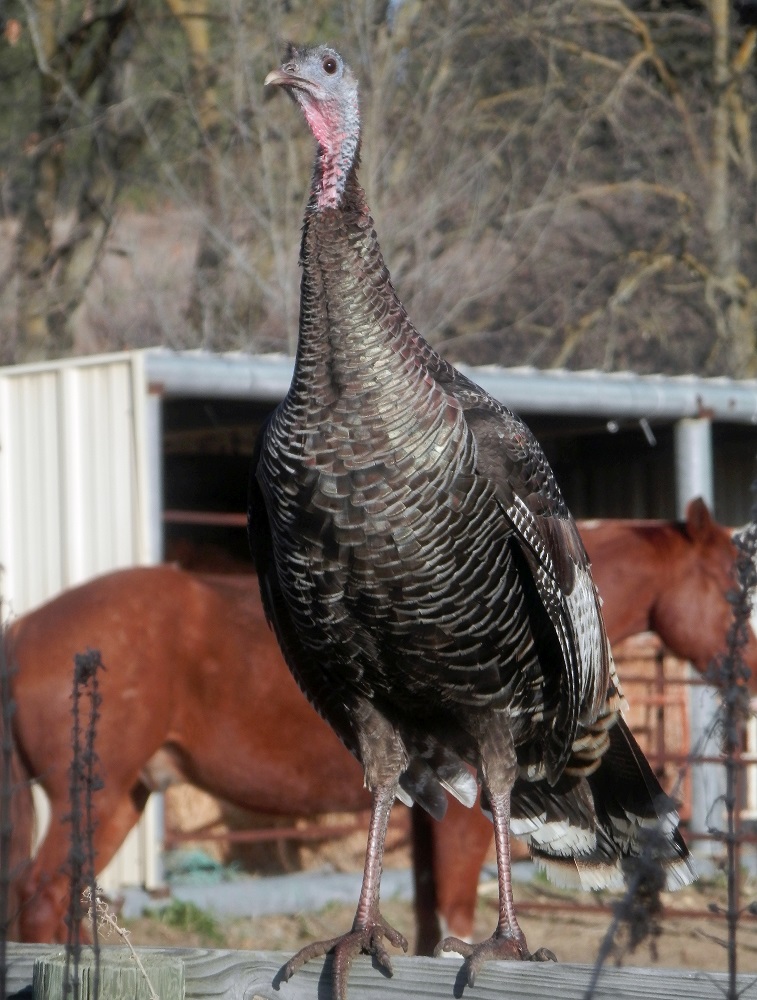

This gobbler was looking in the north window in early morning on April 28th, perhaps to see if the resident birder was awake and going to spread more seed for his companion turkeys to eat?

The Valentine Mill Pond was a prime place for waterfowl, and the results are indicative. Two species added to the overall regional tally from this locale were the Redhead and Bufflehead. There were also larger numbers of the Northern Shoveler (with the best occurrence in a flock number along Minnechaduza Creek, west of Highway 83), Gadwall and Green-winged Teal. Several sorts of waterfowl appreciate the cattail wetlands at the west end of the Valentine Mill Pond, just east of Highway 83. The Snow Goose was a flyover species, as was the Sandhill Crane, with the majority observed on a single day when numerous flocks were moving northward, with kettling in a spectacular manner over the pine-covered hills at the north edge of the city. Wild Turkey liked the free food and once the flock arrived as winter waned, they were daily visitors. There was no need for a morning alarm from a clock because the gobbling sufficed to indicate it was early morning.

Missed during the month was the Franklin's Gull. This was a result of timing, as probably my time of being observant outdoors was not when flocks of this species would have been transient over the locality, as they have been seen in the past. Swallows seemed to have a later arrival this year as none were observed locally during the month.

There were lots of usual observations for the many species that regularly occur or are residential. Chimney Swift were once again present along Main Street at the end of the month. Downy Woodpecker and Hairy Woodpecker are certainly local residents but they are not seen on a regular basis. Once the Icterids arrived, they became very common at the bird seed, with many Red-winged Blackbird, Brown-headed Cowbird and Common Grackle present daily. Their antics can be quite amusing, especially when a couple of the black birds have a dispute over a bit of seed when a few feet away there are seeds where there are no birds foraging. A male Northern Cardinal may not occur at the bird seed buffet on a daily basis, but it also needs to be noted that it may not be heard singing every day at the tree line just to the west. At least the small sparrows had a chance to feed, and often more seed was not put out to facilitate their feeding.

Harris's Sparrow were more prominent this spring. Larger numbers of the Dark-eyed Junco and American Tree Sparrow were counted because they were daily visitors to the bird seed buffet. The Lazuli Bunting was also seen when it foraged for a time one day at this food source.

The blizzard of April 13-14 had an impact on birds. One nest box occupied by Eastern Bluebird ended up filled to the entrance and then a crust of snow. The nest had contained five eggs, according to a local observer. The birds had not returned by the end of the month. South of the Heart City, carcasses of Sandhill Crane were found. There were other reports of crane mortality locally but the wildlife officer in the area of the Fish and Wildlife Service did not respond to an inquiry for further details.

White-tailed Deer were also appreciative of having a supplemental food source, often feeding four feet outside the front door. The corn-oats-barley mix disappeared in entirety each time they arrived, as seven deer are great consumers.

What is becoming more useful is that after years of ongoing observations, particulars associated with dates of occurrence can be compared, which is why all calendar dates are converted to julian date, since calendar dates cannot be grouped in a common fashion by a database query. A standard Julian date indication is the same for a particular date in any year.

Wildbirds Observed During April at Valentine
Proper Name     Julian Date > 93 94 100 101 102 103 105 107 109 110 112 120
Canada Goose -- 12 7 80 9 -- 22 -- -- 12 14 8
Wood Duck -- -- 3 -- -- 2 4 -- -- -- 10 --
Blue-winged Teal -- -- -- -- -- -- 8 -- -- 4 16 --
Northern Shoveler -- -- -- 15 -- -- 2 -- -- -- 32 --
Gadwall -- -- -- -- 8 -- 4 -- -- 7 4 --
American Wigeon -- -- -- -- -- -- -- -- -- 2 3 --
Mallard -- 2 2 -- 6 -- -- -- -- 2 2 --
Green-winged Teal -- -- 18 -- -- -- 6 -- -- 1 -- --
Redhead -- -- -- -- -- -- 1 -- -- 1 -- --
Lesser Scaup -- -- -- 10 -- -- -- -- -- -- -- --
Bufflehead -- 3 -- -- -- -- -- -- -- -- -- --
Wild Turkey 1 8 7 18 9 1 2 11 12 -- 6 13
Great Blue Heron -- 1 1 -- -- -- -- 1 -- 1 -- 2
Double-crested Cormorant -- -- -- -- -- -- -- -- -- 2 -- --
Turkey Vulture 1 17 28 75 -- -- -- 13 -- 12 8 4
Sharp-shinned Hawk -- -- 1 -- -- 1 1 1 -- -- -- --
Bald Eagle -- -- -- 1 1 -- -- -- -- -- -- --
Red-tailed Hawk -- -- 1 -- -- -- 1 -- -- -- -- --
American Coot -- -- -- -- -- -- -- -- -- -- 1 --
Sandhill Crane -- -- -- -- -- -- -- 1400 65 -- -- --
Killdeer 1 1 1 -- -- -- 1 1 -- -- 1 2
Greater Yellowlegs -- -- 1 -- -- -- 1 -- -- -- -- --
American Herring Gull -- -- 4 -- -- -- -- -- -- -- -- --
Rock Dove -- -- -- -- 16 -- -- -- -- -- -- 1
Eurasian Collared Dove 4 -- 7 -- 3 8 5 -- -- 4 7 9
Mourning Dove 2 2 4 3 3 3 5 -- -- 4 3 3
Great Horned Owl -- -- -- -- -- -- -- 1 -- -- -- --
Chimney Swift -- -- -- -- -- -- -- -- -- -- -- 3
Belted Kingfisher 1 1 1 -- 1 -- 1 1 -- -- 1 --
Red-bellied Woodpecker -- -- -- -- -- -- -- -- -- -- 1 --
Downy Woodpecker 1 -- 1 -- -- 1 3 -- -- -- 1 1
Hairy Woodpecker -- -- -- -- -- -- 1 -- -- -- -- --
Northern Flicker -- 1 1 -- -- 1 1 -- -- 1 2 --
Eastern Phoebe -- -- 1 -- -- -- -- -- 1 -- 4 --
Blue Jay -- -- -- -- 1 -- 1 -- -- -- -- 3
American Crow -- 2 2 -- 2 -- 2 -- -- 1 2 --
Black-capped Chickadee 3 -- 3 -- -- -- 3 -- -- -- 6 3
Red-breasted Nuthatch 1 -- 1 -- 1 -- 1 -- -- -- 1 --
White-breasted Nuthatch 2 -- 4 -- -- -- 2 -- -- -- 3 2
Brown Thrasher -- -- -- -- -- -- -- -- -- -- -- 1
Common Starling -- -- 3 -- 6 -- -- -- -- -- -- 3
Eastern Bluebird -- 2 4 -- -- 2 3 -- -- -- 3 --
American Robin -- 5 23 -- 10 125 4 -- -- 6 44 21
House Sparrow -- -- 18 -- -- -- 27 -- -- -- 15 10
House Finch 2 -- 6 -- 4 -- 6 -- -- -- 13 8
American Goldfinch -- -- 3 -- -- -- 20 -- -- -- 5 11
Pine Siskin -- -- -- -- -- 1 -- -- -- -- -- --
Yellow-headed Blackbird -- -- -- -- -- 2 2 -- -- -- -- --
Western Meadowlark -- -- -- -- 2 -- -- -- -- -- 1 --
Red-winged Blackbird 45 -- 55 -- 35 85 100 -- -- 105 36 --
Brown-headed Cowbird -- -- -- -- -- -- -- -- -- -- 8 8
Common Grackle 2 -- 30 -- -- 4 29 -- -- -- 36 12
Song Sparrow -- -- 1 -- -- -- 1 -- -- 2 2 --
Lincoln's Sparrow -- -- -- -- -- -- 2 -- -- -- 2 --
Harris's Sparrow 1 -- -- -- 1 1 2 -- -- -- 1 --
Dark-eyed Junco 12 14 22 10 6 50 40 27 -- 8 8 --
Savannah Sparrow 1 -- -- -- -- -- -- -- -- 4 -- --
American Tree Sparrow 24 11 16 6 4 7 3 4 4 2 2 --
Chipping Sparrow -- -- -- -- -- -- -- -- -- -- 3 10
Field Sparrow -- -- -- -- -- -- -- -- -- 1 -- --
Clay-colored Sparrow -- -- -- -- -- -- -- -- -- -- -- 1
Northern Cardinal -- -- 2 -- -- 2 2 -- -- -- 3 1
Lazuli Bunting -- -- -- -- -- -- -- -- -- -- -- 1

The 63 species seen in 2018 compares to 63 in 2017 and 53 during the month in 2016. The overall tally for the three years combined is 80 species. Eventual plans are to prepare individual accounts for the more than 120 species observed in the immediate vicinity of Valentine and that would include detailed comparisons of numbers and dates of occurrence.

16 June 2017

May Birds in the Vicinity of Valentine

During the month, there were some new arrivals while others had already raised their brood of the year. There was nothing prominently exciting, nor where any rare birds seen. It was a basic month of wild bird occurrence in north-central Nebraska.

The usual bird haunts in the Valentine vicinity were traversed via bicycling or walking as appropriate during the month, especially along the trails at the city park.

Other special places within the sandhills were bird surveys were done have already been reported on. Especially notable was the May 6 visit to Anderson Bridge WMA because this was the first place in Cherry county visited to do some bird watching, 35 years ago! During the month, 876 distinct observations became database records.

This is a tally of the 74 species noted during the month, for seven different dates. These are some comments:

  • Canada Goose: the large number noted at the end of the month were multiple family groups at the Valentine Fish Hatchery and there were more goslings than adults
  • Trumpeter Swan: the two birds were present for just a short time at the Valentine Mill Pond
  • Wood Duck: present at the Mill Pond and on Minnechaduza Creek at the city park; there was no indication of ongoing occurrence during the breeding season
  • Wild Turkey: the birds seen can be very intermittent at the shack, though a hen is most regularly seen foraging in the morning, and calling as if she was asking to be joined by others
  • Great Blue Heron: there were at least two occupied nests in the trees just eastward of the city park; their forage grounds include the mill pond, fish hatchery ponds and other unknown places in the vicinity
  • Turkey Vulture: it is not known where they might be nesting but the sighting of this species is a regular and appreciated occurrence every day as they soar so gracefully above the landscape; there is a regular nagging, personal question: What is available here that they can eat?
  • Eurasian Collared Dove: noted daily
  • Mourning Dove: also noted daily
  • Common Nighthawk: finally seen at the end of the month
  • Chimney Swift: seen as they appreciated buggy skies and the few chimneys - especially in downtown - where they can find a safe haven to raise a family as they have for so many years as they strive to survive
  • Belted Kingfisher: heard less than might be expected though this species certainly continues to be extant
  • Eastern Phoebe: two bridges across Minnechaduza creek at the city park are appreciated as they provide a safe place for a pair to build a nest where their young will thrive
  • House Wren: breeding birds find their preferred nest place and this does not always mean some artificial nest box of which there are many at the western extent of Lake Shore Drive
  • Purple Martin: there are multiple nest structures in the Heart City but not all of them get used; House Sparrows are unwanted squatters; a surprise of the month was finding a few birds nesting at an apartment on the north side of Cherry Hills Estate
  • Grey Catbird and Brown Thrasher: residents, and as a birder, their is a certain appreciation of when the catbird expresses its "mew" song rather than sounding off like a thrasher, which thankfully makes no effort to sound like a catbird
  • Audubon's Warbler: very vocal along my daily route but gone after the first week of the month
  • Spotted Towhee: heard very regularly and none of their compatriot seen
  • Rose-breasted Grosbeak: very well seen along Lake Shore Drive and west end of the city park
  • Northern Cardinal: have only a limited occurrence since they are irregularly heard and less often seen; perhaps more searching is needed?

Based upon regular and ongoing occurrence of wildbirds, it is obvious why Valentine is a birding hotspot as designated on ebird. There are the "big" places like Fort Niobrara NWR and Valentine NWR while also importantly are the many public spaces so close to Valentine where anyone wanting to take the time to enjoy nature's life can venture forth, whenever, and have a personal time of outdoor discovery.

Proper Name        Julian date > 122 127 136 139 146 150 151
Canada Goose 6 8 17 - - - - 12 47
Trumpeter Swan - - - - 2 - - - - - - - -
Wood Duck 3 - - 1 - - - - - - - -
Mallard - - - - 3 - - - - - - - -
Wild Turkey 1 - - - - 3 - - 2 - -
Great Blue Heron 1 - - - - 3 - - - - 2
American White Pelican - - - - - - 2 - - - - - -
Turkey Vulture 5 4 19 - - 1 2 4
Bald Eagle - - - - - - 1 - - - - - -
Red-tailed Hawk - - - - - - 1 - - - - - -
Killdeer - - 1 1 - - - - - - 1
Spotted Sandpiper - - - - 1 1 - - - - 1
Rock Dove - - - - 10 - - - - - - - -
Eurasian Collared Dove 5 - - 12 - - - - 6 - -
Mourning Dove 3 - - 4 - - 2 2 1
Great Horned Owl 2 - - - - - - - - - - 1
Common Nighthawk - - - - - - - - - - - - 1
Chimney Swift - - 9 9 28 1 4 - -
Belted Kingfisher - - - - - - - - 1 - - 1
Red-headed Woodpecker - - - - 1 1 1 - - 1
Red-bellied Woodpecker - - - - 1 - - - - - - - -
Downy Woodpecker - - - - 1 - - 1 1 - -
Hairy Woodpecker 1 - - - - - - - - - - - -
Northern Flicker 2 - - 1 - - 1 2 - -
American Kestrel - - - - - - - - 1 - - - -
Eastern Phoebe - - - - 3 - - 3 - - - -
Eastern Wood-Pewee - - - - 1 1 1 1 - -
Western Kingbird - - 1 6 - - - - - - - -
Eastern Kingbird - - - - 4 - - - - 2 1
Great Crested Flycatcher - - - - 3 - - 4 2 2
Bell's Vireo - - - - - - - - 1 1 - -
Warbling Vireo - - - - 1 - - - - 1 2
Red-eyed Vireo - - - - 1 - - 2 - - - -
Blue Jay 2 - - 3 - - 1 1 - -
American Crow 2 - - 1 - - 1 1 - -
Cedar Waxwing - - - - 13 - - 1 2 - -
Black-capped Chickadee 3 2 2 - - - - - - - -
Purple Martin - - 2 12 - - - - - - 6
Northern Rough-winged Swallow 3 1 3 - - 2 7 1
Barn Swallow - - - - 2 1 - - - - 1
American Cliff Swallow - - - - - - 1 - - - - - -
House Wren 5 7 13 - - 4 3 2
White-breasted Nuthatch 2 - - 3 - - 1 - - 1
Grey Catbird - - - - 5 3 4 1 - -
Brown Thrasher 1 1 1 1 - - 1 - -
Common Starling 2 - - 5 6 7 - - 2
Eastern Bluebird 3 2 - - - - 7 - - 1
American Robin 12 - - 62 - - 8 10 6
House Sparrow - - 2 20 - - - - - - 2
House Finch 6 4 12 - - - - 7 2
American Goldfinch 5 12 15 - - 4 2 2
Ovenbird - - - - - - - - - - - - 1
Common Yellowthroat - - - - 4 - - 2 3 2
American Redstart - - - - 6 - - 7 - - - -
American Yellow Warbler - - 2 4 - - 2 3 2
Audubon's Warbler 2 2 - - - - - - - - - -
Yellow-headed Blackbird 1 - - - - - - - - - - - -
Western Meadowlark - - - - 1 - - - - - - 2
Baltimore Oriole - - - - 4 - - - - - - - -
Orchard Oriole - - - - 4 - - - - 2 3
Red-winged Blackbird 30 - - 15 - - - - - - 5
Brown-headed Cowbird 6 - - 2 21 5 4 4
Common Grackle 26 - - 49 - - 7 4 - -
Song Sparrow 1 - - - - - - - - - - - -
Lincoln's Sparrow 2 - - - - - - - - - - - -
White-crowned Sparrow 7 1 - - - - - - - - - -
Chipping Sparrow 9 14 19 - - - - - - 1
Field Sparrow 1 - - 1 - - 2 1 - -
Clay-colored Sparrow - - - - 4 - - - - - - - -
Lark Sparrow - - - - 8 - - - - 2 2
Spotted Towhee 2 - - 3 3 1 2 1
Rose-breasted Grosbeak - - - - 1 1 - - - - - -
Northern Cardinal 1 - - 1 - - - - - - - -
Indigo Bunting - - - - - - - - - - 1 - -

The tally for May 2016 was 87 species, but this is likely the result of records being available for 17 different dates. Overall, there have been 92 species denoted for this month in the past two years, with particulars available for 22 different julian dates for these periods of time.

Every day was an opportunity to listen and learn while riding my bicycle around.

On the day when this report was written, my left shoe had a blowout and a sock is exposed to the regular cycling breezes. So my usual pair of shoes are now worthless and another option needs to be determined. It is not acceptable to have pathetic, old and broken shoes worn in public and the shoelaces have absolutely no quality. The henceforth direction that needs to be taken in now unknown. There will be something done! I'd like to have a treasured pair of cowboy boots? My former pair disappeared so many years ago, so a new version is needed. There was one night in the Mother Lake country when a pair of spurs were worn. It was such an experience for a man of eastern Nebraska was present because of the wildbirds.

With a pair of exposed boots while wearing fine denim, a nice country sort of hat and scarf, opposing anyone wanting to threaten the values of the sand hills will get a new reality! Besides words, of which is a personal skill, my hope, and which has been a personal endeavor for years, some time there will be a cowboy respect. My garb would be appropriate and distinctive, as looking for a final picture that can be sent to my mom in her final months. I am not a cowboy, but the cowboy way is part of every day of my life.

08 May 2017

Niobrara Valley Wildlife Area Bird Resurvey After 35 Years

There was distinctly unique outing for birding purposes on May 6th, 2017 to Anderson Bridge WMA along the Niobrara River in northern Cherry county, Nebraska. Along with gracious driver and compatriot Gordon Warrick, we left Valentine on a fine spring, Saturday morning. Temperatures were warm and wind was slight at the start. It was the start of a fine spring day in the Great American Sandhillstm.

We watched and I kept track of the wildbirds seen. Notable along the county road near the Stoner Ranch southwest of Kilgore — and just east of a proposed wind turbine facility — was an especially fine view of a Swainson’s Hawk sitting on a fence post, adjusting its wings as it basked in the morning sun. Suddenly a Loggerhead Shrike darted away to the south. This bit of roadside watching resulted in the only observation of these two species for the day. An Upland Sandpiper was also expressive here, and was an initial indication of their return for another breeding season. The environmental assessment done for the project two years ago did not record the occurrence of the Swainson's Hawk. Of course the developers consultant company did not do any May surveys.


Proper Name May 1982 May 2017
Canada Goose - - 7
Wood Duck 6 6
Mallard 2 2
Blue-winged Teal 2 9
Wild Turkey 0 - -
Common Pheasant 0 - -
Great Blue Heron 0 - -
Turkey Vulture 6 4
Swainson's Hawk 0 - -
Red-tailed Hawk 0 1
Killdeer 0 - -
Upland Sandpiper 0 1
Mourning Dove 0 10
Great Horned Owl 1 - -
Belted Kingfisher 1 1
Red-headed Woodpecker 0 - -
Downy Woodpecker 0 1
Northern Flicker 0 1
American Kestrel 0 1
Least Flycatcher - - 1
Western Kingbird 0 - -
Blue Jay 0 1
American Crow 0 1
Cedar Waxwing - - 8
Black-capped Chickadee 0 8
Horned Lark 0 - -
Northern Rough-winged Swallow 0 2
Barn Swallow 0 - -
House Wren 0 8
White-breasted Nuthatch - - 1
Eastern Bluebird - - 2
American Robin 0 1
American Goldfinch 0 3
Common Yellowthroat 0 1
Western Meadowlark 0 1
Red-winged Blackbird 0 25
Brown-headed Cowbird 0 6
Common Grackle 0 5
Song Sparrow - - 1
Lincoln's Sparrow - - 1
White-crowned Sparrow - - 1
Chipping Sparrow 0 6
Vesper Sparrow 0 - -
Lark Sparrow - - 2
Spotted Towhee 0 10
Northern Cardinal 0 2

Upon reaching the valley of the running water river, the actual reason for this outing became prevalent. There was a greater focus on bird activity and my pencil was active on paper to denote the details. After crossing the running water river of grandeur, a true sense of time descended.

It was May 6, 1982 when my first visit was made to this itty-bitty wildlife area of just 137 acres. Though small in size it is a special place with a very nice variety of wildbird species and is very conducive to an overnight stay. There are no facilities, but only weaky people rely on this aspect when they might decide on where to enjoy the natural glories of the Niobrara river.

Because this is a public place was the reason for my first visit to birding in the greater sandhills’ region on a May day in 1982. A bird list was kept but it did not include the number present for all of the 37 bird species observed. Being a complete rookie interloper from an urban setting, this visit was an initial experience to just get used to being at a wild place in newly realized Cherry county ... so different from natural areas visited while birding in eastern Nebraska — some specific outings associated with research work needed to get a M.A. degree in biology while considering the effects of habitat managment on nongame birds occurring with surveys at Twin Oaks WMA in Johnson County, NE. Further visits did ensue to this wildlife area in July with a few notes kept at Merritt Reservoir, and the eventually many more sandhill spaces of known recognition. There were many multitude of visits that occurred on a continual basis, involving a drive to multiple hundreds of distinct localities – some many times – and recording species seen and numbers present. If it was not an actual count there was a number designated based upon the presence of a species, the extent of available habitat and then approximation. It is completely impossible to count the number of Red-winged Blackbird at a expansive place like Carson Lake, but there is certainly more than one of this species present when a number is given. Wherever possible, an accurate count has been indicated.

A Legacy Visit

The 2017 visit on May 6th was not by two “spring-chickens” so we appreciated the recently established mown grass route to stroll westward from the parking area and then on the north side of the marsh.

In past years, I’d have hiked up the southern slope of the valley, after pausing to look at the cabin remains, then making sure to look and listen to anything birdly on the upland, continuing by walking a distance westward to stop and linger and relax at one of the best overlooks in this section of the river valley and then plunged down the steep hillside to the bottoms for further exploration.

Having a mown trail along nearly level land now makes it much simpler and certainly easier on aching bones. In past years it would have be a difficult to hike some areas of the WMA due to the too thick growth of invasive cedar. Habitat management has cut away invasive trees. Prescribed burns have been planned for the area.

Two notable site features noted during our outing were 1) a seemingly newly prominent cellar of stone walls and an eastern doorway very near what had been a bubbling spring until the water feature was inundated by pondworks of the beaver, and 2) cowpies and tracks of cattle though there did not seem to be any signs of any grazing, so were these transitory livestock?

Species Considerations

During our outing in May 2017, there were 35 different species observed. This visit was a bit early in the season – though it was a day with high temperatures in the lower 80s – as there are bird lists for dates later during May when there is a much greater bird occurrence, including even the Barn Swallow as well as the appreciated and so vividly expressive Yellow-breasted Chat.

The number of species noted on our outing in 2017 compare to 37 species in 1982 on the same calendar date.

Combining the results to these two particular visits, the tally is 46 species. Spotted Towhee and House Wren were prevalent among the woods. It was great to see what was apparently a male “wing-fluttering” Black-capped Chickadee courting another chickadee, which was probably a female. The prominent bird’s call was different and its behavior that neither of us two bird men had ever seen, despite conglomerate decades of experience. This instance conveys that there is always something to learn by listening, looking and giving attention to the regular activities of wildbirds. That exhibitory chickadee was incessant in its purpose; the other chickadee went nowhere as the pair — obviously a couple — kept together in their arboreal realm.

Nearby was a cavity in a box elder where a pair of these special little birds had seemingly found a home for the season. Remember that their vocalizations include a sound which can be easily interpreted as sounding everything like “hello” as they go about daily actions for their survival. If you hear this sound, it means that you will have a great day because these little songsters have conveyed a message that needs to be appreciated?

Overall for this locality there are more than 800 records available for 120 species of wildbirds, when all available records are considered.

Any visit to this area is not about deriving records to comparison. It is most essentially a hike where birds and natural land features can be seen and appreciated. Especially noted at the state wildlife management area was the “huge” beaver lodge in the marsh. The construct was been present for a multitude of years. The residents have extended their water environs from what was present decades ago. The earthworks constructed bit-by-bit by the “little paws” of busy beavers. They have done a supreme job as they are natural experts of engineering, knowing just where to place mud to constrict a flow and improve their swimmable living space. They are also know how to take advantage of landscape features, including stabilizing tree trunks to facilitate their efforts. Also enjoyed here — for a brief interlude — were the pushing activities of two small burying bettle pushing along — with their hind legs — a bigger bit of dung, as they went about their big task of the day.

Hand Exclosure, McKelvie Division

While in the area, we also visited the Hand Exclosure at the McKelvie Division of the Nebraska National Forest. It is just a relatively short distance of travel eastward down the country road. Along the way we noted the occurrence of additional species. They were prairie birds vibrant along the way and near the Forest Service property. We added a Western Kingbird sitting on a fence wire, more than one Grasshopper Sparrow, a Vesper Sparrow in the same space and some Horned Lark of the prairie. It seemed that each time that a bird on the fenceline became an intent of our attention, it flew away. Thankfully some of the "little brown jobs" stayed stationary long enough. A special appreciation for one of us birders was enjoying a so subtle tinge of the feather coloration of a Grasshopper Sparrow.

At the forest service property, there were as least two strident Red-breasted Nuthatch in the pines south of the Niobrara valley wetland space on Forest Service property. On the river bottom was a vivid flycather of the willow sort. A Red Crossbill flew above the place while we took a few minutes to rest at a place where the most vibrant plant colors of this day of the season were bits of moss clinging to a tree trunk on the edge of the marsh. A Common Yellowthroat was heard as it sang among the thick vegetation.

There were some distinct colors of bryophytes on a fallen snag on the southside of the marsh. It was too mucky to traverse the few feet to get a photo. Any temptation to collect a specimen was thwarted by the thought that it might be too much of an imposition on someone else to rely on an identification, and it would take years of study from some unknown guide to identification to learn the minutia essential to personally indicate a proper name.

After the trek at this public property with too many cedars and steep terrain, and trying to adhere to property boundaries, we had to go back up the valley slope. We found what may have been a former roadway, so hiking was easier as it had become quite warm. Upon getting back to our ride, there was a working water pump right there and our thirst was slaked and surely eased the rigor and dry mouth from strenuous hiking. We also realized the best route to take if any future visit occurs?

It was a great day of birding amidst distinct Niobrara valley spaces. It was done because two Valentine guys cared enough to travel, look and listen, and partake in natural learning.


Nesting cavity of Black-capped Chickadee pair at Anderson Bridge WMA. A pair of these birds were seen here.

A pair of flat black-colored burying beetles were seen moving this dung. The activity was noted by Mr. Warrick as we hiked along; he was looking at the ground and saw movement so we stopped and took a closer look. The beetles were working hard at their existential chore.

During our time outdoors we pondered what this place might have looked like in 1857 when the Warren expedition travelled traversed the north side of the valley. Certainly the mighty men of local tribes could have readily ridden their horses along through the valley. Any such effort would now be impossible due to a relatively uncontrolled invasion of red cedar trees as well as an increased growth of pine trees.

This chatter has meant further personal ponderings. What will this habitat space look like in a century? Will it be such a distinct natural haven that a permit will be required for anyone wanting to make any sort of visit? Will access be available only to certain approved scientists on governmentally approved tasks and restrained to only approved activities? What is the preferred condition of the wild land habitat, and what metrics will be used to determine its condition? There is no steady-state in nature and so any indicated situation has to be dynamic and changing on a timeline of several years! Will regulations constrict the use of controlled burns, as they degrade air quality and might be a hazard to country resident with breathing problems? This could effectively shut down the use of this well-used habitat management tool during 2017. What funds will be available to ensure that federal and state areas get the attention they require?

Certainly modern-era tools will have to be used. Will aerial drones be used to present a view of wildlands to the public because a place is off-limits in order to conserve the resource and avoid any possible degradation? Will these drones have acoustical recognition equipment able to listen to ambient sounds to a degree that bird songs can be recognized? It would be relatively easy to have a grid established where the drone would hover for a specified amount of time, record sounds and then move to the next spot of a survey area, as breeding residents obviously sing to express their claim to a territory. Imagery could be kept to denote species that may not be heard. A technician in a laboratory would then do an analysis to determine specifics. There would be software available to analyze bird songs and readily identify the species. Technology could readily and regularly denote a consistent record of wildbird occurrence, and this could be done much easier than what is now being done by human efforts. Significantly, there would be aberrant visitors allowed because the natural havens would have to be strictly protected from any environmental degradation because so much of the natural world has been ruined.

Conservation of wild lands is a long-term proposition, and it needs to be done in a manner to ensure long-term survial of their myriad features. The question is, how is this essential goal being addressed now by the state and federal agencies which own public lands? What are the next generations realities for the Sand Hills and Cherry County?

Too many questions without answers!

Bird Species Present at Valentine in April, 2017

A great variety wild birds were noted in the vicinity of Valentine during the month of April. There were several sightings that were new additions to the area birdlist. There were also some occurences many days prior to a date previously indicated.

Notable during the spring days were:

  • Waterfowl: eight species represented with a flock of Green-winged Teal a special treat
  • Wild Turkey were less prevalent than a year ago. Usually only a single female would occur and any larger numbers were earlier in the month
  • the gathering of Turkey Vulture above the hills north of Valentine and a bit more north of Minnechaduza creek was at a locality designated as Water Tanks Tract, the moniker being obvious to anyone that might visit the publicly-owned landspace. The Heart City area is also a significant place for autumnal gatherings of this species. Currently, these seasonal residents have been noted to roost overnight atop a wireless tower on the east side of downtown Main street. The count is one of the largest for the number of birds recorded. What they eat is beyond my comprehension! Valentine City Park is the locality where in September, 2001 there were 100 of these birds reported, and which is the largest number that have ever been reported for the Sandhills and Niobrara Valley regions. Significant is that there are places for birds to roost because snag trees are prevalent due to past-times wildfires. Also, the hills along the Minnechaduza Creek valley provide ground conditions conducive to aerial soaring.
  • a Western Osprey spent some time feeding on fish in Minnechaduza Creek and at the Valentine Mill Pond
  • the Franklin's Gull were a single, transitory group in flight
  • Shorebird: the sighting of a Greater Yellowlegs was a new addition to the species list for the area
  • the local pair of Great Horned Owl were especially vocal during the month; the adults have not yet directly responded to call imitations artificially issued in the night hours
  • Songbirds: two new additions to the area birdlist were the Say's Phoebe and Blue-grey Gnatcatcher. A male Common Yellowthroat was also a significant sighting, as it occurred many days prior to the initial sighting in 2016. A surprising brief sighting was the flock of Red Crossbill that landed for moments on a powerline outside the shack window, but lingered long enough to be able to get them into view with a spotting scope and make an identification, with the crossed bills a prominent feature quickly seen. They were likely moving from one copse of pines to another. The ongoing presence of White-throated Sparrow was especially appreciated. When it comes to towhees, they are more often heard than seen, however, whenever they are directly observed they have been the Spotted Towhee, either skulking amidst a shrub or perched atop a bit of woody vegetation. Following an initial occurrence of Chipping Sparrow, they then occurred in numbers so obviously heard singing among the coniferous trees. As to Cedar Waxwing, they seem to be a permanent resident, though not regularly seen. They are obvious when seen, but not obviously seen. Their habits would be worthy of detailed consideration.

Breeding activity was especially notable by Eastern Bluebird and American Robin carrying nesting material. Obviously Eurasian Collared Dove and Common Grackle were active in getting a nest site established. House Wren appreciate the many nest boxes along Lake Shore Drive, and once again one of these little wrens is taking advantage of a hole in a shed pipe to once again nest.

This is the tally of the 63 species noted on the ten days for which observations were recorded; with 221 individual records from 2017 and 152 from 2016. Often, more records are kept because of a significant sighting.

Weather conditions during the April days were very variable with warm-day interludes and then windy days with cold temperatures. The extent of snow was minimal, with no really significant snow falls.

Proper Name             Julian date > 96 97 99 100 109 112 115 116 117 118
Canada Goose 16 - - 7 19 11 30 - - - - - - 8
Wood Duck 2 - - 2 4 2 2 3 - - - - - -
Gadwall - - - - 8 - - - - - - - - - - - - - -
American Wigeon - - - - - - - - - - 2 - - - - - - - -
Mallard - - 2 - - - - - - - - - - - - - - 1
Blue-winged Teal - - - - 4 6 - - 12 - - - - - - - -
Northern Shoveler - - - - - - 1 - - - - - - - - - - - -
Green-winged Teal 6 - - - - 9 - - - - - - - - - - - -
Wild Turkey - - 6 - - 2 6 1 - - 1 2 - -
Great Blue Heron - - 1 - - 1 - - 1 - - - - 3 1
Double-crested Cormorant - - - - 24 - - - - - - - - - - - - - -
Turkey Vulture 12 80 3 - - 12 - - 9 - - - - - -
Western Osprey - - - - - - - - - - 1 - - 1 1 - -
Sharp-shinned Hawk - - - - - - - - - - - - - - 1 - - - -
Bald Eagle - - 1 - - - - - - - - - - - - - - - -
Red-tailed Hawk - - 1 - - - - 1 - - - - - - - - - -
Killdeer 1 - - - - - - - - 1 2 - - - - - -
Greater Yellowlegs - - - - - - - - - - - - - - - - - - 1
Franklin's Gull - - - - - - - - 79 - - - - - - - - - -
Rock Dove 7 - - - - - - - - - - - - - - 3 - -
Eurasian Collared Dove 11 - - 6 - - - - - - - - 6 2 12
Mourning Dove - - 1 1 - - 1 2 - - - - 3 - -
Great Horned Owl 1 - - - - - - - - - - - - - - - - 2
Belted Kingfisher 1 - - 1 - - - - - - 1 1 - - - -
Red-bellied Woodpecker - - - - - - - - - - 2 - - 1 - - - -
Downy Woodpecker 1 - - - - - - 1 1 - - - - 1 - -
Hairy Woodpecker - - - - - - 1 - - 1 - - - - - - - -
Northern Flicker 2 - - 1 - - 2 2 - - 1 - - 1
Eastern Phoebe 1 - - 2 - - 1 1 - - 1 - - - -
Say's Phoebe - - 1 - - - - - - - - - - - - - - - -
Blue Jay 2 - - 1 - - 2 1 - - - - 1 2
American Crow 2 - - - - 2 - - 1 - - - - 1 1
Cedar Waxwing - - - - - - - - - - - - 26 - - - - - -
Black-capped Chickadee - - 3 2 - - - - 2 - - 2 - - - -
Tree Swallow - - - - - - - - - - - - 6 - - - - - -
House Wren - - - - - - - - 1 1 - - - - 1 - -
Blue-grey Gnatcatcher - - - - - - - - - - - - - - - - 1 - -
Red-breasted Nuthatch - - - - - - - - - - - - 2 - - - - - -
White-breasted Nuthatch 4 - - 2 - - - - 1 - - - - - - - -
Brown Thrasher - - - - - - - - - - - - - - 1 - - - -
Common Starling 2 - - - - - - - - 4 - - 6 - - - -
Eastern Bluebird 3 - - 2 - - 2 2 - - - - 4 1
American Robin 40 - - 45 - - 20 5 - - - - 30 - -
House Sparrow 15 - - 3 - - - - - - - - 15 - - 10
House Finch 16 - - 12 - - 4 6 - - - - - - 4
Red Crossbill - - - - - - - - - - - - - - - - - - 12
American Goldfinch 23 - - 30 - - 4 4 - - - - - - 10
Common Yellowthroat - - - - - - - - - - - - - - 1 - - - -
Audubon's Warbler - - - - - - - - - - - - - - - - - - 2
Western Meadowlark - - - - - - - - - - - - - - - - 3 - -
Red-winged Blackbird 25 - - 25 - - 10 20 - - 25 - - - -
Brown-headed Cowbird - - - - - - - - 4 - - - - 4 1 1
Common Grackle 37 42 54 - - 25 20 - - - - - - 65
Song Sparrow - - - - 1 - - - - - - - - - - - - - -
Lincoln's Sparrow 1 - - - - 2 - - - - 2 - - 2 - -
White-crowned Sparrow - - - - - - - - - - - - 15 18 24 21
Dark-eyed Junco 6 7 10 - - - - - - - - - - - - - -
Chipping Sparrow - - - - - - - - 3 3 - - - - 18 - -
Field Sparrow - - - - - - - - 2 - - - - - - - - 1
Clay-colored Sparrow - - - - - - - - - - - - - - - - - - 2
Lark Sparrow - - - - - - - - - - - - - - - - 2 - -
Spotted Towhee - - - - - - - - 1 1 2 - - 1 - -
Northern Cardinal - - 2 1 1 1 - - - - - - 1 - -

There were 53 species denoted for eleven survey dates in April 2016. One notable difference is that there were 221 records kept for April 2017 and 152 during this month in 2016. It often occurs that records are kept for multiple species when a significantly different species occurs. Overall, there have been 70 species noted during April of 2016 and 2017. My personal tally for birds in the area is 132. Since the year 2000, there the record list for this area includes 155 species. Without any date restriction, the total is 168 species, each which has been appreciated enough to become a legacy record of wild bird occurrence.

At least two window-strikes occurred this year. One was a Dark-eyed Junco that took a few hours to eventually fly away and another was a female Red-winged Blackbird that was able to depart in less than an hour. There were also a few glancing strikes where the bird hit but continued its flight.

More flycatchers will be welcomed in May. Attention will need to be given to get records for migratory warblers seen in past years at local places that are havens for wildbirds.

08 April 2017

Birds in the Valentine Vicinity, March 2017

March was exciting month for birding among the places in and near Valentine, Nebraska and along the Minnechaduza Creek. Most prominent was the diversity of wildbird species seen, several which occurred as migrants and had not been previously seen.

New additions to the area bird species tally for the past 18 months or so, were, significantly:

  • Snow Goose at the Valentine Mill Pond
  • Gadwall seen in lesser numbers, also at the Mill Pond
  • Green-winged Teal, also at the Mill Pond

On a particularly fine day while hiking trails through the Valentine City Park, a Yellow-bellied Sapsucker was silent among the woodland of the park's eastern extent. When a few minutes later, a Brown Creeper was seen at the same locality, it became an especially fine day to be looking. The creeper on an oak was a sighting that had been hoped for for months. Nearby were a couple of vocal Eastern Phoebe singing from a sunny place atop a tree along the creek.

The Wild Turkey, which are certainly area residents, arrived back to the North Lake Shore Hills earlier this year than a year ago. Where these birds spend the winter is not known.

Summer season Turkey Vultures were notably less prevalent in 2017, in compared to 2016. It was a day's moment to see Sandhill Crane moving northward of the heart city, on two occasions. Nice numbers of Killdeer were seen at the Mill Pond, which was a birding hotspot on occasion. This is were the local Great Horned Owl pair was heard during the dark hours, near their secretive nest.

Among the winter-condition cattails at the west end of the pond, a very vocal Marsh Wren was vididly heard and subtly heard while watching the flock of Gadwall.

Several Northern Flicker were seen grubbing for what they found edible on the horse pen drive north of the west end of the Mill Pond. It was quite nice to see six flickers foraging at the same time. American Robin have been especially pervasive. On a couple of days during the last days of the month, more than 100 Dark-eyed Junco were obvious pecking for seeds at the same place where the flickers were activly digging. Among the mix were a few robins.

Always appreciated during the month the expressive Eurasian Collared Dove, the flighty Cedar Waxwing and always appreciated American Goldfinch that enjoy bird feeders at yards in Valentine. Northern Cardinal were singing at multiple places that they have selected as their pending breeding season home. The voice of a Chipping Sparrow was indicative, being heard first in March rather than April. Once heard, the species was not obvious again during the month. The same situation occurred with the Common Grackle foraging among the many local blackbirds.

The monthly tally is indicative on the species present, date of their occurrence (as extrapolated for database record purposes) and number present. Once again, the common name and taxonomic sequence follows that of the International Ornithological Council, not the American Ornithologists' Union nor the particulars expressed by the Nebraska Ornithologists' Union. The species list by the latter two organizations are simply outdated and not comprehensive in their consideration of birds of the world.

Records were kept during the month, in order to denote particularly significant sightings. For some of the dates, no records were kept for common, resident species.

Common Name           Julian Date: 61 64 65 67 68 71 72 76 77 80 82 86 88 90
Snow Goose - - - - - - - - - - - - - - - - - - 1 - - - - - - - -
Canada Goose 100 - - - - - - - - - - 115 14 - - 18 16 26 - - - -
Wood Duck - - - - - - - - - - - - - - 3 4 3 12 1 2 - -
Gadwall - - - - - - - - - - - - - - - - - - 2 6 12 - - - -
Mallard - - - - - - - - - - - - 6 2 - - 2 - - 2 - - - -
Northern Shoveler - - - - - - - - - - - - - - - - - - 2 - - - - - - - -
Green-winged Teal - - - - - - - - - - - - - - - - - - 8 - - - - - - - -
Common Merganser - - - - - - - - - - - - - - - - 1 - - - - - - - - - -
Wild Turkey - - - - - - - - - - - - - - - - - - - - - - - - 2 4
Great Blue Heron - - - - - - - - - - - - - - - - 1 - - 1 1 - - - -
Turkey Vulture - - - - - - - - - - - - - - - - - - - - - - 1 - - - -
Bald Eagle - - - - - - 3 - - - - - - - - 2 - - - - - - - - - -
Red-tailed Hawk - - - - - - 1 - - - - 1 1 - - - - 1 1 - - 1
Sandhill Crane - - - - - - - - - - - - - - - - - - - - - - 150 350 - -
Killdeer - - - - - - - - - - - - - - 1 - - 9 - - 2 1 - -
American Herring Gull - - - - 5 - - - - - - - - 18 - - 1 - - - - - - 5
Rock Dove 14 - - - - - - 14 - - - - - - 15 - - - - 10 - - 8
Eurasian Collared Dove 8 - - 6 - - - - - - 4 4 7 9 - - 25 - - 10
Great Horned Owl - - - - - - - - - - - - - - - - 1 - - - - 2 - - 1
Belted Kingfisher - - - - - - - - - - - - 1 - - - - - - - - - - - - - -
Red-bellied Woodpecker 1 - - - - - - - - - - - - - - - - - - - - 1 - - - -
Yellow-bellied Sapsucker - - - - - - - - - - - - - - - - - - - - - - 1 - - - -
Downy Woodpecker 1 - - - - - - - - - - 2 3 - - - - - - 3 - - - -
Hairy Woodpecker 1 - - - - - - - - - - - - - - - - 1 - - 1 - - - -
Northern Flicker 1 - - - - - - - - - - 1 1 - - 1 2 3 6 3
American Kestrel - - 1 - - - - 1 - - - - - - - - - - - - - - - - - -
Eastern Phoebe - - - - - - - - - - - - - - - - - - - - 1 2 1 - -
Blue Jay 1 - - - - - - - - - - 1 1 1 1 - - 1 - - 2
American Crow 9 - - - - - - - - - - 2 3 - - 2 - - 1 - - - -
Cedar Waxwing 11 - - - - - - 4 11 - - - - - - - - - - 10 - - 8
Black-capped Chickadee 6 - - - - - - - - - - 3 2 - - - - - - 7 - - - -
Horned Lark 1 - - - - - - - - - - - - - - - - - - - - - - - - - -
Marsh Wren - - - - - - - - - - - - - - - - - - - - - - 1 - - - -
Red-breasted Nuthatch 1 - - - - - - - - - - 1 - - - - 1 1 3 - - - -
White-breasted Nuthatch 4 - - - - - - - - - - 4 4 - - - - - - 8 - - - -
Brown Creeper - - - - - - - - - - - - - - - - - - - - - - 1 - - - -
Common Starling - - - - 17 - - - - 12 - - - - - - 21 - - 14 - - 125
Eastern Bluebird - - - - - - - - 1 - - - - 3 3 2 4 2 1 - -
American Robin 96 - - 18 - - - - 75 - - 60 50 - - 42 97 - - 120
House Sparrow 45 - - 2 - - - - - - - - 10 - - - - - - 30 - - - -
House Finch 8 - - - - - - - - 2 15 8 - - - - - - 19 - - - -
American Goldfinch 35 - - - - - - - - - - 30 2 - - 10 - - 6 - - 7
Red-winged Blackbird 4 - - 20 - - - - 55 - - 27 - - 50 - - 30 50 - -
Common Grackle - - - - - - - - - - 1 - - - - - - 7 - - 20 4 29
Dark-eyed Junco 4 - - 4 - - 4 16 - - 11 - - 10 - - 72 100 106
American Tree Sparrow - - - - - - - - - - - - - - - - - - - - - - - - 2 - -
Chipping Sparrow - - - - - - - - - - - - - - - - - - 1 - - 2 - - - -
Northern Cardinal 2 - - 1 - - 1 - - 1 - - 2 - - 1 3 1 2

The 48 species seen during March 2017 was a significant increase over the 36 seen during the same month in 2016. There was no significant difference in days when records were kept, at the number of days for records was similar. There were, however, more species noted. Perhaps there were some times when the "luck of an observation" occurred, and these notations are indicated in the overall tally of wild bird species.

This information is based upon more than 2500 individual records.