16 November 2007

Waterfowl Conservation Group Acquires Platte River Property

By James Ed. Ducey

An important tract of Platte River channel habitat in central Nebraska has been acquired for waterbird management.

"This is Ducks Unlimited’s second largest Nebraska acquisition and DU’s first on the Platte River,” said Steve Donovan, DU’s manager of conservation programs for Nebraska.

Whooping Cranes have already been sighted using riverine habitat at the site, which is also beneficial to waterfowl, including geese and many types of ducks.

The tract was purchased from the Younkin Estate in October, using funds from a grant from the North American Wetlands Conservation Act and other donors. Other grant partners include Prairie Plains Resource Institute, Nebraska Environmental Trust, U.S. Fish and Wildlife Service and several private landowners.

The 400-acre property extends for a mile along the river, just west of Rowe Sanctuary, owned by the National Audubon Society. DU and the Audubon Society are entering into an agreement to allow Audubon to manage this property as an extension of its Rowe Sanctuary.

The Younkin place is also in close proximity to other protected habitats managed by The Nature Conservancy, Platte River Whooping Crane Maintenance Trust and the Nebraska Game and Parks Commission, all partners in the grant.

"DU will be working with partners on a restoration plan for the property over the next six months," Mr. Donovan said. "We have already submitted a proposal to the Nebraska Environmental Trust seeking a grant to assist with the cost of proposed restoration work. If we are successful, habitat restoration actitivities will be completed in late 2008."

Platte River on the Younkin property, during a period of extremely low flows on the river. Looking east from the bridge.

Grasslands on the Younkin property. Looking east from the highway. Images courtesy of Steve Donovan, Ducks Unlimited.

The Big Bend Reach of the Platte River NAWCA grant will protect and enhance about 2,600 acres of some of the most important migratory bird habitat in Nebraska, according to a press release issued by Ducks Unlimited. This bend serves the vast majority of waterfowl that travel through the state, including millions of ducks, geese, shorebirds, Sandhill Cranes and several endangered species like the Piping Plover and Least Tern.

The Big Bend Reach of the Platte River is one of North America’s most popular birding areas, and the site of an annual Rivers and Wildlife Celebration of the Sandhill Cranes and other spring fowl.

NAWCA is a federal grant program that funds wetland habitat conservation projects throughout North America.

The North American Waterfowl Management Plan identifies the Platte River as a waterfowl habitat of major concern due to long-term habitat loss and reduced water flows. In addition, aggressive, non-native plant species are choking the river and reducing the river’s ability to provide critically needed habitat for migratory birds.

15 November 2007

Strategy for Asian Waterbird Conservation Released

By James Ed. Ducey

An Asian Waterbird Census Strategy document has just been released by Wetlands International.

“Its target is that by 2015, a high quality, standard waterbird monitoring programme will be carried out in all countries in the Asia-Pacific region which covers most of the international important wetland sites for waterbirds,” said David Li Zuowei, the AWC International Coordinator for Wetlands International. “The AWC strategy is the major output of the AWC Coordinators' Meetings held in 2003 and 2006 for achieving a high standard waterbird monitoring programme in the Asia-Pacific region.”

“The Asian Waterbird Census has rapidly developed to become the largest biodiversity monitoring programme in the Asia-Pacific region, monitoring millions of waterbirds and their key wetland areas in the region,” according to details on the groups website. “The Asian Waterbird Census: Development Strategy 2007-2015 is intended to function as a guide not only for Wetlands International and the organisations that coordinate the Asian Waterbird Census (AWC) in the region but also for each individual who participates, supports or expresses interest in the AWC.”

The Asian Waterbird Census covers South, East and Southeast Asia (including eastern Russia) and Australasia. A number of groups are involved in the programme, including the Australasian Wader Studies Group, Bird Conservation Society of Thailand, Hong Kong Bird Watching Society, Malaysian Nature Society, and Singapore Nature Society, for example.

Countries which are part of the Asian Waterbird census programme. Participating countries are shown in blue. From the Asian Waterbird Census Strategy.

The “objectives and priority actions to develop the Asian Waterbird Census in 2007–2015” are:

To enhance geographic and site coverage of the AWC.
To ensure the high quality of AWC data collected in order to monitor waterbird populations effectively and support the implementation of conservation actions.
To develop a fundraising strategy for the AWC and seek funding opportunities to support its development.
To build the capacity of national networks to monitor waterbirds and wetlands.
To enhance communication and public awareness of the AWC.
To support improved decision making on waterbird and wetland conservation at national and international levels.
To develop a coordination mechanism for effective operation and targeting of the AWC.

For each objective, the report discusses 25 specific actions to be undertaken, and 83 steps for their implementation.

“The strength of the AWC is that it is a long-term, volunteer-based international network that has been able to continue despite a low input of resources,” the report says. “The Asian Waterbird Census programme was initiated in the Indian subcontinent in 1987 in the framework of the International Waterbird Census, which had successfully been running from the mid Sixties in Europe. Since its inception, the AWC has rapidly developed to become the largest biodiversity monitoring programme in the Asia-Pacific region. To date, more than 6,300 sites from 27 countries have been surveyed, with the active participation of tens of thousands of volunteers.”

During the first year of the programme, there were 345 sites surveyed, and within two years, the number increased to over 1000. Numbers have fluctuated since then, and in 2004, the most recent year given in the strategy report, 1075 sites were surveyed.

“A review of the development of the AWC over the past 20 years clearly reveals that the programme has seen many achievements,” said Mr. Li, in a posting on the Oriental Birding forum. “Its greatest strength has been its ability to mobilise large networks of volunteers to undertake the census work. However, there have also been challenges, typical of the problems in many developing Asian countries. Major issues are the lack of adequate census capacity, equipment and financial support, and changes in levels of volunteer interest, resulting in inconsistent site coverage and data quality. Because, worldwide, financial resources for this work are very limited, it has not been possible to provide support strong enough to make a significant improvement to these constraints.”

The AWC aims to contribute to the conservation of waterbirds and their wetland habitats by:

  • “providing the basis for estimates of waterbird levels ranging from local to global by supporting populations;
  • “monitoring changes in waterbird numbers and distribution by regular, standardised
  • “improving knowledge of little-known waterbird species and wetland sites;
  • “identifying and monitoring (networks of) sites that are important for waterbirds in general and, more specifi cally, identifying and monitoring sites that qualify as Wetlands of International Importance under the Ramsar Convention on Wetlands;
  • “providing information on the conservation status of waterbird species and wetland sites, for use by international agreements and other nitiatives;
  • “increasing awareness of the importance of waterbirds and their wetland habitats at local, national and international levels.”

This programme is part of the International Waterbird Census, which includes the Western Palaearctic and Southwest Asia, and some countries in Africa and South America. These regions are not part of the Asian Waterbird Census strategy.

Asian Waterbird Census Strategy 2007-2015

14 November 2007

Oil Spills Devastate Birds on Two Continents

By James Ed. Ducey

On 7 November as the freighter Cosco Busan entered San Francisco Bay, it side-swiped a bridge support, and tore a gash in the ship’s hull, releasing 58,000 gallons of bunker oil.

Seabirds being effected by the oil in the ocean waters include Surf Scoters and Eared Grebes, according to Point Reyes Bird Observatory Conservation Science information. “Other species include Common Murres, Western Grebes, Clark's Grebes, Horned Grebes, Ruddy Ducks, Greater Scaup, Lesser Scaup, White-winged Scoters and Common Loons.”

The Oil Spill Response Team of PRBO is responsible for the logging and processing of birds at the San Francisco Bay Oiled Wildlife Care and Education Center in Cordelia, CA. Numerous people were calling to volunteer, the group reported, but the greatest need was for people to report the occurrence of oiled birds.

Oiled species currently reported by the Farallon Islands National Wildlife Refuge include “Rhinoceros Auklets, Western Grebes, Brown Pelicans, and Western Gulls. Most of the oiled birds have been identified as Common Murres.”

The Farallones National Marine Sanctuary is recognized as one of the most extraordinary and environmentally sensitive areas in the world.

As of Monday evening, Golden Gate Audubon reported handling “186 oiled birds, including 9 captured and 17 dead,” according to a report on the California birds forum. “Many of the birds remain frustratingly out of reach. The numbers of birds captured or recovered is expected to increase during the coming week.

As of Tuesday, November 13th, this number had increased to 715 live birds are in care at The San Francisco Bay Oiled Wildlife Care Center.

Several birders associated with the Audubon group conducted a survey of oiled birds. They “covered the south shore of Alameda, including Elsie Romer Wildlife Sanctuary, Crown Memorial State Beach, Crab Cove Marine Reserve, and parts of the former Alameda Naval Air Station. About 60 oiled birds were found, “including a few covered nearly from head to toe.”

Pictures documenting the impacted birds, show Western Grebes, Greater Scaup, Surf Scoter, Sanderling, Eared Grebe, Surf Scoter, Ring-billed Gull, and Black-bellied Plover. Other species noted to have been oiled were Horned Grebes, Great Blue Heron, Dunlin, Least Sandpiper, Mew Gull and Western Gulls, they reported on the California Bird forum.

Golden Gate Audubon listed several locales where volunteers were needed to locate and identify impacted birds.

On Saturday, November 10, Audubon's Richardson Bay Sanctuary, the largest marine reserve in San Francisco Bay, was struck by oil from the spill.

Northern Black Sea

The spill fuel oil into the Black Sea at Kerch Strait, occurred on 11 November.

Government estimates provided a figure of 1300 tons, with an estimate of 2000 tons from Greenpeace.

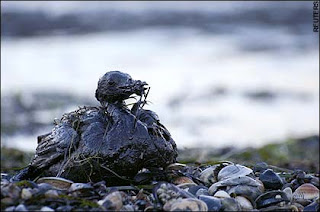
Pictures show birds coated in a black sludge.

“Birds seeking shelter on the shore near the center of the storm were covered in a treacly mixture of oil and seaweed — the first evidence of what one Russian official called an “environmental disaster,” according to news in the St. Petersburg Times.

Krasnodar Territory Governor Alexander Tkachev called the spill an ecological disaster at a meeting of the territorial administration, and as reported by Kommersant. “Thirty thousand birds have died and the number of fish that have died is uncountable,” he noted. “The damage is so great that it is hard to assess. It can be called an ecological catastrophe.” Tkachev said that one of the main causes of the catastrophe in the Strait of Kerch was the foolhardiness of the ships' captains, who “received storm warnings and hoped for luck.”

The main species reported to be affected are Great Cormorant, Common Coot, Great Crested Grebe and Black-necked Grebe,” according to a report by Birdlife International.

The group reports that “two Important Bird Areas (IBAs), nearby, the Kiziltash Bay and the Tamanski and Dinskiy Bays, are under threat. Both are designated primarily for migrating and wintering birds. Up to 50,000 migratory waterfowl and other birds are known to use the sites during migration. Among these are Dalmatian Pelican, listed as vulnerable on the IUCN Red List and White-tailed Eagle.”

On Tuesday, “scores of birds, weighed down by thick coatings of the fuel oil, hopped weakly along the shore or sat helplessly in the sand,” according to an Associated Press report in the Moscow Times. “Workers with pitchforks and shovels collected vast clumps of oil mixed with sand, seaweed and dead birds. “ The area is a bird migration route for those species flying from Siberia to the Black Sea, and this is the peak migration for red-throated and black-throated Siberian divers, according to the Irish Times.

So far, 50km of Russian coastline is affected by the oil spills.

There has been $3 million allocated to the cleanup process, according to a Russian news report.

Oil affects birds in several ways, according to the Point Reyes Bird Observatory:

  • “hypothermia- oil interferes with the waterproofing of their feathers and allows their skin to come in contact with the cold water.
  • “starvation-birds beach themselves to avoid the hypothermia and therefore can't feed at sea; or they preen (clean their feathers) so obsessively to try to remove the oil that they do not spend any time feeding.
  • “toxicity from ingesting oil during preening."

Web Sites

International Bird Rescue Research Center
Kill the Spill

13 November 2007

Holy Fowl Watching Birdfans‏

[Tibetan Monks at Oak Lake] James Ed. Ducey

While on an outing at Lincoln on a recent chilly Tuesday, my route went to Oak Lake Park.

Usual autumn fowl present included a bunch of Ring-billed Gulls and more Canada Geese.

The most interesting part of the visit to appreciate was an unexpected ceremony by a group of seven Buddist Monks, from the Drepung Loseling Monastery in Tibet.

The men were finishing a ceremony started earlier at the Lentz Center for Asian Culture. For several days the visitors had created a vividly colored mandala for peace, made of a multitude of tiny grains of sand.

Before coming to the lake, the closing ceremony at the center included chants, songs and music to mark the completion of the sand art masterpiece. The sand art was destroyed - in a slow, methodical manner - to convey the message that life is temporary, and how nothing is permanent. Some sand grains of the former mandala were given to people at the building ceremony.

According to the translator for the group, the remainder of the sand was thrown into the lake since water is part of a great cycle of continuity. The water of the lake flows into a stream, down the river and on to the great oceans. The sea-water transpires into the air to then fall to the earth as rain or snow.

At the lakeside, their guttural chants and glorious foreign song had a musical accompaniment using Tibetan horns.

Two-three gulls flew above, winging their way around this little bit of the lake during the brief ceremony.

The serene setting was enjoyed by a small group of solemn, human observors.

Other birds at the holy lake scene were the American Kestrel, Mallard and Northern Shoveler.

It was certainly a blessed place. [Tibetan monks at Oak lake Park]

11 November 2007

Projects Funded by WRDA to Benefit Bird Habitats

James Ed. Ducey

An override of the presidential veto on November 8th, enacted the Water Resources Development Act of 2007.

“In today's historic veto override, Congress has kept its promise to restore America's Everglades and made an historic national commitment to the protection of more of America's most sensitive and valuable ecosystems, including the Gulf Coast, the Mississippi River, and the Great Lakes," said April Gromnicki, Audubon's Director of Ecosystem Restoration. "If there is a cause that merits a historic vote such as this, it's fitting that the cause be to restore some of our most special places before they are lost forever." 

The Legislation provides $23 billion funding for navigation, flood protection and ecosystem restoration. There is a plethora of projects from Alaska to Florida, and throughout the United States given in the 180-page plus bill.

Ecosystem restoration is slated for the Everglades, Mississippi River, coastal Louisiana and the Great Lakes, and Río Oeste, along the Salt River in Arizona.

The House legislation - H.R. 1495 - lists provisions for 178 projects, with 43 aquatic ecosystem restoration projects identified.

Examples of restoration projects given include:

  • Clam Bayou and Dinkins Bayou, Sanibel Island, Florida
  • Napa River Salt Marsh Restoration, Napa, California
  • Hudson Raritan Estuary, Liberty State Park, New Jersey
  • Hocking River Basin, Monday Creek, Ohio
  • Lower Colorado River Basin

The bill has seven small projects for improvement of the quality of the environment.

Mitigation, recovery, and restoration will be funded for the Missouri river and tributaries in Iowa, Kansas, Missouri, Montana, Nebraska, North Dakota, South Dakota, and Wyoming.

Passage of the legislation has been lauded by other environmental organizations.

“The passage of WRDA represents an important milestone in The Nature Conservancy’s efforts to protect and restore the Upper Mississippi River Basin,” said Michael Reuter, director of the Conservancy’s Great Rivers Partnership. “We applaud all of the senators and congressional representatives who recognized the benefits of this legislation – creating and enhancing habitat for native species, improving water quality, reducing the risk of flooding and increasing recreational opportunities.”

Most of these projects will be administered by the Army Corps of Engineers. Some projects will be carried out with local partners, which may provide additional funding.

Similar legislation was last enacted in 2000.

Water Resources Development Act

09 November 2007

Feather Atlas Useful for Identification of North American Birds

A unique resource for identification of flight feathers of North American birds is now available at the online Feather Atlas.

“The Feather Atlas is the first widely-available resource to provide species identification tools for detached feathers,” said Pepper Trail, the ornithologist with the National Fish and Wildlife Forensics Laboratory, a division of the U.S. Fish and Wildlife Service. He is the coordinator for the atlas website project.

“Until the Feather Atlas, there was no widely-available image database of detached flight feathers of North American birds,” Trail said in an email interview. “These scans will be useful in terms of illustrating feather structure and function (compare, for example, the outer primaries of buteos, accipiters, and falcons), as well as documenting plumage variation."

“The primary intended use is for species identification, but there are many other possible uses, including by researchers (as a source for feather measurements), artists (to reference fine details of plumage when they lack access to specimens), and educators (to show examples of feather shape and appearance). There will likely be other uses for these scans that have not even been imagined."

Groups represented by the atlas thus far are hawks, eagles, vultures, falcons, pigeons and doves, cuckoos, owls, and woodpeckers, with 64 species currently illustrated.

Tail fathers of the Red-bellied Woodpecker. Image courtesy of the Feather Atlas.

“We began with raptors, with particular emphasis on the different plumages of Bald and Golden Eagles,” said Pepper Trail, a biologist in the Laboratory. “The feathers of birds of prey, including hawks, eagles, and owls, are the most commonly encountered by FWS agents, both in partial carcasses (for example, electrocuted bird remains) and in crafted items (such as feather fans). Flicker feathers are also frequently used in crafted items, which led us into the woodpeckers.”

For each species, examples of wing and tail feathers are shown on a background that provides a scale for referencing the size of each feather. Precise measurements – to the nearest millimeter – are also given in a data table found beneath each scan. “The measurements are an important additional resource for making identifications,” Trail said.

Further details for each image provide the bird’s sex, age and where it originated.

Also provided with the atlas is a glossary of terms used to describe parts of a feather, illustrated with annotated figures. Coming soon to the web site will be options to zoom in to view feathers in a greater detail, print an image or create a portable document file with the image.

Details on the legal issues related to feather possession are presented, including a link to the complete list of protected species. There is also information about special rules which are applicable to Native Americans, which often use bird material in tribal ceremonies.

The Forensics Laboratory created the atlas since it provides “identification resources to the field officers of the Office of Law Enforcement,” Trail said. “Much of our work at the laboratory involves making species identifications from partial remains, including loose feathers,” Trail said. “Therefore, we have both the expertise and the specimen reference collection needed to undertake this effort.

“Law enforcement personnel will find the scans useful in identifying flight feathers in crafted items and bird carcasses. Field biologists will be able to use the scans to identify feathers encountered during field work. For example, I am often asked to identify molted feathers picked up during field surveys, where the goal is to distinguish Great Gray versus Great Horned Owls or Northern Goshawk versus other raptors.

“The Feather Atlas marks an expansion of our identification resources onto a widely accessible web-based platform that will be useful not only to Fish and Wildlife Service agents, but to refuge officers, state game departments, researchers, and the general public.”

The laboratory already provides a variety of bird “Identification Notes” for use by agents and researchers.

The web site has already undergone a review by “various Fish and Wildlife Service personnel and museum-based ornithologists,” Trail said. “Their comments were very helpful in refining our search tools and in developing the information presented on the homepage. We are still working toward implementation of some of their suggestions, for example, making thumbnails of the scans available.”

The ultimate goal of the atlas is to present images of the flight feathers of all species of North American birds – a project that will take years.

Trail stated that the strategy is to scan as many members of a bird family as possible before adding that group to the atlas, thus allowing comparisons between similar species. As a result, he explained, “the availability of specimens influences which groups we work on. We are currently scanning the feathers of upland gamebirds (quail, grouse, and relatives) and nightjars. After that, we plan to begin work on waterfowl. And on an ongoing basis, we will add new species and scans to existing groups as additional specimens become available.”

Feathers scanned for the website are from specimens in the reference collection of the Forensics Laboratory, Mr. Trail said. “Almost all these are salvaged carcasses that have been donated by our wide network among wildlife rehabilitation centers, National Wildlife Refuges and other FWS offices, bird-banders, and state game departments. No birds are killed to provide specimens.”

The actual scanning is done by a Laboratory volunteer, Sue Polich, and the specimen preparation and website design are done by Laboratory staff when time is available, Trail said.

The website emphasizes that it is illegal to possess birds or parts of birds protected by the Migratory Bird Treaty Act, which covers almost all native North American species.

“This includes molted feathers and feathers that may have come from road- or window-kills,” Trail explained, noting that the Feather Atlas offers a legal way to study and appreciate the beauty of the feathers of protected native species: “Appreciate the images, but don’t collect feathers unless you have a permit to do so!”

Opportunities for close examination of feathers may be available at museums, zoos, and wildlife rehabilitation centers.

“Education about feathers can be done using the feathers of non-native birds such as Ring-necked Pheasant, Indian Peafowl, Rock Pigeon, European Starling and House Sparrow, Trail concluded. “The feathers of all these species can be legally possessed without permits.”

“Feathers represent a supreme combination of beauty and functionality, Trail said. “The variety of their patterns and shapes is an endless source of fascination, and I never tire of the challenge of making species identifications based on feathers alone. This project has required a sustained focus on the details of feather appearance that has been very rewarding. The response so far has suggested wide interest in this resource, which is certainly encouraging.”

National Forensics Laboratory Feather Atlas
National Forensics Lab bird “Identification Notes”

08 November 2007

Columbus Voyages Discover Birds in America

By James Ed. Ducey

There were four Columbus voyages to sea-side lands of American. After the initial exploration in 1492-1493, others soon followed in response to the original discoveries. The second voyage of 493-1496 discovered the Lesser Antilles and Cuba. There was a third exploration in 1497-1498, with the final voyage of first discovery from 1502-1504.

Christofforus de Columbo received government approval and funding for the first voyage of discovery. Official documents were issued from the king and queen to allow him to sail, expenses paid, for the new world of the west Indies. Articles of agreement were signed in April 1492.

[Illustration of Columbus]

Admiral Columbus set forth a few months later, on August 3rd. The sailing vessels are the now famous caravels Pinta and Nina, and the Santa Maria with their crews of sailing men.

By mid-September while floating along in the western Atlantic Ocean, there were birds being seen. Among the sea birds seen were the boat-swain bird, booby, petrels, and man-of-war bird. Terns and ducks were noted in the chronicles resulting from the brave men's voyages.

It was mid-October when land fall in the new world occurred, and the first sightings were made of new types pf wild birds.

Information from the voyages as summarized here, is based on an original translation of the journal narratives. The original spelling is retained.

Journal of the First Voyage - Discovery of the West Indies, 12 October 1492 - 15 January 1493

Friday, 12 October

"... I saw no animal of any kind in this island, except parrots. ..."

Saturday, 13 October

"... They brought skeins of spun cotton, and parrots, and darts, and other trifles that would be tedious to describe, ..."

Sunday, 21 October

'At ten o'clock I arrived here at the Cape of the Islet and anchored, ... Here are some great lagoons, and around them, on the banks, the verdure is marvellous; and round about there is a marvellous amount of woodland, the grass like in April in Andalusia, and the singing of the little birds such that it would seem that man would never wish to leave here; and the flocks of parrots obscured the sun, and big and little birds of all sorts, and so different from ours that it is marvellous. ..."

Sunday, 28 October

"... never beheld so fair a thing; trees all along the river, beautiful and green, and different from ours, with flowers and fruits each according to their kind, many birds and little birds which sing very sweetly. ..."

Monday, 29 October

"... There were dogs that never barked, wild birds tamed in their houses, ... large birds and small birds and the chirping of crickets, ..."

Saturday, 3 November

"... all he had seen was so beautiful that his eyes would never tire beholding so much beauty, and the songs of the birds large and small. ..."

Sunday, 4 November

"Presently at sunrise the Admiral got into the barge and went ashore to hunt the birds that he had seen the day before. ..."

Tuesday, 6 November

"... They saw many kinds of trees and plants and fragrant flowers; saw birds of many kinds different from those of Spain, except partridges and nightingales which sang; and geese, of which there were many; ... "

Saturday, 17 November

"... many birds he saw ... "

Tuesday, 27 November

"... As he went along it was a marvellous thing to see the trees and greenery and the very clear water, and the birds and the amenity, ... "

Friday, 7 December

"... He went a short distance into that country, which is all cultivated, and heard sing the nightingale and other songbirds like those of Castile. ... "

Thursday, 13 December

"... And because the Indians aboard had understood that the Admiral wanted a parrot, it seems that Indian who went with the Christians told them something of it, and so they brought parrots, and gave them as they wanted, without asking anything for them. ... "

Saturday, 22 December

"... After evening fell the lord gave them three very fat geese, ... "

Sunday, 23 December

"... Afterwards the king gave to each one some cotton cloth which the women wear, and parrots for the Admiral, and some pieces of gold. ... "

Sunday, 13 January

"... He had his face all stained with charcoal, although in parts they are wont to use different colors; he wore his hair very long and drawn together and fastened behind, and gathered into a little net of parrots' feathers; and he as naked as the others. ... "

The explorers returned to Europe in early March 1493, landing in Portugal.

Michele de Cuneo's Letter on the Second Voyage, 28 October 1495

[parrots illustration]

c. Fauna and Flora

"To continue, we shall now tell of the birds.

"First, going from the island of Ferro to the island of Guadaloupe, for six days almost constantly we saw in the air many hawks flying across. We also saw an infinite number of swallows, and that is why we thought we were near either to an island or a continent.

"There are in all the islands, as well as of the Caribs as of the Indians, where I have been, innumerable parrots of three kinds, viz., green all over and not very big, green spotted with red and not too big, and as big as chickens, spotted with green, red and black. Of the last I have eaten several times, their flesh tastes like that of the starling. There are also wild pigeons, some of them white-crested, which are delicious to eat. There are also innumerable swallows and sparrows and some little birds of the forest. ...

"d. The Indians

... the arrows of canes, ... and the feathers are taken from parrots' wings. ..."

Ferdinand Columbus's Account of the Return Passage, 1496

Sunday, 10 April

"... but before they touched land a muster of women came out of the bush, carrying bows, arrows and wearing plumes, apparently determined to defend the country. ... Among other things which they found in the houses were big parrots, honey, beeswax, iron which they used to make hatchets, and looms, like ours on which rugs are made, ...

The Third Voyage of Discovery, 1498-1500

Birds were not noted in America during this voyage, according to a review of the source document. The region visited included the northern tip of current South America and Hispaniola.

Ferdinand Columbus's Account of the Fourth Voyage

Ferdinand Columbus was the son of Christopher Columbus, and accompanied his father on the fourth voyage. A primary area of exploration was the western Caribbean, with a goal of discovering a passage to the Pacific Ocean and beyond.

Sunday morning, 14 August 1502

"... But, being pleased with what had been given them, above two hundred came next day to the same place, laden with several kinds of provisions such as native fowls (which are better than ours), geese, roasted fish, red and white beans like our kidney beans, and other things not differing from those of Hispaniola."

Columbus's Lettera Rarissima to the Sovereigns, 7 July 1503

e. Navigation and Miscellaneous Events

"There were many varieties of animals but they all die of the pip; many fowls of great size (having feathers like wool), lions, stags, does and birds. ..."

Localities of Bird Observations

These are the fifteen localities where birds were known to have been observed during the Columbus voyages. The designated names are based on names determined in the original narrative, and based on voyage maps, have been correlated to modern place names.

• Cabo de la Laguna - Bahama Islands
• Guadeloupe Island - Bahama Islands
• Guanahani - Bahama Islands
• Harbor of San Salvador - Cuba
• Isabela - Dominican Republic
• La Costa de las Orejas - Nicaragua
• Lamahich - Jamaica
• Puerto Baracoa - Cuba
• Puerto de la Concepcion - Haiti
• Puerto de la Mar de Sancto Thomas - Haiti
• Puerto Tanamo - Cuba
• Rio de Mares - Cuba
• Samana Bay - Dominican Republic
• Sierra del Cibao - Cuba
• Western Atlantic Ocean - West Indies

Species Analysis

There was a small, yet exquisite variety of species identified for the Columbus voyages. Some of the birds had a description sufficient to allow attribution to a particular species, while others can only be attributed to a broad category. And, based on an editorial interpretation given with the translated voyage narratives, this is the list:

• Arctic Tern
• Bird effigy
• Bird-motif garment
• Booby
• Cuban Parrot
• Dove
• Falcon
• Goose
• Magnificent Frigatebird
• Northern Mockingbird
• Parrot
• Perching birds
• Petrel
• Phalarope
• Pigeon
• Quail
• Sparrow
• Swallow
• Tern
• Tropicbird
• Unidentified birds
• Unidentified waterfowl
• Wattled Curassow
• West Indian Whistling-Duck
• White-crowned Pigeon

A more precise identification of some species, perhaps the quail for example, could perhaps be feasible if the records were studied in detail by those familiar with local avifauna in the regions visited by the Columbus voyages.

The specific bird observations from the Columbus voyages can be summarized as follows:

1492
Cuban Parrot - Cabo de la Laguna - 10/21/1492
Perching birds - Cabo de la Laguna - 10/21/1492
Unidentified birds - Cabo de la Laguna - 10/21/1492
Unidentified birds - Harbor of San Salvador - 10/28/1492
Parrot - Rio de Mares - 10/29/1492
Unidentified birds - Rio de Mares - 11/3/1492
Unidentified birds - Rio de Mares - 11/4/1492
Quail - Sierra del Cibao - 11/6/1492
Northern Mockingbird - Sierra del Cibao - 11/6/1492
West Indian Whistling-Duck - Sierra del Cibao - 11/6/1492
Unidentified birds - Puerto Tanamo - 11/17/1492
Unidentified birds - Puerto Baracoa - 11/27/1492
Northern Mockingbird - Puerto de la Concepcion - 12/7/1492
Unidentified birds - Puerto de la Concepcion - 12/7/1492
Parrot - Puerto de la Concepcion - 12/13/1492
Unidentified birds - Puerto de la Concepcion - 12/13/1492
West Indian Whistling-Duck - Puerto de la Mar de Sancto Thomas - 12/22/1492
Tern - Western Atlantic Ocean - 9/14/1492
Tropicbird - Western Atlantic Ocean - 9/14/1492
Tropicbird - Western Atlantic Ocean - 9/17/1492
Petrel - Western Atlantic Ocean - 9/18/1492
Booby - Western Atlantic Ocean - 9/19/1492
Arctic Tern - Western Atlantic Ocean - 9/20/1492
Unidentified birds - Western Atlantic Ocean - 9/20/1492
Booby - Western Atlantic Ocean - 9/20/1492
Booby - Western Atlantic Ocean - 9/21/1492
Unidentified waterfowl - Western Atlantic Ocean - 9/22/1492
Petrel - Western Atlantic Ocean - 9/22/1492
Dove - Western Atlantic Ocean - 9/23/1492
Booby - Western Atlantic Ocean - 9/23/1492
Tern - Western Atlantic Ocean - 9/23/1492
Phalarope - Western Atlantic Ocean - 9/23/1492
Booby - Western Atlantic Ocean - 9/24/1492
Petrel - Western Atlantic Ocean - 9/24/1492
Tropicbird - Western Atlantic Ocean - 9/27/1492
Magnificent Frigatebird - Western Atlantic Ocean - 9/29/1492
Booby - Western Atlantic Ocean - 9/29/1492
Tropicbird - Western Atlantic Ocean - 9/30/1492
Booby - Western Atlantic Ocean - 9/30/1492
Tern - Western Atlantic Ocean - 10/2/1492
Petrel - Western Atlantic Ocean - 10/4/1492
Booby - Western Atlantic Ocean - 10/4/1492
Magnificent Frigatebird - Western Atlantic Ocean - 10/4/1492
Tern - Western Atlantic Ocean - 10/4/1492
Petrel - Western Atlantic Ocean - 10/5/1492
Unidentified birds - Western Atlantic Ocean - 10/7/1492
Tern - Western Atlantic Ocean - 10/8/1492
Unidentified waterfowl - Western Atlantic Ocean - 10/8/1492
Booby - Western Atlantic Ocean - 10/8/1492
Unidentified birds - Western Atlantic Ocean - 10/9/1492
Petrel - Western Atlantic Ocean - 10/11/1492
Cuban Parrot - Guanahani - 10/12/1492
Cuban Parrot - Guanahani - 10/13/1492
Parrot - Puerto de la Mar de Sancto Thomas - 12/23/1492
1493
Bird effigy - Samana Bay - 1/13/1493
Booby - Western Atlantic Ocean - 1/17/1493
Magnificent Frigatebird - Western Atlantic Ocean - 1/18/1493
Booby - Western Atlantic Ocean - 1/19/1493
Tropicbird - Western Atlantic Ocean - 1/19/1493
Magnificent Frigatebird - Western Atlantic Ocean - 1/19/1493
Magnificent Frigatebird - Western Atlantic Ocean - 1/20/1493
Petrel - Western Atlantic Ocean - 1/20/1493
Unidentified birds - Western Atlantic Ocean - 1/20/1493
Tropicbird - Western Atlantic Ocean - 1/21/1493
Petrel - Western Atlantic Ocean - 1/21/1493
Unidentified birds - Western Atlantic Ocean - 1/21/1493
Tropicbird - Western Atlantic Ocean - 1/22/1493
Tropicbird - Western Atlantic Ocean - 1/28/1493
Petrel - Western Atlantic Ocean - 1/28/1493
Tropicbird - Western Atlantic Ocean - 1/30/1493
Tropicbird - Western Atlantic Ocean - 1/31/1493
Petrel - Western Atlantic Ocean - 1/31/1493
1494
Falcon - Guadeloupe Island
Petrel - Guadeloupe Island
Parrot - Isabela
Pigeon - Isabela
Sparrow - Isabela
Swallow - Isabela
White-crowned Pigeon - Isabela
Cuban Parrot - Isabela
Parrot - Isabela
1496
Bird-motif garment - Guadeloupe Island - 4/10/1496 - 1496
Parrot - Guadeloupe Island - 4/10/1496 - 1496
1502
Unidentified birds - La Costa de las Orejas - 8/14/1502
Goose - La Costa de las Orejas - 8/14/1502
1503
Wattled Curassow - Lamahich - - 1503
Unidentified birds - Lamahich - - 1503

References

This review of bird sightings hardly touches on the expansive history associated with the voyages. The best presentation of the events is given by the many source documents published for the explorations during the four voyages of Christopher Columbus and his hearty companions.