11 December 2013

Birds That Go On Hats - An Explanation

A great heap of wide-spread antlers in the window, with a simple black and white sign above them which reads, "Taxidermist," is the only street display of a down town place of business where hundreds of thousands of birds have been flayed and their skins dressed for the ornamenting of hats and bonnets, and hundreds of hides of all sorts of animals, from a mouse to a cinnamon bear or an African tiger, have been mounted for the use of dealers in furs and the decoration of parlors and studies. The chief part of this business is the preparation of birds for milliners. A pretty black-eyed girl behind the counter in the front room said that the business was not very brisk in winter, but with the coming of the birds in spring it would become very lively.

"What kind of birds do you use most?"

"The common sorts — red-winged blackbirds, reed birds, snipes, turtle doves, orioles, yellow birds, thrushes. Any small bird can be used."

"How do you get them?"

"We buy them from men who make a business of supplying us. Most of the birds we handle are from New Jersey, but a good many come from Long Island, and we receive some from the West and South. A few are imported.

"What do you pay for them?"

"That depends on the fashions entirely. Two years ago the demands of the milliners was for red wings and yellow birds. We paid from twenty-five to thirty-five cents apiece, and at one time we had to pay as high as forty-seven cents apiece for a lot. Last year we got all we wanted at from seven to eight cents each. When the hunters have to supply a brisk demand, they can get more, of course, because the supply of birds of each variety does not vary greatly from year to year."

"Do the hunters shoot the birds?"

"I guess not, I do not find any shot in flaying those brought from regular customers."

"How do they catch them then?"

"I guess you could not get them to tell you. There is one man who brings us from 1,500 to 2,000 a week during the warm months. He says he has a partner and no other help. He lives in Red Bank. One would think the woods would be depopulated, or else that he would get rich enough to retire, but he has been working away for years now."

"Where do all these fancy birds that look like pictures of tropical rarities come from?"

"All from Jersey. By inserting a snipe's bill in the place of the bill of a crow blackbird, and then combining parts of the skins of other common birds we produce a monstrosity, but if the colors are well matched the result is attractive to the common eye, however grotesque it may appear to one who knows all about the appearance of birds. It is not uncommon to see in the Grand street windows hats that have half a dozen heads projecting from one mass of feathers that might be the breast of a swan or the pickings from a second hand pillow. The wings that adorn some hats are about as much like wings as a stove pipe is like a lead pencil. But those queer tastes are the making of our business. The portions of the bird's skin which are cut away when mounting a bird naturally for a hat can all be used up in wings by gluing them on a model. I read in The Sun the other day about an Ohio young woman whose nerves were wholly shattered in a millinery store because, as the article said, of her sympathy for the poor little birds she had to handle. I guess there was some error about that. I think the shock must have come a contemplation of some of our combination birds. She has my sympathy."

February 19, 1885. Birds that go on hats. An explanation of some of the mysterious creations that are seen. New Market Church Paper 13(6): 4.

09 December 2013

An Assault of Pigeons - West of Omaha

Nor has the day gone by when the traveler could come home with wild and thrilling tales of outrageous adventure, stories of wonders witnessed and startling phenomena experienced. Not much. The loquacious traveller still turns up and blithely reels off his little romance. here is one from a passenger fresh from the glorious climate of California. He came in on a through train from San Francisco on the 5th inst. with the story that when the train was 20 miles west of Omaha, a flock of wild pigeons — myriad in numbers, apparently — made a dash into one of the Pullman cars, knocking over the men, tangling themselves in the store hair of the women and creating a matchless consternation, such even as Jesse James could not have excelled in his palmy days. We have illustrated this story after the sketch of the veracious traveller. The reader will of course be perfectly willing to believe that the markets in Omaha were overstocked with wild pigeons shortly after the arrival of that train, and all the brakemen were flush the next day.

A train assulted by pigeons.

A veracious traveller's sketch of the rush of a flock of wild pigeons into a palace car near Omaha, Neb.

October 28, 1882. An assault of pigeons. National Police Gazette 41(266): 13.

04 December 2013

Tree Sparrows Killed at CenturyLink Center Windows

Three American Tree Sparrows were found dead at the CenturyLink Center on December 3rd. This is the latest date known for a bird-window strike in the Omaha area. The last known records was five days prior, and this is also the only known occurrence of this sort.

The carcasses were found at three different spots during the morning visit. They were brought together to get documentary photographs.

The sparrows were found along the west side of the building, which is the deadliest building for migratory birds in Omaha.

Each carcass was taken from the scene of their demise, and disposed of properly at a natural setting, rather than their likely ending up being indifferently thrown into the trash.

02 December 2013

Four Days of Bird Surveys During Thanksgiving Weekend

With moderate weather of acceptable temperatures and mostly slight winds, and since time was available, a big number of bird surveys were done during this years Thanksgiving Holiday and subsequent weekend. Nearly all of the outings were at Omaha parks.

The outings began early on the holiday morning, before the festivities.

Many hours were were involved in an effort to determine the species present at during these days of this year. The details might also provide a comparison to past times?

  • Starting a bit after sunrise, despite a brisk wind and its associated chills, a walk-about was done through Memorial Park and Elmwood Park, with at least five miles of walking.
  • Friday morning, the northern extent of Hummel Park and eastern extent of N.P. Dodge Park were hiked on two jaunts representing at least four miles of walking.
  • Saturday meant an outing to Mandan Park and the river flats to the east, and to Spring Lake Park; at least four miles of walking.

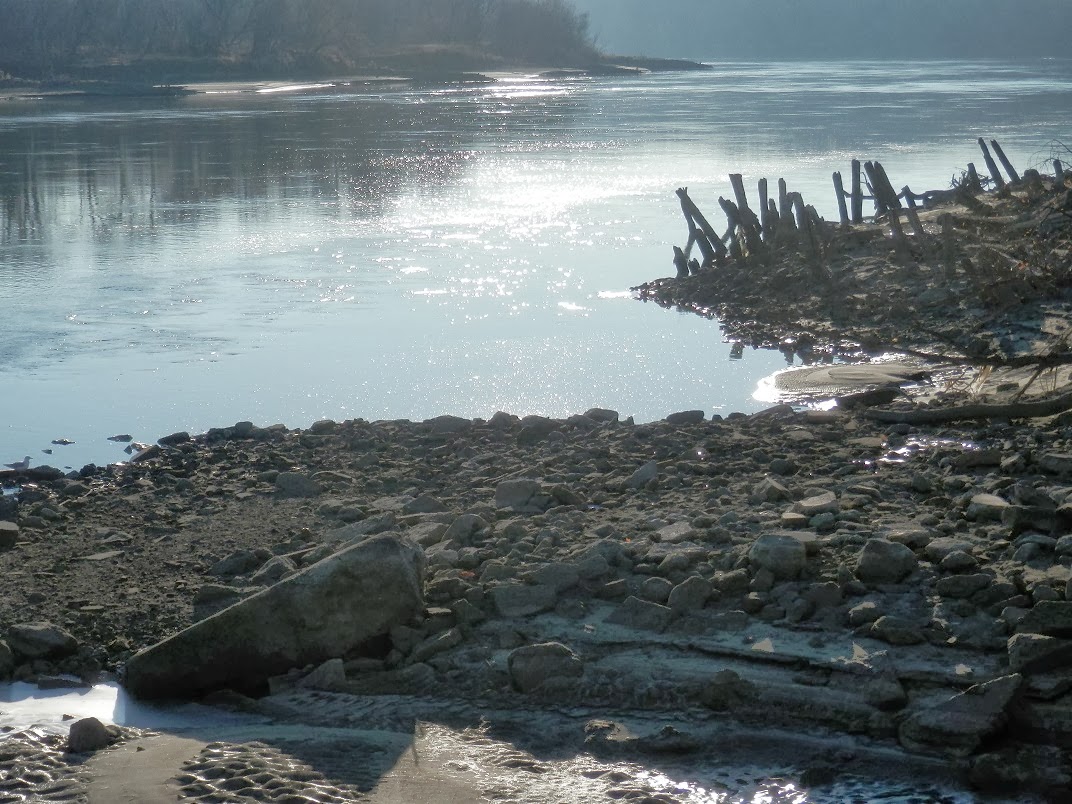
  • View of the Missouri River along the east edge of Mandan Flats.


    Ring-billed Gull along the sandy shoreline of the Missouri River. There is plenty of shore due to the low water level.


    Tires below the Big Spring at Spring Lake Park.

  • Sunday started with chilly conditions for birding via bicycle at Levi Carter Park and Carter Lake. The ride just after sunrise was done among a temperature about 23o and along a route of at least six miles to arrive at the start of the regular survey route; add in a couple miles pedaled along the way. Then the return route is a back-ways of six miles, though along a different path. Just when the sun was starting to provide was appreciated warmth, clouds moved in and a slight breeze added to less than optimal conditions. The day improved nicely later, so the CBSR Pond and the Fontenelle Park were visited to get a count of the gathered geese. After a bit of lunch, the bicycle riding continued to some other neighborhood parks in the midtown area. During the morning bird survey effort, a bunch of aluminum cans were picked up from where they had been trash, especially along the neighborhood streets. The afternoon bicycle effort was similar but shorter in extent and duration. The route was still nearly five miles of pedaling the bicycle along, or walking, with another bunch of trash cans gathered for preferable disposal, rather than their otherwise fate of ending up as waste in a local landfill.

Bird Variety

More than fifty species were recorded for 33 distinct localities, which includes multiple places within a larger expanse in order to convey occurrence at particular habitat features and to also indicate an extent of distribution. Places with the largest number of species were:

1). Mandan Flats - which is the floodplain along the Missouri River, east of Mandan Park: 18
2). Carter Lake: 17, and a site distinctive for the adjacent Levi Carter Park, where separate records were kept
3). N.P. Dodge Park: 17
4). North Hills - Hummel Park: 16.

The park place with the lowest number of species was Bemis Park, where only one American Robin was seen. though some of the other nearby parks had a better diversity.

Bird Highlights

There were some particulars of these four days which are worth particular mention, as listed an appreciative manner, which also happens to be sequentially presented.

A single Barred Owl at the Elmwood Park Ravine.

More than 35 Mallards were actively eating, and quacking about the pondweed at Shadow Lake, Elmwood Park.

A surprising number of Red-headed Woodpeckers at Hummel Park which included adults and youngsters with their black heads with the number of this species a new record for this park. During this outing a plastic bag was filled with aluminum cans strewn about the park, especially in association with the disc-golf course. When a disc-golf guy was asked about the trash, he responded in a manner so typical and as heard before: someone else did it. This is the obvious situation here, where the disc-golf proponents take credit for positive results, but blame others for other things, as has been conveyed more than once.

A Pileated Woodpecker was the first bird seen upon getting out of the car at N.P. Dodge Park. Later in the morning, while walking back from the river, it took ten minutes to observe a single Fox Sparrow among the undergrowth.

While at Mandan Park and Mandan Flats, there was a lot of bird activity at certain places. The sites appreciated were not the "bum camp" in the park with its lingering trash, nor the "bum camp-fire site" near the river where pieces of bark had been carefully placed to obscure the light of the flames upon this city of Omaha property. It was tough walking among the flats, but the results were positive, and some additional species were added to the tally for this place. In the park, a new addition was a Great Horned Owl. Adjacent and along the river, new additions were the a few Mallards, a Merlin, a Ring-billed Gull foraging along the river bank) and a nice bunch of Eastern Bluebird. These bluebirds were associated with the spring-water flows along the railroad tracks.

There was nothing new at Spring Lake Park. The place continues to be a haven for discarded tires, with more than thirty noted, along with other trashy things. A new place name was used for this survey, to indicate the vibrant bird activity in a spring-hollow along the north side of F Street, newly designated as Leafy Spring Hollow. Two Carolina Wrens with their distinctively, yet surprising vocals, were a highlight here along with a number of other species.

Waterfowl on Sunday morning were once again appreciated. Most of Carter Lake was ice-covered. The congregation was among water where they could swim and forage. A nice variety was seen, and there may have been other sorts, but personally being nearly thoroughly chilled at this time, it was difficult to keep the spotting scope steady and in focus, so the results are a best-effort survey. Levi Carter Pond was barren of bird-life, especially since there was no understory vegetation along its eastern and northern banks, where birds had formerly been seen during this season in past years.

There were several Northern Flicker at the Northwest Pond Natural Wildlife Area. At one time, there were four in two adjacent trees.

In comparison to this appreciated view, nearby there were two trashy problems that could not be ignored: 1). the tire which Omaha Public Works staff were specifically asked to remove on the most recent visit here, still remains; and, 2) there is now a plastic garbage can in the middle of the pond, which somehow was thrown into the water and is now encased by ice. There is other trash present, and more work is needed to remove unwanted, invasive cedar trees. The perceived improvement done on a November day a couple of weeks in the past, seems to now be insignificant since there is still further attention needed! The task will require more effort than might be done by a bird-guy riding a bicycle. Having necessary tools would be at the top of the list of requirements. Improvements occur in increments which succeeds only through regular and ongoing attention to the details.

The lack of effective results is obvious at the site designated as the CBSR Pond, a few blocks west of the Levi Carter Park area. Birds here don't care about trash, thankfully. Later on Sunday morning there was an especially nice variety of species, with flowing water an attractant. Among the west-side bluff, there were exciting woodpeckers among the excessive trash of many sorts.

This is a place which is also managed by the Department of Public Works of the City of Omaha. Trash here has been present for many recent months, so obviously there has been no apparent, recent effort to remove the unwanted trashy debris of so many different sorts. This site is a bit of a treasure for birds, but it is impossible to ignore particulars of the place. During my walk and ride here, a bunch of aluminum cans were removed for proper disposal, though it was a slight effort.

This table indicates a tally of the primary results.

Common Name Hummel District Dodge Park District Miller Park District Carter Lake District Carter Boul. District Fontenelle Park District Gifford Park District Bemis Park District Memorial Park District Elmwood Park District Spring Lake Park District Mandan District
Snow Goose - - - - - - 6 - - - - - - - - - - - - - - - -
Cackling Goose - - - - - - 22 - - - - - - - - - - - - - - - -
Canada Goose - - 110 190
2400
- -
400
- - - - - - - - - - - -
Gadwall - - - - - - 30 - - - - - - - - - - - - - - - -
American Wigeon - - - - - - 1 - - - - - - - - - - - - - - - -
Mallard - - - - - - 650 - - - - - - - - - - 37 - - 6
Northern Shoveler - - - - - - 165 - - - - - - - - - - - - - - - -

Green-winged Teal
- - - - - -
2
- - - - - - - - - - - - - - - -

Canvasback
- - - - - -
75
- - - - - - - - - - - - - - - -

Redhead
- - - - - -
85
- - - - - - - - - - - - - - - -

Ring-necked Duck
- - - - - -
250
- - - - - - - - - - - - - - - -

Lesser Scaup
- - - - - -
15
- - - - - - - - - - - - - - - -

Common Goldeneye
- - - - - -
40
- - - - - - - - - - - - - -
2

Hooded Merganser
- - - - - -
25
- - - - - - - - - - - - - - - -

Ruddy Duck
- - - - - -
3
- - - - - - - - - - - - - - - -

Wild Turkey

4
- - - - - - - - - - - - - - - - - -
8
- -

Bald Eagle
- -
2
- -
2
- - - - - - - - - - - - - - - -

Cooper's Hawk

1
- - - - - - - -
1
- - - - - - - -
1
- -

Red-tailed Hawk

1

1
- -
1
- - - - - -
1
- - - -
1

1

Merlin
- - - - - - - - - - - - - - - - - - - - - -
1

American Coot
- - - - - -
165
- - - - - - - - - - - - - - - -

Ring-billed Gull
- - - - - -
1
- - - - - - - - - - - - - -
1

Rock Pigeon
- - - - - - - -
2
- - - -
2
- - - - - - - -

Mourning Dove
- - - - - - - - - - - - - - - - - - - -
1
- -

Great Horned Owl

1
- - - - - - - - - - - - - - - - - - - -
1

Barred Owl
- - - - - - - - - - - - - - - - - -
1
- - - -

Red-headed Woodpecker

11
- - - - - - - - - - - - - - - - - - - -
2

Red-bellied Woodpecker

6

2
- - - -
1
- -
1

1

1

3

1

4

Downy Woodpecker

1

1
- -
4

1

1

1

2

2

2

2

3

Hairy Woodpecker

1
- - - - - -
1
- - - -
1
- -
1

2

1

Northern Flicker

2

1
- -
7

2
- - - - - - - - - -
1
- -

Pileated Woodpecker
- -
1
- - - - - - - - - - - - - - - - - - - -

Blue Jay

2

1
- -
2

1
- - - -
4
- -
6

3

4

American Crow

2

2
- - - - - - - - - - - -
2
- -
1

2

Black-capped Chickadee

6

4
- -
2
- - - - - -
2
- -
9

9

4

Tufted Titmouse

1
- - - - - - - - - - - - - - - - - - - - - -

White-breasted Nuthatch

8

3
- -
1

1
- -
1

2

1

6

3

4

Brown Creeper
- - - - - - - - - - - - - - - - - -
1
- - - -

Carolina Wren

1
- - - - - - - - - - - - - - - - - -
2

2

Winter Wren

1
- - - - - - - - - - - - - - - - - -
1

2

Eastern Bluebird

2
- - - - - - - - - - - - - - - - - - - -
8

American Robin
- - - - - -
7

8
- -
11

31
- -
38

16
- -

European Starling
- -
20
- -
75
- - - -
25

23
- -
12

86
- -

American Tree Sparrow
- -
65
- - - - - - - - - - - - - - - - - - - -

Fox Sparrow
- -
1
- - - - - - - - - - - - - - - - - - - -

Song Sparrow
- -
1
- -
4
- - - - - - - - - - - - - -
2

White-throated Sparrow
- - - - - -
2
- - - - - - - - - - - -
3

4

Harris's Sparrow
- -
4
- - - - - - - - - - - - - - - - - -
3

Dark-eyed Junco

22

18
- -
45

7

24

1

27

8

39

8

22

Northern Cardinal

6
- - - -
3

1
- - - -
2
- -
4

3

13

Red-winged Blackbird
- -
1
- - - - - - - - - - - - - - - - - - - -
House Finch - - - - - - 4 - - - - 5 4 - - 3 2 2

American Goldfinch
- -
6
- - 7 - - - - - - - - - - 7 3 8
House Sparrow - - - - - - 2 - - - - 14 - - - - 7 - - - -

A special thanks to Ducey family members which provided a car for transportation which made possible the far-to-the-north, and far-to-the-south bird surveys. It would have been too much to do these via bicycle!

All Sorts of Stuffed Owls in Lively Demand

"It is really surprising," said the old English taxidermist in William Street the other day, "what an extraordinary demand has sprung up for owls this season. It has been good and gradually increasing for two or three years, but this winter it has exceeded anything I ever knew before as a rage for one particular variety of bird. Why, before the holidays, out of every ten people who entered my store, nine were after owls. When this year opened I didn't have an owl left on hand except a few little screech owls. Even now, although the call for them has slackened off since the holidays, whenever a stranger comes in I find myself instinctively moving over toward the owls, expecting they are what is wanted. I don't know why the popular taste has rushed so in that direction and further than that it appears to be one of those inexplicable crazes that people do not try to account for further than by saying: 'It's the fashion.' But I have stocked up again with all sorts of owls, and am ready and willing for the craze to boom all along. Prices? Why, better than ever before. That great snowy owl, the largest and most beautiful of the family, is worth $25. I have snowy owls as low as $15, $12, and even $10, but not such a superb specimen as that. Yet I used to be glad to get $8 or $10 for the very best of them. These great horned owls are worth $10 each. The barred, long-eared, and short-eared owls (the latter sometimes known as the swamp or meadow owl) are worth $4 each. Barred owls made into a screen are worth $6. They are not much wanted in fancy forms, however, either as screens or in flying attitudes. The owl's strongest suit is his dignity, and he shows that best in repose. The Acadian owls are the smallest found in this section of the country, not bigger than quails; and the Sawit owls, from somewhere away out west, are not more than half their size. They command pretty good prices, as they are rarer than the others, but still never anything like the big ones. All the fine large owls came from Canada as a rule, but this season two handsome snowy owls were shot over in Jersey City. Another was shot on Biker's Hospital. Owls the only birds used for screens? Oh! no; not by any means. Herons, hawks, and gulls are also used, and indeed, many others. The handsomest is the white heron, which, when spread out so as to make a sort of halo of wings and tails while perched naturally on one log, is worth $15. All the prices I have named are for owls mounted complete and life-like."

Another taxidermist in Fourth street says he sells are one owl a day, right along, and cannot get enough to supply the demand.

Mr. Reiche, the bird dealers says that nothing is done in live owls; people only want them stuffed. In Germany some people look upon stuffed owls as a talisman to bring good luck, and perhaps that notion has just broken loose over here.

Capt. William Fowler says the great increase of the owl's popularity is due to the vast social, moral, and generally artistic and aesthetic influence of the famous "Owl Club," which is want to gather in "the hollow tree roost" at the Knickerbocker Cottage at midnight, there — in the language of the call for their recent dinner — "to eate, to drynke, to be merrie, to hoote ande to screeche l'ye barne."

January 21, 1883. Minerva's bird in fashion. All sorts of stuffed owls in lively demand at extraordinary prices. New York Sun 50(143): 6. Excerpts published February 22, 1883 in the Los Angeles Herald, and March 17, 1883 in the Washington D.C. Bee.

20 November 2013

Improving Northwest Pond at Levi Carter Park

The Northwest Pond Natural Habitat Area at Levi Carter Park is cleaner now than it has been for a long time, and it has been seeded to improve the flora because of activities on Wednesday morning, November 20th.

As the sun was rising behind clouds in the east, the day started with a personal, quick pickup of trash, and then a repeat effort. There were two unwanted concrete blocks that were a heavy burden to carry from the edge of the woods to a place along Carter Boulevard where they could be taken away.

There was then an opportunity to converse with a local resident — he stopped his truck on the street to talk — about the ponds, stormwater runoff, street trash, and most importantly experiences with city of Omaha staff. We agreed that a natural setting was something to appreciate. He was not however satisfied that neighborhood has to deal with the trash (and he mentioned several disgusting things) and water from the "upland" to the west. He certainly wanted the ponds to be kept clean and that Levi Carter Park be managed in a manner that reflects local interests. He was more than disappointed in city officials that made claims that something was going to be done, and then nothing happened. There were "promises made" and they have not been completed. His comments were an acute perspective on how some city officials, with Brook Bench, the Omaha Parks Recreation and Public Property Department specifically mentioned as being a particularly problematic official. This residents words may have been different, so his perspectives in conveyed in a civil manner.

We did not agree on everything, but it was obvious that city officials be forthright and honest in what they say and how they present public property changes and plans to the public, and especially to residents in the neighborhood.

Site Improvement

Staff of the Stormwater Section, of Omaha Public Works then arrived. The three men got to work, using rakes to work the soil to improve and prepare its condition for seeding, and also removing errant twigs on the ground.


The seeds they spread were a native prairie-grass mix which included big bluestem, little bluestem, side-oats grama, indian grass, switch grass, said Andy Szatko. These are warm-season species that flourish later in the growing season. Cool-season species included were Virginia and Canada wildrye, and western wheat-grass. The mix included some oat seed with an intention for it to provide a cover crop.

Some forbs were included in the mix, according to Andy Szatko. He indicated jopye weed, partridge pea, spotted menarda, prairie blazing star, black-eyed susan and echinachia were among the seeds spread. They had been individually collected from other stormwater project sites in Omaha, so there was no cost for their purchase.

With snow pending, the conditions are great for the seeds to get established and sprout in the 2014 growing season.

Through a group effort, a bunch of trash was taken away, including numerous plastic bottles along the railroad tracks and newspaper pages, a nearly oblivious pad of some sort among the grass which was personally torn away and taken to the curb for disposal, a large circular piece of plywood, a mess of carpet, a pile of tiles, a tire from the water, and no longer necessary markers for the nearly completed culvert work.

Also at the scene and actively involved on a great day for this bit of a natural area, were city workers Ben Beller, Jim Kee and Christine Antoniak.


Andy Szatko removing a bunch of tile trash.


Ben Beller planting native prairiegrass mix.


Jim Kee checking the recent culvert work, which was not yet entirely finished.


Carpet trash pulled from the woods by Christine Antoniak, along with other trash we removed.

We accomplished a lot.

There were even a few unwanted cedar trees pulled from the ground to ensure this invasive species would not flourish and create a subsequent, unwanted condition among the flora.

The pond area is jointly managed by the Public Works Department primarily, along with the Parks and Recreation Department. The goal is to have a naturalistic setting at the site, Szatko said. Other benefits include improving visual appeal, establishing a buffer at the pond in association with the adjacent streets, enhancing habitat value, and reducing the extent of maintenance, such as mowing.

Public Works is responsible for the maintaining the pond, and ensuring that trash does not accumulate.

On Monday, Public Works personnel had excavated and worked dirt to improve flow conditions through the culvert beneath the U.P. railroad tracks. That work was done with consideration given to the site being a natural habitat area.

The stormwater pond was initially established in the mid-1990s, Szatko said.

Seeds of the native prairiegrass mix.

16 November 2013

Slaughter of Geese by Lightning

On Monday, the 16th instant, an almost incredible occurrence transpired in the northern part of Sutter and the southern part of Butte county. On Monday evening, just before sunset, a large thunder cloud came up, apparently from the northeast, accompanied by an unusual amount of chain lightning. First a small amount of common hail fell, and then followed sufficient snow to whiten the ground. As the hail began to fall and the lightning flashed, thousands of white geese, which were in the ponds of shallow water which exist in that locality during very wet winters, suddenly rose up in great flutter, as if many hunters had discharged a volley among them. they went up and up, apparently to rise above the fearful cloud. It was nearly dark, and those who saw them rise thought no more of it till morning, when they began to find dead geese, and hear of hundreds being picked up by the neighbors. Some 700 had been found. One man picked up on his farm all two horses could haul, for their feathers. Their heads were badly torn and their bills split into fragments. Many of them had the feathers of their backs crisped and burnt and their bodies bursted open. The portion of country thus affected was about a mile and a half wide, and reached several miles in Butte county. The terrific lightning in this cloud was witnessed by people on the Honcut, in Yuba county. The thunder was heard twenty miles distant.

April 29, 1874. Memphis Public Ledger 18(51): 2. From the Yuba City (Cal.) Banner.