Showing posts with label Big Sit. Show all posts

20 October 2010

Comparing Big Sit Results From Two Missouri River Refuges

The annual "Big Sit" was held nationwide on October 10th, and two participating sites were along the lower Missouri River.

The "Eagle Eyes Big Sit" was done at Squaw Creek National Wildlife Refuge by Mound City, Missouri, and the "DeSoto's Gooseless Wonders" team was at Desoto NWR, west of Missouri Valley, Iowa.

There were four participants in "Desoto's Gooseless Wonders" team, with about 40 casual visitors watching for about ten minutes, with 120 additional visitors inquiring about the count, according to the report submitted by Jim Hartman, team captain and a biologist at the refuge. The Fish and Wildlife Service was the sponsor for the count which lasted from 7 a.m. to 5 p.m. for this circle placed at the north end of the visitor's center, on an oxbow of the river.

At Squaw Creek, five miles eastward of the Missouri River channel, the eight members of the "Eagle Eyes," comprised of eight members of the local Audubon Society Chapter kept the vigil, according to the submitted report. There were 17 visitors to the sit spot - the refuge look-out tower. The survey period was from 6 a.m. to 5 p.m. James Voltz was the team captain.

The observation spot is "near the entrance to the refuge and is the first and primary stopping point for visitors," said Ron Bell, refuge manager. "It also overlooks Eagle Pool yet there are woodlands fairly close. Therefore, that is probably why we are able to see different birds than the DeSoto group. I like our location because it provides the primary location to get visitors to stop. However, during this time of the year, there usually isn't too much moving through as far as marsh, water birds and waterfowl and we don't get that many visitors that early in the fall. They usually come in large numbers when more ducks show up and the snow geese and bald eagles arrive."

There were calm conditions at both localities.

Missouri Valley Avifauna

There were 66 species noted at the two sites.

Common Name

Desoto NWR

Squaw Creek NWR

Canada Goose

**

**

Wood Duck

**

**

Mallard

**

**

Northern Shoveler

**

-

Northern Pintail

**

-

Green-winged Teal

**

-

Canvasback

**

-

Common Goldeneye

**

-

Common Merganser

**

-

Ring-necked Pheasant

**

-

Wild Turkey

**

-

Pied-billed Grebe

**

**

Horned Grebe

**

-

American White Pelican

**

-

Double-crested Cormorant

**

-

Great Blue Heron

**

**

Snowy Egret

**

-

Green Heron

**

-

Turkey Vulture

**

**

Osprey

-

**

Bald Eagle

**

**

Northern Harrier

**

**

Sharp-shinned Hawk

**

-

Broad-winged Hawk

**

-

Swainson's Hawk

**

-

Red-tailed Hawk

**

-

Merlin

-

**

Peregrine Falcon

-

**

Sora

-

**

American Coot

**

**

Sandhill Crane

-

**

Killdeer

**

**

Greater Yellowlegs

**

-

Ring-billed Gull

**

-

Rock Pigeon

**

-

Mourning Dove

**

**

Great Horned Owl

**

-

Belted Kingfisher

**

-

Red-bellied Woodpecker

**

**

Downy Woodpecker

-

**

Northern Flicker

**

**

Blue Jay

**

**

American Crow

**

**

Tree Swallow

**

-

Cliff Swallow

**

-

Barn Swallow

**

-

Black-capped Chickadee

**

-

White-breasted Nuthatch

-

**

House Wren

**

-

American Robin

-

**

Gray Catbird

-

**

Northern Mockingbird

**

-

European Starling

**

**

Yellow-rumped Warbler

**

**

American Redstart

**

-

Common Yellowthroat

-

**

American Tree Sparrow

-

**

Song Sparrow

-

**

Swamp Sparrow

-

**

White-throated Sparrow

-

**

Northern Cardinal

**

**

Red-winged Blackbird

-

**

Common Grackle

**

**

Brown-headed Cowbird

-

**

American Goldfinch

**

**

House Sparrow

**

-

There were 20 common species of the Missouri River Valley which were noted at both localities.

There were 50 species noted in the tally for the Desoto sit. This tally was notable for the number of water birds denoted. Surprising was the lack of any blackbirds being present.

The Eagle Eyes noted 36 species. Two highlights of the day were a Sora and Sandhill Crane, according to a report on the vent posted on the Missouri Birds forum by Larry Lade. Raptors were also appreciated. A summary statement was: "The lack of open water and no adjacent wooded area contributes to low counts at this time of year." There was a comment made that perhaps a different spot will be considered next time.

"A new spot could be on the west side at Snow Goose Pool B or near the Davis Creek moist soil unit #1," said Bell. The quality of the site would depend on "whether we are able to provide mudflats, shallow water or able to accomplish any habitat work. Some years it is either too wet or too dry to get any good habitat close to the auto tour route."

A greater variety of sparrows was noted at Squaw Creek, probably because their observation point was outdoors. There were some surprising omissions, including the Ring-necked Pheasant, Red-tailed Hawk, Great Horned Owl, Belted Kingfisher, no swallows, and not even the House Sparrow.

Counts are not kept during this survey, with information derived solely from the presence of an observed species.

During the days surrounding the Big Sit, there were 25,000 ducks on this refuge and numerous Bald Eagles, according to Bell. There were few geese, because it is still early in the season.

Squaw Creek NWR is recognized as a globally important bird habitat, as designated by the Western Shorebird Reserve Network, as established in 2007.

The Fish and Wildlife Services manages the refuge for the benefit of waterfowl and shorebirds, including active water management, prescribed burning to retain habitats and discing, Bell said.

Squaw Creek NWR "is a perfect location for birding enthusiasts to watch the migration," Bell said.

This event provides another opportunity to survey birds present in a unique manner. With its national scope, results can be compared for many regions to provide a snap-shot of bird life present in different place in mid-October. With its organized focus, it is also a valuable educational opportunity, as indicated for the number of inquisitive people at Desoto NWR.

A "Big Sit" count is a count of the total number of species observed from within a 17-foot circle on a particular day. The event is sponsored by Bird Watcher's Digest. Additional details on all the results are available online.

19 October 2009

Custer County Farm the Site for First-ever Big Sit in Nebraska

A farmstead in Custer County was the locale for the first Big Sit done in Nebraska.

Common Name

10/8-9

10/10

10/11

American Crow

24

28

3

American Goldfinch

-

-

1

American Pipit

-

5

5

American Robin

-

-

2

Barn Swallow

-

1

-

Blue Jay

-

-

2

Brewer's Blackbird

-

7

7

Chipping Sparrow

7

0

1

Clay-colored Sparrow

4

0

-

Common Grackle

3

-

-

Dark-eyed Junco

1

-

-

Dickcissel

-

2

-

Eastern Bluebird

1

-

-

European Starling

-

-

65

Field Sparrow

15

0

-

Fox Sparrow

-

-

1

Grasshopper Sparrow

3

0

-

Great Blue Heron

-

1

-

Great Horned Owl

-

-

2

Greater Prairie-Chicken

-

25

0

Harris's Sparrow

1

0

1

House Sparrow

-

-

1

House Wren

1

1

-

Killdeer

-

-

1

Le Conte's Sparrow

-

2

-

Lincoln's Sparrow

8

0

-

Mourning Dove

-

-

5

Northern Bobwhite

-

-

1

Northern Flicker

-

1

1

Northern Harrier

-

-

1

Orange-crowned Warbler

10

-

1

Prairie Falcon

-

-

1

Red-headed Woodpecker

1

-

-

Red-winged Blackbird

55

-

-

Ring-necked Pheasant

-

-

10

Ruby-crowned Kinglet

1

-

-

Sandhill Crane

0

200

0

Savannah Sparrow

6

0

5

Sharp-tailed Grouse

-

1

-

Song Sparrow

4

0

2

Spotted Towhee

1

-

1

Vesper Sparrow

6

0

3

Western Meadowlark

-

-

50

White-crowned Sparrow

24

0

12

White-throated Sparrow

2

1

1

Yellow-rumped Warbler

20

-

8

Tim Hajda contributed the results for Team Merlin, based on observations made from a circle in the yard of the family farm a few miles southeast of Broken Bow, on October 11th.

Though "bad weather made it downright miserable for most of the time," Hajda noted, 30 different species were seen from his vantage point.

It was windy and cloudy on the Sunday, with temperatures in the 30s.

Each species seen was appreciated, he said.

"The weather caused me to have some doubts that birds would be active and present in their normal numbers. It did turn out that there was a marked difference in bird activity, so I especially appreciated seeing the birds that were out and about, despite the weather."

Hajda did not keep watch during the entire day, but spent many hours outside scanning the nearby rural landscape — "mostly half-melted snow blanketing cane and corn fields across the rolling hills" — to see what species were visible.

"In true 'big day' fashion, what seemed to be the easiest species to find suddenly disappeared," Hajda noted in a contributed posting to the NEBirds forum. "There were no Horned Larks, Field, Lincoln's or Clay-colored sparrows, Red-winged Blackbirds, Red-tailed Hawks, etc. It was made up by some pretty neat birds, though."

A particular highlight on Sunday was a "beautiful 'red'" Fox Sparrow, especially appreciated. The most prevalent native species were the Western Meadowlark, Ring-necked Pheasant, and Greater Prairie-Chicken, and migratory Yellow-rumped Warblers.

In anticipation of the Big Sit, an international birding event held on the second Sunday of October, Hajda had been closely watching bird activity in the area to determine what species were present. His observations for the two previous days were submitted for other Nebraska birders to read, and obviously indicated that he was spending time afield each day of a three-day weekend.

The passage of a cold weather front on Friday and Saturday "really stirred the birds up," he noted. There was a fresh "7 inches of snow" on the flatlands of central Custer County. Among the 23 species seen during a Saturday hike within two miles on his house, were 2 adult Le Conte's Sparrows, as well as a possible juvenile.

"I was sorting through sparrows in a weedy ditch down the road when I came across them," Hajda said. "I got incredible looks from just a few yards away." This is the first record he has of the species in Custer County, as he has for several months been working to compile a list of known species. Pictures of these sparrows were posted online.

Le Conte's Sparrow noted during the weekend of the Big Sit in Custer County. Image courtesy of Tim Hajda.

There were a dozen sparrows noted in the vicinity during his foray. Other species were noted on Friday, but not during any other time of the weekend.

An overall tally of 47 species during the weekend readily indicates the different avifauna tht can be seen on a particular day ... during a short hike or noted from the limited perspective that is the primary criteria of any Big Sit, wherever it may occur.

"Birding becomes habitual, so I always feel a desire to get out and see what birds are around. On top of that, area bird activity was high and unusual stuff was showing up, possibly due to the fluctuating weather conditions. It was nice out and there were a lot of birds — good enough reasons for me to spend time outdoors!"

The Big Sit has taken place for more than a decade, but the closest point of participation was at DeSoto NWR — along the Missouri River — in an event sponsored by the refuge, and with multiple observers present during the day.

Team Merlin was comprised solely of Hajda, with support provided by his family.

"My family was very supportive. My Dad brought out some hot soup mid-morning and got the latest report on what I had seen. Even my 'non-birding' siblings were very interested in what I was doing and what birds I saw."

"The Big Sit! puts a fun spin on encouraging birders to get out and look for birds at a less-popular time of year. As was proved during my Sit, unusual birds can and do show up at unexpected times and in unexpected places. Going out and doing an intensive count like The Big Sit! opens up a wider opportunity for these birds to be detected, documented and reported, which ultimately increases our overall knowledge of the Nebraska avifauna. The Big Sit! is also a tool in ornithological public education, drawing people in with the social atmosphere and then increasing their awareness of the birds. Now that I have experienced The Big Sit! myself, I hope to further popularize it throughout the area and throughout the state."

Hajda had first first read about The Big Sit! two years ago and thought that it would be a fun excuse to get out and do some birding. He wasn't able to take part in the last two Sits because of other planned activities, but made it a priority to participate this year.

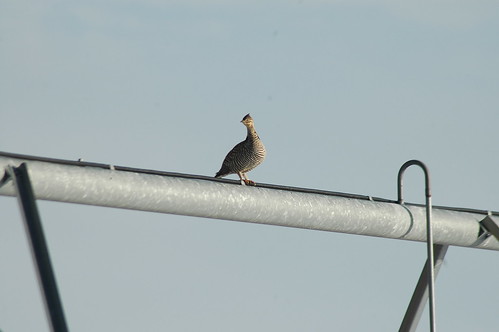
Greater Prairie-Chicken on a center pivot. Image courtesy of Tim Hajda, who has taken additional pictures of birds at the Hajda farm and elsewhere in Nebraska.

12 October 2009

DeSoto's Gooseless Wonders Contribute to Bird Distribution Research

Whether it was swallows flitting above riverine lake waters in search of a tasty insect morsel, cormorants resting on a perch or geese winging into a safe haven, each of some particular bird species noted on Sunday were a contribution that will help in the understanding of particular distribution of autumn season birds across the U.S. and a few other places of the world.

View from the Bit Sit "circle" at DeSoto NWR.

The sightings of an autumn Sunday were made during another Big Sit at DeSoto National Wildlife Refuge, along the Missouri River, west of Missouri Valley, Iowa.

With temperatures in the mid-30s, and under gray, overcast skies, the tiny observation spot for this annual event was in the comfort of the viewing gallery of the refuge nature center. Valid observations were made from a small place at the end of a hallway, with glass walls conducive to looking outside. There was warmth and chairs. A spotting scope was setup used to view the oxbow lake and other habitats visible outside the windows.

It was a good vantage point to look at where the Canada geese gathered, and to scan the water habitat which attracted other notable species. A Northern Harrier could be seen in a nearby field. Off in the distance was a Red-tailed Hawk sitting on the snag of a tree. A Pied-billed Grebe floated along, ignorant of it being noted in a tally of results for a days' research. Occasionally, gulls coursing over the lake, in search of a tasty tidbit. Other bird activity was intently watched.

Being inside, the participants were able to converse with other visitors. Some inquired about which birds were being seen, or took the opportunity to look through the spotting scope to get an upclose view of the avifauna in view.

The wintery weather of Saturday, moved waterfowl southward, and this included flocks of geese moving down the Missouri River valley.

Deb Hunsberger and James Hartman looking for bird species during the Big Sit.

For Deb Hunsberger, the highlight of her time closely watching the scene for birds was the arrival of a small flock of greater white-fronted geese, which she had not seen in a while. She was present to help - being a regular refuge volunteer - and a member of the Friends of DeSoto Refuge board. She normally birds outside, so did miss not seeing any songbirds which might have been identified after being heard among the woods along the banks of the lake-shore.

The 41 species noted this year was comparable to the two previous Big Sits, when the watchers made their observations from a boardwalk on the east side of the nature center, and outside.

During the morning, when the majestic Bald Eagle was seen winging southward over the oxbox lake, Jim Hartman noted that a pair have raised a brood - just off to the east on the refuge - since 2000. Next season, the refuge will install a web-cam at the nest, so live views of the breeding activity can be sent back to the nature center. This will help with environmental education efforts, he said, and allow visitors to get a close-up view of the birds' breeding activities.

DeSoto refuge is "happy to participate in this important research effort," said Hartman, a biologist at the refuge. "DeSoto NWR was established as a refuge for migratory waterfowl. So birding is a natural fit on our refuge. The date of The Big Sit falls in National Wildlife Refuge week. We were looking for activities to do during that week and found this one."

The moniker "Desoto's Gooseless Wonders" refers to the dramatic change which has occurred at the refuge, which was formerly a haven for tens of thousands of snow geese during autumn migrations. Snow geese which formerly occurred, now migrate further west, Hartman said, noting that people still call and ask when the geese will be present.

The Big Sit is always held on the second Sunday of October. DeSoto NWR has participated for three years, and plans to be involved next year as well, Hartman said. About 10-12 people have participated each year.

There were 194 registered circles for the Big Sit this year, with eight located outside the U.S.A.

Species noted during the Big Sits done at the refuge.
The 1 is used to represent that the species was observed, and does not have anything to do with the number present, which is not recorded.

Common Name

Oct 2007

Oct 2008

Oct 2009

Greater White-fronted Goose

-

-

1

Snow Goose

-

-

1

Canada Goose

1

1

1

Wood Duck

1

1

1

Mallard

1

1

1

Blue-winged Teal

-

1

1

Northern Shoveler

-

-

1

Northern Pintail

-

1

1

Green-winged Teal

1

1

1

Common Goldeneye

-

-

1

Common Merganser

1

1

1

Ring-necked Pheasant

1

1

1

Wild Turkey

1

1

1

Northern Bobwhite

1

-

-

Pied-billed Grebe

-

-

1

American White Pelican

1

1

1

Double-crested Cormorant

1

1

1

Great Blue Heron

1

1

1

Great Egret

1

1

1

Turkey Vulture

1

-

1

Osprey

1

1

-

Bald Eagle

1

1

1

Northern Harrier

1

-

1

Broad-winged Hawk

-

1

-

Red-tailed Hawk

1

1

1

Prairie Falcon

-

-

1

Killdeer

-

1

1

Ring-billed Gull

-

-

1

Rock Pigeon

1

1

-

Eurasian Collared-Dove

-

1

-

Mourning Dove

1

-

-

Great Horned Owl

-

-

1

Barred Owl

1

-

-

Belted Kingfisher

1

-

1

Red-bellied Woodpecker

1

-

1

Northern Flicker

1

1

1

Acadian Flycatcher

1

-

-

Eastern Phoebe

1

-

-

Blue Jay

1

1

1

American Crow

1

1

1

Tree Swallow

1

-

1

Bank Swallow

-

1

-

Cliff Swallow

-

-

1

Barn Swallow

1

1

1

Black-capped Chickadee

1

-

-

Eastern Bluebird

-

-

1

American Robin

1

-

1

European Starling

1

1

1

Northern Cardinal

1

-

1

Common Grackle

1

-

1

American Goldfinch

-

-

1

House Sparrow

-

-

1