19 October 2013

Fashionable Cruelty - Slaughter of Birds for Ladies' Hats

What Mr. Bergh Thinks of It

Walking up Broadway one fine afternoon lately, a Tribune reporter noticed an unusually large display of plumage on ladies' hats. He was the wings, plumes, heads and bills of red birds, yellow birds, robins and humming-birds and almost every variety of the feathered songster known, doing duty in adorning the headwear and trimmings of the enthusiastic devotees of fashion. In many instances the birds that looked so pretty on those jaunty hats were complete, and the stuffed songster looked as gay as in life. In the windows of a millinery store, frequented mainly by wealthy ladies of fashion, the reporter saw many hats thus decorated. With a hesitating stop he went in and was met by a stout dame, who wore on elaborate dress dotted with dead fire-flies. In life these fire-flies had undergone a squeezing process, which causes the phosphorus in them to exude and has the effect of making a brilliant costume.

The storekeeper informed the reporter that fire-flies are imported from warm countries, mainly the Indies, where they are preserved for market. She had them for sale. One of the large counters was almost entirely covered with stuffed birds and various parts of birds, trade to be placed on hats and trimmings, as the fancy or taste of the wearer might suggest.

"Are you not afraid of being arrested for cruelty?" asked the reporter.

"No, indeed! We import them," replied the woman, looking the reporter out of countenance. "They would not arrest a woman?" she asked or rather stated in the most assuring manner.

The reporter called on President Bergh, who said: "I have noticed lately that this cruel onslaught is increasing. There is a greater display of these little tortured creatures than ever before. I notice it in the fashionable stores to upper Broadway, in cheap 6th avenue, and down in 8th avenue. The wanton slaughter, flaying birds alive, and tearing feathers from their quivering bodies, is the most barbarous cruelty that can be practised. It is an insult to the civilization which we boast. The savages can do no more than that. If he does take a few feathers from a fowl, it is the pride of a warrior that prompts him, not a merciless vanity, and he is, therefore, more excusable that our more cultivated and refined people. The feathers are plucked from these living birds, and their limbs are torn from them while in the agonies of death, under the impression that if the feathers are cured while the blood is warm they have a fresher and more lasting tint.

"They may import a few," continued Mr. Bergh, "but the demand for birds has become so great of late that the Jersey farmers are now trapping pigeons and raising squabs for this market, to be sacrificed to cruel fashion whims. The squabs are killed when only a few weeks old and their plumage is fresh and bright. A stuffed squab sometimes looks more "cunning" on a hat than a full-fledged pigeon. Stuffed squirrels are also largely used. What is more ridiculous, and yet suggestive of insatiable vanity than to see a couple of squirrels on a woman's hat? These squirrels are brought over from Jersey and the Long Island bogs by boys who sell them at 15 or 20 cents each. The young squirrels are generally selected for this bloody sacrifice because of their desirable size. Cats were formerly used, but there was so much trouble in cutting their skins down to the proper size that kittens have been substituted.

"It seems that nothing — not even the most defenseless and prettiest of God's creatures — the birds of the air, can escape the merciless hands of fashion's slaves. Fashion has such an unlimited power that are women are not only dead to mercy, but ruin their own health and sacrifices their lives in following its arbitrary decrees. A few years ago, England, and even India, took steps to prevent the further slaughter of birds. But America has done practically nothing.

"If the wealthy ladies of fashion of this city should set the fashion at discountenancing this practice, a great deal would be accomplished. If the leaders of society would cease using ornament's that were obtained only through cruelty, there would soon be no demand for them. The prevention of this slaughter rests with the leaders of fashion more than with this society; for the work is done so secretly that we cannot traces the doers to their butcher shops or get even the slightest evidence. We see only the results of their cruelty. So poplar has this cruelty of plucking live animals become that live geese are picked under the impression that the feathers make a better bed than if they were plucked after the goose was killed."

December 10, 1884. Washington D.C. Evening Star 64(9867): 3. From the New York Tribune.

Urbane Autumn Visit of Prairie Meadowlarks

After an extended walk up and down the hills on the west side of the Missouri River valley while retrieving aluminum for recycling purposes, and following a bicycle-based survey of birds based upon a long and detailed view of an area oxbow, my movement was quashed by the surprising sighting of a single meadowlark.

This bird was going about its usual larkian antics during the midst of a Sunday's time. It was walking about the low-shorn grass looking for a tidbit to eat, its mode of movement mostly dependent upon its two feet. While making its way along the side of a hill, when a local resident of color and unknown nationality stopped for a moment to glance at this particular bit of birdlife, he then moved along. The lark just walked a bit quicker away. During its transit, it moved a little bat faster and had to resort to a quick burst of flight to transport it from 49th Street into the adjacent, asphalt-covered parking lot where beer cans often lurk. Otherwise? Well, the situation ended in a manner which does not require an otherwise ... except one of continuation of a bird in action.

As it is autumn along the Missouri River valley, this migratory species more often seen about Nebraska grasslands, was walking around a tiny bit of green turf just south of 49th Street and Hamilton Street. There is no prairie expanse or even any sort of a bit of a natural grassy place which a wandering meadowlark might seem to prefer. Yet this lark of the east was satisfied with the situation.

The obvious occurrence conveys, once again, a meadowlark in the neighborhood. Seen mid-day, it was not seen later in the afternoon while gathering aluminum cans strewn about the area, while on a walk-about to note the local birdlife on a splendid autumn day when being outside was a preferential place.

While purchasing refreshments at the Hamilton Convenience Food Mart on Tuesday the 15th, the clerk Walt said there had been a meadowlark out in the parking lot yesterday. The date of occurrence was repeated three times, upon a request to get a particular indication of when there was still a lark within the city confines.

On the day he noted the visitation by a meadowlark, he talked about Red-tailed Hawks which nested in the vicinity, and about a protective parent focused upon a young bird on the ground. The youngster did not survive he said, and the cause of its demise seemed to be a cat, according to his perspective. His comments were nothing new, as he had indicated that some other patron had taken a picture of a small owl, immediately southeast of Metcalfe Park, as he was shown the picture. Some time many months ago, he indicated the visiting gulls and a Bald Eagle eating a squirrel in the same property lot where the meadowlark lingered.

Some people in Carthage appreciate birds and pay attention to their presence, and also, more importantly share their views.

Perhaps that is why there is food provided to the local birds at the place? Walt now throws out seeds or some other sort of food appreciated by the autumnal flocks of House Sparrows. Some of these flighty birds are a sight preferential to looking at the many aluminum cans or whatever other trashy items get tossed away, at particular places in the neighborhood!

While looking towards the ground a lively meadowlark is obviously a better seen.

Observations of a meadowlark in Carthage were another opportunity to appreciate this species. On October 18, 2012 a meadowlark was seen at the same place.

Might this be visitation by a single bird which during its migratory flight has found that Carthage is a place to visit? Only the bird(s) know, and their perspective is not written in any book.

15 October 2013

Omaha's Zesto Building Conveys Design Problems and Causes

The relatively recently built Zesto building in North Downtown is gaining prominence for its significance associated with bird-window strikes.

The weekend of October 12-13 was especially revealing. Primarily the east facade — but newly realized for the north facade — the structure had at least seven window strikes on Saturday (four) and Sunday (three). There were certainly other strikes. Rainy weather on the morning of October 14th, limited survey efforts due to the wet conditions for a route which is usually traversed via a bicycle.

Birds were obviously active in the landscaping associated with the west parking lot of the CenturyLink Center, and on the north side of TDAmeritrade Park. They could be seen flying among the trees and ground vegetation, early in the morning.


A portion of the northern treescape at the west parking lot of the CenturyLink Center, with the Zesto building in the background.


Tree and ground vegetation on the south side of TDAmeritrade Park, which is directly north of the Zesto Building, on 12th Street.

Some of them hit the outer glass of the three businesses at this location: Zesto (at the south end of the building, and which is currently closed for the season), Blatts Beer and Table, and Lids Locker Room.

Most of the strikes occurred because of the glass exterior of Lids Locker Room, which is deadly to migratory birds.

Within a few days of mid-October, at least a dozen strikes occurred, as shown by the available records, derived from site visits on each day indicated from October 5th to October 13th. Weather during the most recent weekend was especially hazardous, as clear skies, slight winds and dearth of storms meant that many birds moved south in association with their autumnal migration.

  • 278: 3
  • 279: 1
  • 281: 1
  • 285: 4
  • 286 (October 13th): 3

During the Saturday visit, while appropriately dealing with the triage of the birds already dead or injured on the sidewalk along the east side of the building, another bird bounced off the glass and, thankfully, was able to continue its flight onward back to the trees at the CenturyLink parking lot.

Once notes were written, the mornings' route continued on both Saturday and Sunday. There may have been other disabling strikes that happened, but there were other hazardous buildings to survey in downtown Omaha, along the riverfront and bluffs of the great migratory flightway associated with the Missouri River.

The species noted during 2013 at the Zesto building have, thus far, been the: Orange-crowned Warbler (one which was moved away from the sidewalk to beneath a tree and upon the few square feet of mulch, so it could die on a natural surface); Yellow-rumped Warbler (one), Mourning Warbler (one), Common Yellowthroat (five, which have mostly been female birds), Clay-colored Sparrow (three); Lincoln's Sparrow (seven, including some which hit the glass and suffer for quite a time upon the sidewalk as they recover); White-throated Sparrow (one); and, Dark-eyed Junco (one).


Pictures showing bird strike victims and the setting at the Zesto Building in North Downtown.


There was only one window-strike noted at this building during the autumn of 2012, in September. Six strikes are known to have occurred in May 2013. Add in an additional occurrence on September 11, 2013 to indicate the tally of suffering wrought by the architectural features of this place.

Dangerous Architecture by Design

Owners of the Zesto building are probably not aware of how dangerous their building is for appreciated migratory birds. Nothing has been done to address this intentionally built structure, which can now be known for its well recognized facet of causing bird deaths, as well as for other lesser features.

The obvious threats associated with this building were originally conveyed to its architect's before the plans began to become a structure. Some of the first strikes were indicated to the agency, so they are aware of the results.

Several obvious changes wrought the demise of so many birds in North Downtown. They include:

  1. Clearing of the historic setting for urban redevelopment which has changed the urban habitat;
  2. Requirements by planning officials of the City of Omaha which require landscaping features, as supported by advocacy groups such as Omaha by Design, for example;
  3. Building architecture which include prominent glass facades, instead of the more "passive" wall features, such as brick, used for historic construction;
  4. Failure of building architects to actively consider bird-safe designs;
  5. Construction of numerous buildings with associated plantings which attract birds to a hazardous environment;
  6. Failure of building owners to suitably address problems at places where bird strikes occur and have been repeatedly documented;
  7. Failure of the U.S. Fish and Wildlife Service to enforce the Migratory Bird Treaty Act, wherein every bird strike is considered a taking of a protected species; and
  8. An obvious lack of intention in multiple instances by building owners to show any concern for conservation of wildbirds associated with the Missouri River valley. This is especially the case at the CenturyLink Center and TdAmeritrade Park managed by the Metropolitan Entertainment and Convention Authority, at the 1200 Landmark Center, the Curtis Federal Building which has offices of the United States National Park Service, the Gottschalk Freedom Center associated with the Omaha World-Herald, Central Park Plaza, actions by the an unctuous official associated with the First National Bank tower, Union Pacific Center which is the home to a company which has millions of dollars in profit throughout the year and would would seem to be sufficient to provide funds to establish a bird-safe building, Holland Performing Arts Center, Zorinsky Federal Building which has federal offices and whose building management ignore the mandate of a "sister" agency of the United States of America government, Omaha-Douglas Civic Center, Law Building, etc.

Steps can be taken to reduce the incessant and illegal "taking" of wildbirds. There are a multitude of options, obvious to any knowledgeable and tendentious observer. This includes especially blinds which would be relatively inexpensive and not mar the static display of merchandise which no one might look at during the overnight and early morning hours.

Wildbirds are dying and suffering for unnecessary reasons in north downtown, and well as in the greater downtown area! Every building owner where they occur is responsible!

12 October 2013

An Evening Nighthawk at Carthage

It is late in autumn for nighthawks to occur
But based upon a vivid look there is no reason to demure,
It was a late season view of a nighthawk so profound
Which was an observation based upon reasons so sound,
Among the birds of an evening's flight
This species presence was more than slight,
It was a single nighthawk seen
Flitting southward over the Carthage scene,
Though it is rather late in the season,
For one to be seen there is no adverse reason
The lengthy wings and flight seemed to be characteristic,
But being seen far away the id may not have been distinctive.
 
With other birds prevalent among the skies of an October eve,
Wending their way onward and often only slightly seen,
The primary time watching above during the descending light,
Was observing antics of swifts in numbers not slight.
It is autumn and here are chimneys where they descend,
Which are places were a birders time might ascend.
Swifts can only be enjoyed with attention,
Based upon multiple observations to enforce retention.
Get out in the night and enjoy the sight,
Because the time will be time spent so right.
Written October 11, 2013 while on the scene.

11 October 2013

Swift Watching at Dundee Streetscape Dedication

On a fine October morning, many more than fifty people gathered at the corner of 50th Street and Underwood Avenue to recognize the completion of the Dundee streetscape improvement project.

Politicians talked. A local activist expressed their view. Contributors associated with the local utilities company, other contributors, etc. were also recognized by speakers the four primary speakers at the podium.

Above it all, the skies were a barren blue. Chimney swifts — the original bugeaters — coursed hither and yon up there following their natural proclivity to snag an edible morsel.

Several newly installed metallic benches have been placed at this corner. On this Thursday morning, there was the first instance when a local bird enthusiast sat down on one of these benches, and looked at the swifts in the skies above central Dundee.

Win Finegan, a local resident, was the first to appreciate the swifts as seen from these new Dundee benches. There were more than ten obvious to a watcher with the knowledge to see them going around the dome of the sky. She rode her bicycle to the morning's event. Also noticed, was one Turkey Vulture floating above the scene. Robins and grackles were also about.

During the morning, work was still underway on creating the rain garden at the same corner which will add additional flora diversity. The new trees put in place are now rather scrawny.

Win Finegan gazing up at the swifts overhead, from the comfort of one of the new streetscape benches.

The crowd at the dedication ceremony. More than 60 people attended.

Mary Romero speaking, and in the background, from right to left: Jean Stothert Mayor, and City council members Chris Jerram and Pete Festersen. New bicycle racks are visible in the background.

Mary Romero on top of the new landscape rock, that is now part of the corner setting.

Another Presbyterian Church in Dundee Caps Swift Chimney

On October 10, 2013, another important chimney used by Chimney Swifts was capped by a presbyterian church in the greater Dundee area.

Contractors indicated they would be placing a cap atop the chimney at the Central Presbyterian Church, 55th and Leavenworth Streets. Apparently the heating and cooling system is being modernized.

One contractor did refer to there being a "hundred years of pigeon poop" at the base of the chimney. This was undoubtedly swift droppings, instead, though apparently pigeons have occurred at the site. This was the last comment from one of the three men sitting on the tail-gate of a pickup, or standing around, before they refused to provide any further details, including one basic question as to why the chimney needed to be capped.

Information from church officials could not be obtained as the contractors threatened arrest if the yellow cautionary tape was ignored. Other doorways into the building were locked during the mid-morning visit. They then said was a safety issue.

There was no danger because there was no work underway at the time!

In 2012, the church had its one hundred year anniversary, so swifts have undoubtedly been using this chimney for many decades.

During the two visits on the morning of the tenth — once when the work was initially observed while bicycling westward, and then a couple of hours later for further investigation — there was a swift or two present in the airspace above the church.

Historic records indicate a season's used of this urban habitat:

  • 10/03/2008: 235
  • 10/07/2008: 360
  • 10/12/2008: 120
  • 10/15/2008: 132

These records obviously indicate a historic use of the chimney by the swifts, and indicate dates when similar visitation could have occurred.

There are undoubtedly other dates when Chimney Swift use could have been denoted, but it is impossible to provide complete and thorough coverage when resources and, more importantly, observers are limited.

This chimney roost is now gone, thanks to the changed situation. A phone call to their office on Thursday resulted in a lively discussion associated with their replacement of the building's boiler. This was not the issue, but the point was that the change would result in a lost habitat.

There was apparently a consultation with an engineering company, which obviously were indifferent as to how the change would impact a habitat used by multiple generations of swifts. Although it may be improper to use quotes from someone not realizing that their words might be denoted further, the words conveyed were however pertinent: a "church is not a haven for birds" with another comment from the church person that they "don't have time to talk about birds."

This is a limited perspective, much to the chagrin of bird enthusiasts and to the sad result for bugeaters about the church area in the city of Omaha.

There seems to be a trend for presbyterian churches in Dundee to obliterate roost habitat as they undertake actions which they considers as improvements.

Another recent example of a similar situation was at the Dundee Presbyterian Church, when they undertook similar action, a couple of years ago, which also destroyed a roost well known and appreciated by migratory swifts.

The swift's place is no longer available for their important use. What a sad day for so many bugeaters striving to survive as they make their way southward during this autumn's migration.

Images of workers destroying access to a former swift chimney

10 October 2013

Demise of a Big Red Chimney Utilized by Swifts

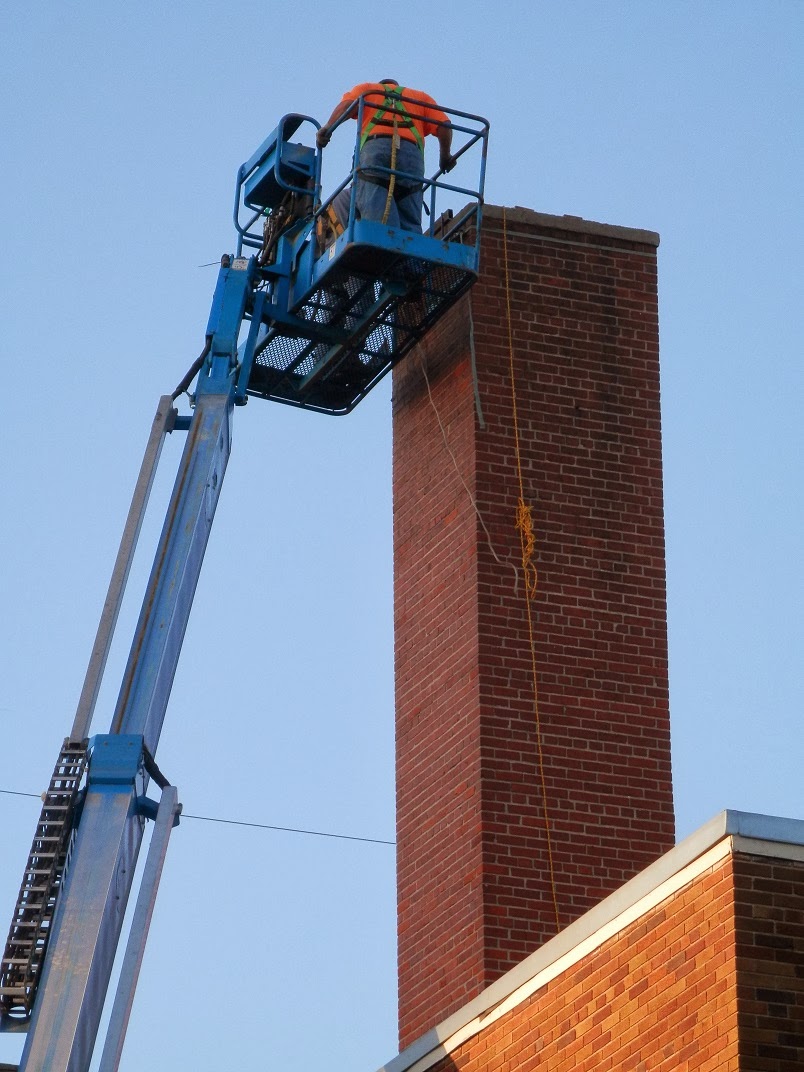
The clues could not be missed. There was work underway that would permanently alter the scene for a significant chimney repeatedly used by migratory chimney swifts in eastern Omaha. The progress was obvious based upon daily observations, most often in the evening when workers were not present. Once the final change occurred the results became readily apparent as they transitioned along the brick walls of the significant building along Izard Street just east of 43rd Avenue. Spots of differing color indicated what was going to happen.

The chimney was tall and especially a big vivid red in splendid color echoed by the reddish tinge of the little fluffy clouds overhead, one recent evening. But on Wednesday, October 9th, the big red chimney was gone. Its six sides of brick which had been prominent with a consistent red hue was obliterated.

Typical for Omaha, no sooner is a landmark recognized than it gets altered. This particular architectural feature — recently dubbed the big red chimney — has been recognized for years as a place especially appreciated by the bug-eating Chimney Swifts. They know the place well, as regularly in the autumn, more than a hundred roost among its internal confines on many different nights.

The big change was, however, simply one of color. "Big Red" is now covered by gray paint, with the structure still the same. Chimney Swifts (148) using this roost site as duck descended on October 9th, as day declined, were indifferent to the cosmetic change which was nothing different from their birdly perspective.

Thankfully, the roost habitat remains for swift use on more pending days?

The roost on the evening of October 9th, after the swifts had all arrived.