A summer expedition to Mongolia was a complete success according to the men that traveled from the central plains of North America to the eastern Asia country to investigate the unique and different features of natural history and to evaluate the presence of different diseases and how they may have an influence on public health.

Typical mountains in the region visited by the expedition. Two photographs courtesy of Pete Hosner. Additional photographs shown within the text as thumbnails are courtesy of the expedition members. Click on the image to go to a larger size. |
During a recent conversation with Dave Tinnin, Gabor Racz and Terry Haverkost - associated with the University of Nebraska-Lincoln – each conveyed the distinctive events of the expedition. Comments from Pete Hosner, the ornithologist and graduate student at the University of Kansas, were provided by email.
This trip was a year later than planned. The original intent was to start a three-year period of study in 2008, but due to troubles with transportation of expedition materials, the research started this summer instead.
The UNL men left May 25th on a plane flight, east 25 hours to Seoul, in South Korea. Then it was onward to Ulaanbantor, the national capital of Mongolia where the entire party gathered before departure into the distant country.
Much of the essential gear needed for the survey tour was already present in the country, being stored from its prior arrival. Supplies included gallons of peanut-butter important as a bait for traps used to lure small mammals, they noted.
Minimal food was shipped in, according to the group, with many of the essential food staples bought at western-style stores present in the country's capital. A couple of larger provincial capitals also sold needs for the roving crew, which started with 18-20 but settled to from 10 to 16. Bought locally were pasta, rice, onions, potatoes, cabbage and some vegetables, they said. Butchered goats and sheep provided meat.
The party left the capital city early in June to drive and camp about the Gobi Desert region in the south of the country, staying at six sites to explore the local vicinity, continually until July 18-19.
Gobi Desert Days
Four vehicles transported the research crew from the capital to other regional, urban centers and on to the primary camps.
Transportation along primitive roads was provided by a military transport truck, one or two Russian-made mini-buses 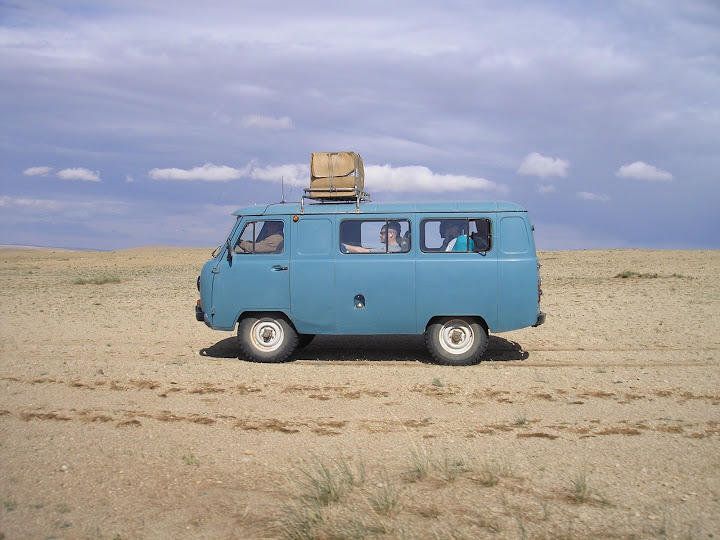 and a land-cruiser. It was a difficult environment for vehicles, said Gabor. "The roads were rough, dusty and sandy, and the gasoline was usually of a poor quality, often having been shipped to local centers, and stored in rusty tanks."
The roadways were often spread wide on the land, as when a particular track became too rutted, the path spread outward, with an area of ruts occasionally being a mile in width because drivers would establish new tracks, "destroying land along the corridor," the researchers noted.
An independent contractor provided the vehicles and a driver that also took care of the vehicles. The transportation was organized with the help of the National University of Mongolia, which was closely involved in the project.
The first portion of the overland journey was about 550 kilometers from the capital to Dalanzagad, and then onward to Gobi Gurvan Sayhan, a national park which was the primary place for the groups' research. The Ikh Bogd region to the north, was also an area investigated.
Local Sustenance
The local food "required some getting used to," Racz said, especially noting that there was no concept of refrigeration. "It took a while to get used to the simple diet."
A sheep or goat that was butchered locally by the residents, was usually dried and made into jerky. Milk 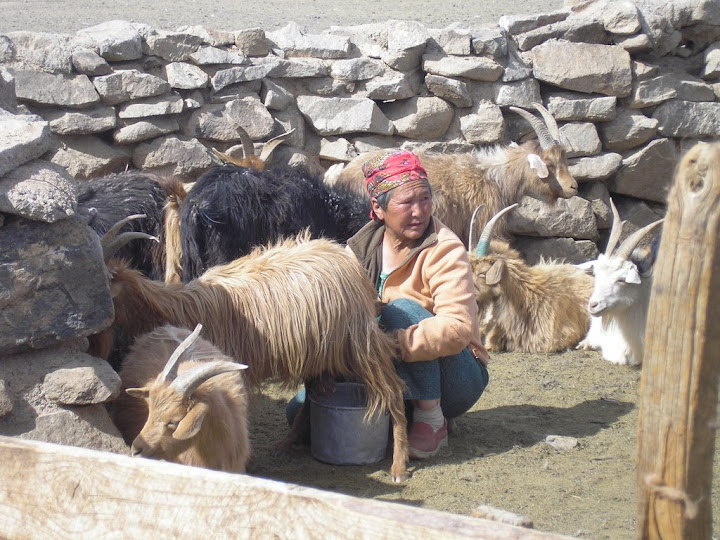 was usually made into a dry sour cheese.
The hired cook 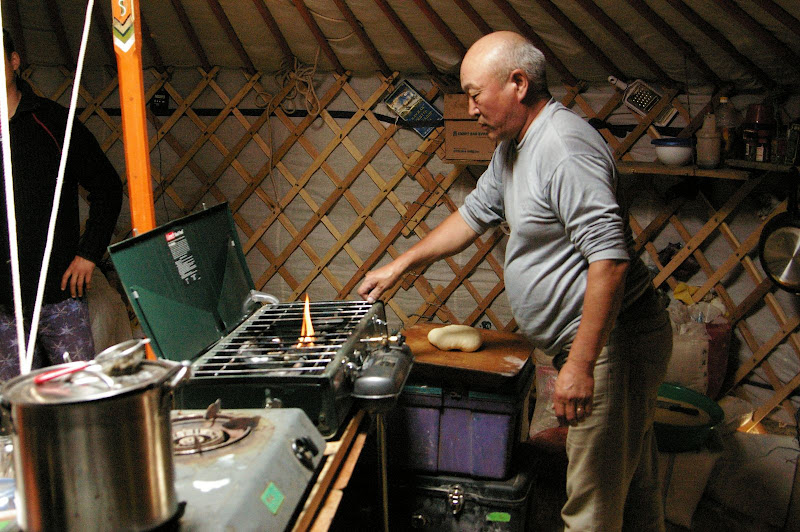 - using two kerosene stoves - usually made a goat stew for every meal, with fried bread often included. The only variety was a stew made from sheep meat.
The local means were quite limited. Eggs were available a couple of times to add a bit of variety.
Gobi Gurvan Sayhan Park
Local habitats of this national park - which was the primary research region - included desert grassland, marsh, small areas of forest and some uplands which were alpine grassland. The researchers found that most of the grasslands were well grazed, and in noting the features of the forests, realized they were more brushy due to the dry climate, rather than being large trees with a predominant canopy.
The three UNL researchers all agreed upon the success of this year’s efforts.
About 873 specimens of small mammals were procured, which was twice as many as were expected. These were mostly voles, jerboas, pikas and a few rabbits. Skins were prepared as scientific voucher specimens from the trapped specimens, with tissue samples also taken.
There were 2100 samples of parasites procured, with about a third of the animals being infected and providing a documented source.
Based upon sampling or observations from each area visited, there were about 180 different species of birds noted.
As for herptiles, there were 180 or so records, even though there are few known species in the country.
"Over the course of the trip we recorded about 120 species," of birds, Hosner said. "Birding in Mongolia is all about habitat diversity, as any single habitat has only 10-20 birds species. However, slight differences in habitats (i.e., rock outcroppings vs. no rock outcroppings, bare earth vs. grass vs. shrubs) added up to provide a decent number of birds for such a dry and northerly area. The most similar areas in the United States are the high plains of Wyoming, Montana, and the Great Basin.

Adult Lammagier and chick at a nest. |
"For notable bird records, we had one vagrant, the Black Drongo, which is the second report in the country, and is an overshot migrant from further south. Some of the typical interesting birds of the region included Mongolia's only breeding endemic, the Mongolian Accentor, Mongolian Ground-Jay, Altai Snowcock, Demoselle Crane, Mongolian Lark, and Saxaul Sparrow. Birds of prey are very common, and Mongolia has some of the largest populations of birds like Saker Falcon, Lammagier, Cinereous Vulture, and Griffons.
"On the down side, we really missed out on the waterbirds of the country. Mongolia has numerous basin salt lakes that contain great diversity and numbers of waterfowl, migrant and breeding shorebirds, and Gulls and Terns. There has been a long drought, and many of these lakes (including every one we were near) have completely dried up, which is a great concern for conservation of some bird species like the Relict Gull" which breeds in colonies on saltwater lakes. This gull is classified as vulnerable on the 2009 IUCN Red List.
Precise Localities for Specimens
GIS coordinates - denoting a precise latitude and longitude - were most useful for indicating the place where a specimen had been collected, as local place names varied. Some historic Russian military maps from 1950 provided geographic particulars, but local residents were often confused by the designated names. The accepted place name may have been revised, and a recognized spelling was often different in comparison language of the current communities.
The local residents did not depend on maps, but their movements were based on an intimate familiarity with the land and the places they traveled.
Personal Highlights
Each of the men shared a particular highlight of their time in the country, when they agreed how easy it was to lose track of time when the only indication of the daily chronology were the regular field notes marking the changing days:
Terry Haverkost: He had been checking small mammal traps in the forest, and had to stop along the way to buy a goat from a local Mongol family. After drinking an offered "airag," or fermented mare's milk drink that tasted like sour milk and was chunky as well, he also took advantage of an opportunity to ride a two-humped camel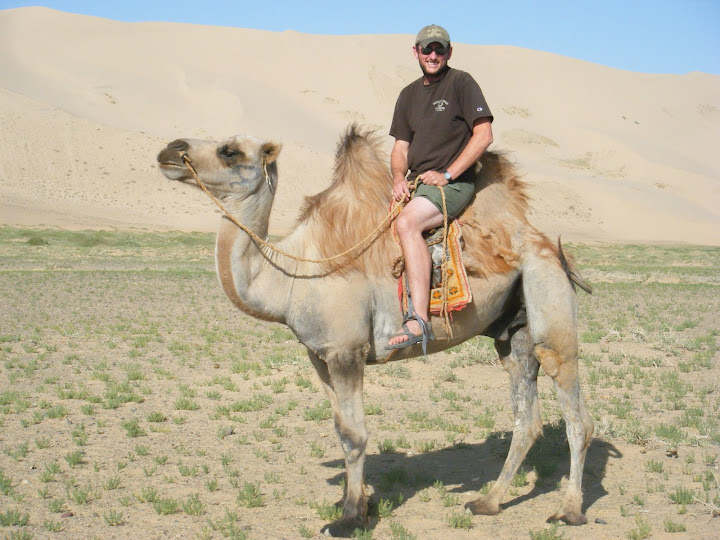 . The animal was agitated, and despite being led along, decided to move ahead and make its own way. When the saddle slipped off, its user followed. This was his first and only time to have had the distinct experience of falling from a camel, anywhere in the world.
Dave Tinnin: winds of the great Gobi desert seemed to never end. At one camp - while within a somewhat sheltered compound for a few days - the bothersome winds blew at 50-70 kilometers per hour, spreading sand and making for some harsh outdoor conditions.
Gabor Racz agreed that strong winds were a prominent feature of the Asian lands. The tents often flapped in the strong winds, poles were bending under the pressure of the gales, and on occasion stakes were pulled from the ground. "It was often difficult to sleep due to the flapping of the tents," he said.
Windy conditions also were hazardous to the cameras being used to record essential images for the expedition. Solar chargers were part of the expedition gear, and were vital to recharging batteries. Digital cameras were typically used, and at the end of the harsh times, only two cameras still worked. A couple of generators among the gear could provide a means to recharge batteries, or were used to provide light for taking notes or studying specimens when there was insufficient natural illumination.
Pete Hosner’s "favorite site visited was the top of Ikh Bogd Mountain, one of the largest mountains in the country, well over 13,000 ft. At the top of the mountain there was still snow in July, and a lush alpine meadow with many flowers and butterflies typical of the Rockies or Alps, not what one expects in Mongolia. We even had Asian Rosy-Finches up there, which are close relatives of the North American species, and similar in their habits."
Future Research
The grant from the National Science Foundation which supported this expedition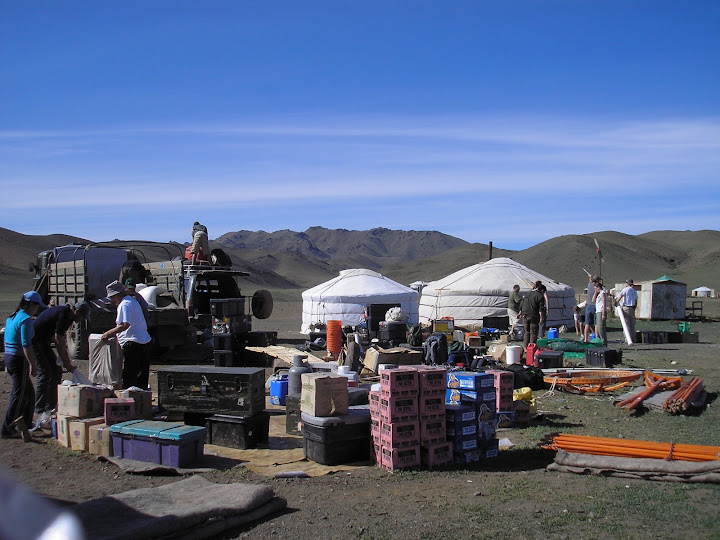 , provides for three years of field work in Mongolia.
The basic information needed is knowing what is present in the areas surveyed, said Tinnin. Although there had been some limited scientific work in the latter 1990s, there were still some places in the park not previously surveyed.
The three investigators agreed on the importance of letting people know about the natural diversity present, and how the findings of the expedition could help with efforts to conserve the natural features of the region.
Mongolia is twice the size of Texas, and in the southern region visited, the mountainous terrain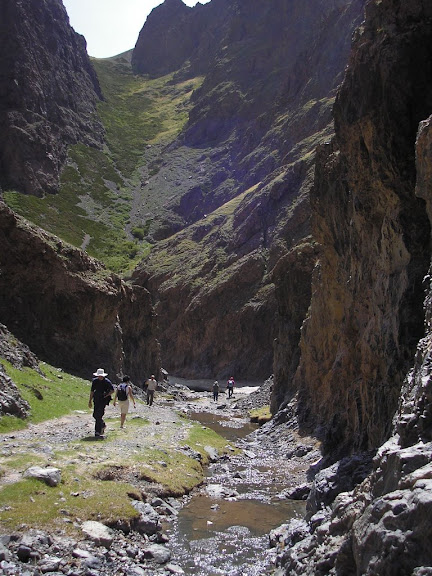 has numerous plateaus which are very isolated, where it is "poorly understood" what fauna is present, said Racz.
Knowing more about these areas is essential in realizing the effects of population isolation, the genetic variety of diversity, and simple basics such as species composition at different places.
has numerous plateaus which are very isolated, where it is "poorly understood" what fauna is present, said Racz.
Knowing more about these areas is essential in realizing the effects of population isolation, the genetic variety of diversity, and simple basics such as species composition at different places.
Changing Conditions
Although further analysis of results will be done to clarify the results of the first season of field studies, there are some preliminary indications.
In particular, the men realized that some species that might have been expected based on historic records, they no longer occur. In other instances, species formerly present may occur in lesser numbers.
Habitats are also changing. For example, a large, shallow lake shown on maps from the past, is no longer present, apparently having dried up due to an ongoing drought which has endured for several years, perhaps because of climate change, they said.
Alpine environments, especially meadows, are disappearing, seemingly from drying out in a climate with reduced precipitation.
This initial season of the expedition has started the evaluation of natural history of the Gobi region. Its findings can have a vital role to determine how known Asian ecosystems are changing due to human impacts and a changing environment.

