Showing posts with label expedition. Show all posts

18 September 2009

Expedition Explores Natural History of Mongolia

A summer expedition to Mongolia was a complete success according to the men that traveled from the central plains of North America to the eastern Asia country to investigate the unique and different features of natural history and to evaluate the presence of different diseases and how they may have an influence on public health.

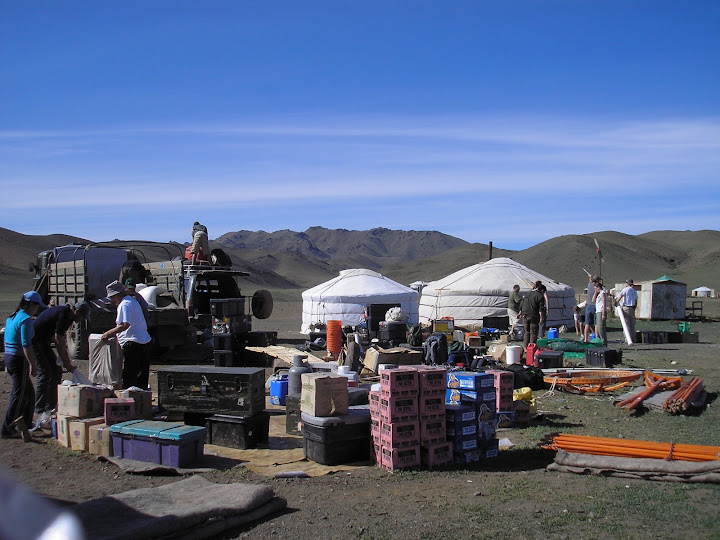
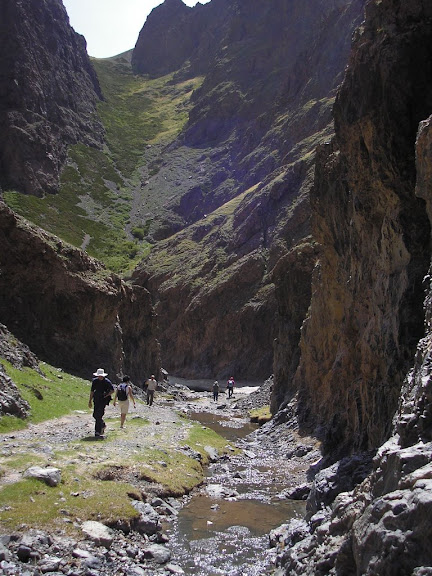
Typical mountains in the region visited by the expedition. Two photographs courtesy of Pete Hosner. Additional photographs shown within the text as thumbnails are courtesy of the expedition members. Click on the image to go to a larger size.

During a recent conversation with Dave Tinnin, Gabor Racz and Terry Haverkost - associated with the University of Nebraska-Lincoln – each conveyed the distinctive events of the expedition. Comments from Pete Hosner, the ornithologist and graduate student at the University of Kansas, were provided by email.

This trip was a year later than planned. The original intent was to start a three-year period of study in 2008, but due to troubles with transportation of expedition materials, the research started this summer instead.

The UNL men left May 25th on a plane flight, east 25 hours to Seoul, in South Korea. Then it was onward to Ulaanbantor, the national capital of Mongolia where the entire party gathered before departure into the distant country.

Much of the essential gear needed for the survey tour was already present in the country, being stored from its prior arrival. Supplies included gallons of peanut-butter important as a bait for traps used to lure small mammals, they noted.

Minimal food was shipped in, according to the group, with many of the essential food staples bought at western-style stores present in the country's capital. A couple of larger provincial capitals also sold needs for the roving crew, which started with 18-20 but settled to from 10 to 16. Bought locally were pasta, rice, onions, potatoes, cabbage and some vegetables, they said. Butchered goats and sheep provided meat.

The party left the capital city early in June to drive and camp about the Gobi Desert region in the south of the country, staying at six sites to explore the local vicinity, continually until July 18-19.

Gobi Desert Days

Four vehicles transported the research crew from the capital to other regional, urban centers and on to the primary camps.

Transportation along primitive roads was provided by a military transport truck, one or two Russian-made mini-buses and a land-cruiser.  It was a difficult environment for vehicles, said Gabor. "The roads were rough, dusty and sandy, and the gasoline was usually of a poor quality, often having been shipped to local centers, and stored in rusty tanks."
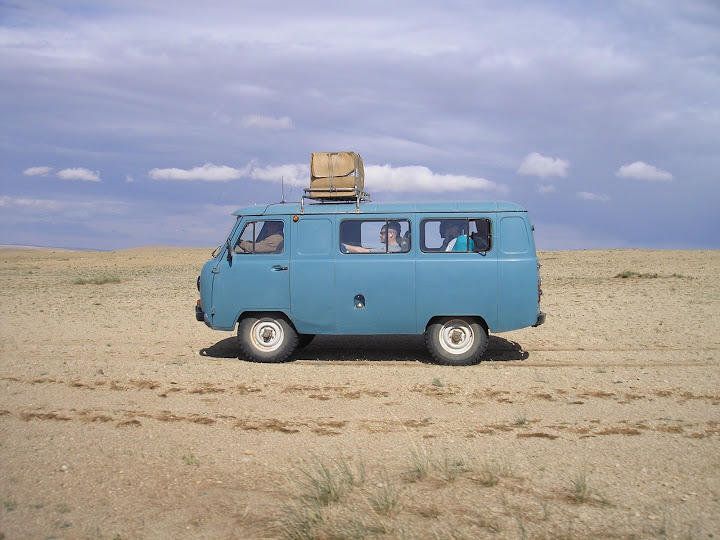
The roadways were often spread wide on the land, as when a particular track became too rutted, the path spread outward, with an area of ruts occasionally being a mile in width because drivers would establish new tracks, "destroying land along the corridor," the researchers noted.

An independent contractor provided the vehicles and a driver that also took care of the vehicles. The transportation was organized with the help of the National University of Mongolia, which was closely involved in the project.

The first portion of the overland journey was about 550 kilometers from the capital to Dalanzagad, and then onward to Gobi Gurvan Sayhan, a national park which was the primary place for the groups' research. The Ikh Bogd region to the north, was also an area investigated.

Local Sustenance

The local food "required some getting used to," Racz said, especially noting that there was no concept of refrigeration. "It took a while to get used to the simple diet."

A sheep or goat that was butchered locally by the residents, was usually dried and made into jerky. Milk was usually made into a dry sour cheese.
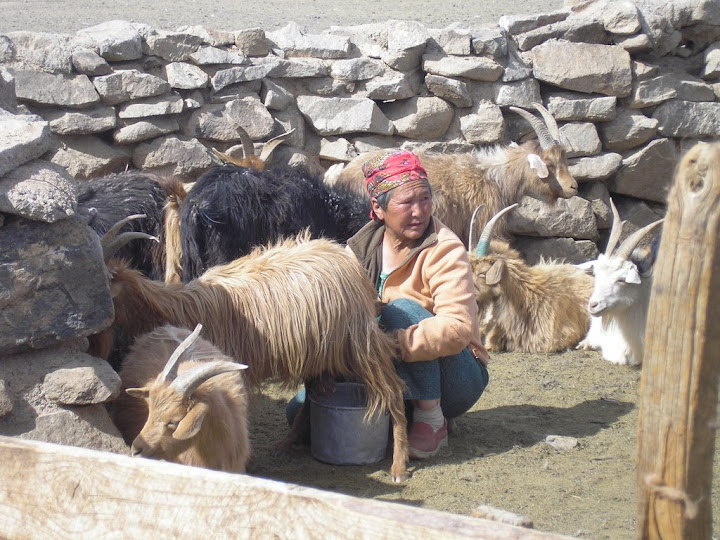
The hired cook - using two kerosene stoves - usually made a goat stew for every meal, with fried bread often included. The only variety was a stew made from sheep meat.
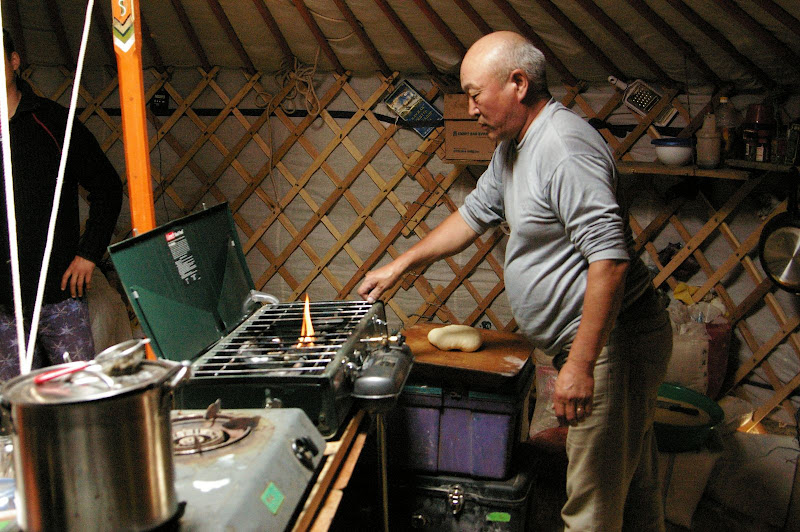
The local means were quite limited. Eggs were available a couple of times to add a bit of variety.

Gobi Gurvan Sayhan Park

Local habitats of this national park - which was the primary research region - included desert grassland, marsh, small areas of forest and some uplands which were alpine grassland. The researchers found that most of the grasslands were well grazed, and in noting the features of the forests, realized they were more brushy due to the dry climate, rather than being large trees with a predominant canopy.

The three UNL researchers all agreed upon the success of this year’s efforts.

About 873 specimens of small mammals were procured, which was twice as many as were expected. These were mostly voles, jerboas, pikas and a few rabbits. Skins were prepared as scientific voucher specimens from the trapped specimens, with tissue samples also taken.

There were 2100 samples of parasites procured, with about a third of the animals being infected and providing a documented source.

Based upon sampling or observations from each area visited, there were about 180 different species of birds noted.

As for herptiles, there were 180 or so records, even though there are few known species in the country.

"Over the course of the trip we recorded about 120 species," of birds, Hosner said. "Birding in Mongolia is all about habitat diversity, as any single habitat has only 10-20 birds species. However, slight differences in habitats (i.e., rock outcroppings vs. no rock outcroppings, bare earth vs. grass vs. shrubs) added up to provide a decent number of birds for such a dry and northerly area. The most similar areas in the United States are the high plains of Wyoming, Montana, and the Great Basin.

Adult Lammagier and chick at a nest.

"For notable bird records, we had one vagrant, the Black Drongo, which is the second report in the country, and is an overshot migrant from further south. Some of the typical interesting birds of the region included Mongolia's only breeding endemic, the Mongolian Accentor, Mongolian Ground-Jay, Altai Snowcock, Demoselle Crane, Mongolian Lark, and Saxaul Sparrow. Birds of prey are very common, and Mongolia has some of the largest populations of birds like Saker Falcon, Lammagier, Cinereous Vulture, and Griffons. 

"On the down side, we really missed out on the waterbirds of the country. Mongolia has numerous basin salt lakes that contain great diversity and numbers of waterfowl, migrant and breeding shorebirds, and Gulls and Terns. There has been a long drought, and many of these lakes (including every one we were near) have completely dried up, which is a great concern for conservation of some bird species like the Relict Gull" which breeds in colonies on saltwater lakes. This gull is classified as vulnerable on the 2009 IUCN Red List.

Precise Localities for Specimens

GIS coordinates - denoting a precise latitude and longitude - were most useful for indicating the place where a specimen had been collected, as local place names varied. Some historic Russian military maps from 1950 provided geographic particulars, but local residents were often confused by the designated names. The accepted place name may have been revised, and a recognized spelling was often different in comparison language of the current communities.

The local residents did not depend on maps, but their movements were based on an intimate familiarity with the land and the places they traveled.

Personal Highlights

Each of the men shared a particular highlight of their time in the country, when they agreed how easy it was to lose track of time when the only indication of the daily chronology were the regular field notes marking the changing days:

Terry Haverkost: He had been checking small mammal traps in the forest, and had to stop along the way to buy a goat from a local Mongol family. After drinking an offered "airag," or fermented mare's milk drink that tasted like sour milk and was chunky as well, he also took advantage of an opportunity to ride a two-humped camel. The animal was agitated, and despite being led along, decided to move ahead and make its own way. When the saddle slipped off, its user followed. This was his first and only time to have had the distinct experience of falling from a camel, anywhere in the world.
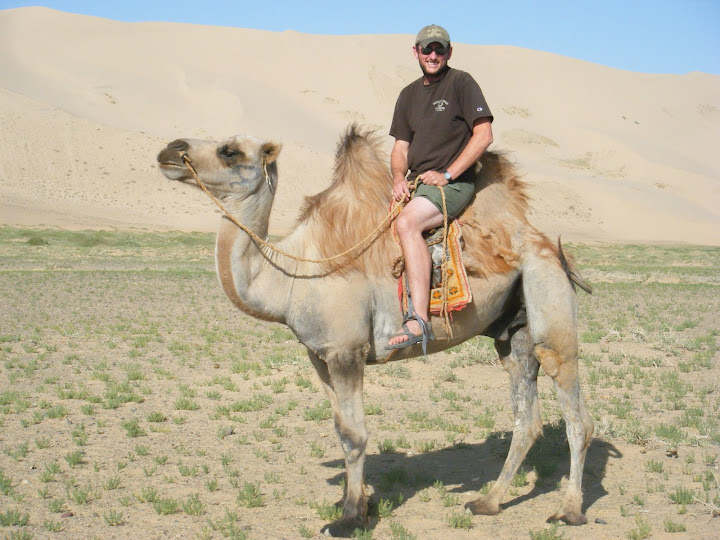
Dave Tinnin: winds of the great Gobi desert seemed to never end. At one camp - while within a somewhat sheltered compound for a few days - the bothersome winds blew at 50-70 kilometers per hour, spreading sand and making for some harsh outdoor conditions.

Gabor Racz agreed that strong winds were a prominent feature of the Asian lands. The tents often flapped in the strong winds, poles were bending under the pressure of the gales, and on occasion stakes were pulled from the ground. "It was often difficult to sleep due to the flapping of the tents," he said.

Windy conditions also were hazardous to the cameras being used to record essential images for the expedition. Solar chargers were part of the expedition gear, and were vital to recharging batteries. Digital cameras were typically used, and at the end of the harsh times, only two cameras still worked. A couple of generators among the gear could provide a means to recharge batteries, or were used to provide light for taking notes or studying specimens when there was insufficient natural illumination.

Pete Hosner’s "favorite site visited was the top of Ikh Bogd Mountain, one of the largest mountains in the country, well over 13,000 ft. At the top of the mountain there was still snow in July, and a lush alpine meadow with many flowers and butterflies typical of the Rockies or Alps, not what one expects in Mongolia. We even had Asian Rosy-Finches up there, which are close relatives of the North American species, and similar in their habits."

Future Research

The grant from the National Science Foundation which supported this expedition, provides for three years of field work in Mongolia.
The basic information needed is knowing what is present in the areas surveyed, said Tinnin. Although there had been some limited scientific work in the latter 1990s, there were still some places in the park not previously surveyed.

The three investigators agreed on the importance of letting people know about the natural diversity present, and how the findings of the expedition could help with efforts to conserve the natural features of the region.

Mongolia is twice the size of Texas, and in the southern region visited, the mountainous terrain has numerous plateaus which are very isolated, where it is "poorly understood" what fauna is present, said Racz. Knowing more about these areas is essential in realizing the effects of population isolation, the genetic variety of diversity, and simple basics such as species composition at different places.
Changing Conditions

Although further analysis of results will be done to clarify the results of the first season of field studies, there are some preliminary indications.

In particular, the men realized that some species that might have been expected based on historic records, they no longer occur. In other instances, species formerly present may occur in lesser numbers.

Habitats are also changing. For example, a large, shallow lake shown on maps from the past, is no longer present, apparently having dried up due to an ongoing drought which has endured for several years, perhaps because of climate change, they said.

Alpine environments, especially meadows, are disappearing, seemingly from drying out in a climate with reduced precipitation.

This initial season of the expedition has started the evaluation of natural history of the Gobi region. Its findings can have a vital role to determine how known Asian ecosystems are changing due to human impacts and a changing environment.

09 May 2008

Birds of New Spain Recorded by Mocino ca. 1800 Identified by Researchers

Least Bittern. Images courtesy of the Hunt Institute for Botanical Documentation. Used through news reporting fair use condition as given on terms of use page. Images have been cropped to reduce file size.

A detailed investigation of records for birds noted more than 200 years ago in New Spain indicate the importance of historic ornithology in determining the former occurrence of birds in different regions.

A group of international researchers studied records from the 1787-1803 Real Expedicion Botanica a Nueva Espana (Royal Botanical Expedition to New Spain), under commander Martin de Sesse. Jose Mariano Mocino was the scientist that joined the expedition in 1790.

Adolfo G. Navarro-Siguenza, of the Museo de Zoologia at the Universidad Nacional Autonoma de Mexico, collaborated with A. Townsend Peterson of the Natural History Museum and Biodiversity Research Center at the University of Kansas at Lawrence, Miguel Angel Puig-Samper of the Instituto de Historia of the Consejo Superior de Investigaciones Cientificas in Madrid, and Graciela Zamudio of the Laboratorio de Historia de la Biologia at UNAM, identified Mocino's efforts as a "stellar example of inventory and analysis of bird fauna" with "an impressive level of detail and scientific commentary," and "consistent and mostly complete" information," according to their recently published journal article.

"We definitely consider Mociño as the greatest Mexican ornithologist of his times, and one of the greatest of all times," Adolfo said.

"It was very rewarding to collaborate closely as ornithologists with personnel working on the history of biology at the Museo Nacional de Ciencias Naturales in Madrid that found the manuscripts and, as experts in the Sesse and Mociño expedition, invited us to do a deeper analysis of the ornithological results," Adolfo said. "Our ornithology groups at the Museo de Zoologia and University of Kansas have been interested in history of science, especially ornithology, for many years" and this study was a chance to contribute to a better understanding of the birds present more than two centuries ago, especially in southern North America.

Gray-necked Wood-Rail.

The primary reference works used included images of paintings previously published in other sources, and photocopies of the two volumes of the ornithological manuscripts preserved at the museum in Madrid, Spain.

"The greatest challenge was to put together the different pieces of evidence in the texts and paintings, all of which were dispersed among several institutions on both sides of the Atlantic Ocean," Navarro-Siguenza said. "Then, it was a challenge to accurately identify the species involved based on the original descriptions given in Latin."

The different species had been identified, and were named according to a variety of historic nomenclature. Mocino used sources such as the Systema Naturae of Carl Linnaeus and works by J.F. Gmelin. Many of the names matched the names used in later-era publications by William Swainson, William Bullock, Charles Lucien Bonaparte, for example.

One of the major tasks of the researchers was to update the historic scientific names to match those of currently accepted, modern nomenclature. The journal paper specifically notes how nomenclature was "unstable" during the late 1700s and early 1800s.

List of bird species determined for the Royal Botanical Expedition (Navarro-Siguenza et al., November 2007, Condor 109: 808-823). The 262 species recognized, are listed in modern taxonomic sequence. Numerous other bird types with vague description or unrecognizable nomenclature could not be identified to a modern equivalent.

• Black-bellied Whistling-Duck
• Greater White-fronted Goose
• Muscovy Duck
• Gadwall
• Blue-winged Teal
• Green-winged Teal
• White-winged Scoter
• Plain Chachalaca
• Crested Guan
• Red Junglefowl
• Wild Turkey
• Scaled Quail
• Elegant Quail
• California Quail
• Northern Bobwhite
• Montezuma Quail
• Least Grebe
• Double-crested Cormorant
• Anhinga
• Magnificent Frigatebird
• American Bittern
• Least Bittern
• Bare-throated Tiger-Heron
• Great Blue Heron
• Great Egret
• Snowy Egret
• Green Heron
• Black-crowned Night-Heron
• Yellow-crowned Night-Heron
• Boat-billed Heron
• Roseate Spoonbill
• Wood Stork
• Turkey Vulture
• King Vulture
• Osprey
• Northern Harrier
• Cooper's Hawk
• Common Black-Hawk
• Harris's Hawk
• White-tailed Hawk
• Red-tailed Hawk
• Harpy Eagle
• Crested Caracara
• Laughing Falcon
• American Kestrel
• Merlin
• Aplomado Falcon
• Prairie Falcon
• Virginia Rail
• Sora
• Common Moorhen
• Sandhill Crane
• Black-bellied Plover
• Semipalmated Plover
• Killdeer
• Black-necked Stilt
• American Avocet
• Spotted Sandpiper
• Willet
• Upland Sandpiper
• Least Sandpiper
• Wilson's Snipe
• Laughing Gull
• Marbled Murrelet
• Tufted Puffin
• Rock Pigeon
• Red-billed Pigeon
• Band-tailed Pigeon
• White-winged Dove
• Mourning Dove
• Inca Dove
• Common Ground-Dove
• Blue Ground-Dove
• Orange-fronted Parakeet
• Military Macaw
• Thick-billed Parrot
• Barred Parakeet
• White-fronted Parrot
• Lilac-crowned Parrot
• Red-lored Parrot
• Yellow-headed Parrot
• Squirrel Cuckoo
• Yellow-billed Cuckoo
• Lesser Ground-Cuckoo
• Lesser Roadrunner
• Greater Roadrunner
• Groove-billed Ani
• Great Horned Owl
• Whip-poor-will
• Canivet's Emerald
• Broad-billed Hummingbird
• White-eared Hummingbird
• Berylline Hummingbird
• Amethyst-throated Hummingbird
• Blue-throated Hummingbird
• Lucifer Hummingbird
• Costa's Hummingbird
• Rufous Hummingbird
• Black-headed Trogon
• Citreoline Trogon
• Violaceous Trogon
• Mountain Trogon
• Elegant Trogon
• Russet-crowned Motmot
• Blue-crowned Motmot
• Belted Kingfisher
• Green Kingfisher
• Emerald Toucanet
• Collared Aracari
• Keel-billed Toucan
• Acorn Woodpecker
• Black-cheeked Woodpecker
• Golden-cheeked Woodpecker
• Ladder-backed Woodpecker
• Hairy Woodpecker
• Strickland's Woodpecker
• Smoky-brown Woodpecker
• Golden-olive Woodpecker
• Northern Flicker
• White-striped Woodcreeper
• Black Phoebe
• Vermilion Flycatcher
• Great Kiskadee
• Social Flycatcher
• Scissor-tailed Flycatcher
• Fork-tailed Flycatcher
• Masked Tityra
• Loggerhead Shrike
• Rufous-browed Peppershrike
• Steller's Jay
• White-throated Magpie-Jay
• Green Jay
• Brown Jay
• Purplish-backed Jay
• Azure-hooded Jay
• Western Scrub-Jay
• Mexican Jay
• Common Raven
• Horned Lark
• Purple Martin
• Gray-breasted Martin
• Mangrove Swallow
• Northern Rough-winged Swallow
• Barn Swallow
• Mexican Chickadee
• Bushtit
• Brown Creeper
• Band-backed Wren
• Gray-barred Wren
• Boucard’s Wren
• Rock Wren
• Canyon Wren
• Bewick's Wren
• Golden-crowned Kinglet
• Black-tailed Gnatcatcher
• Eastern Bluebird
• Brown-backed Solitaire
• Orange-billed Nightingale-Thrush
• Clay-colored Robin
• American Robin
• Gray Catbird
• Northern Mockingbird
• Ocellated Thrasher
• Curve-billed Thrasher
• Blue Mockingbird
• Gray Silky-flycatcher
• Phainopepla
• Nashville Warbler
• Yellow Warbler
• Yellow-throated Warbler
• Black-and-white Warbler
• Louisiana Waterthrush
• Common Yellowthroat
• Hooded Warbler
• Wilson's Warbler
• Red Warbler
• Painted Redstart
• Slate-throated Redstart
• Yellow-breasted Chat
• Red-breasted Chat
• Hepatic Tanager
• Western Tanager
• Yellow-winged Tanager
• White-collared Seedeater
• Rufous-capped Brush-Finch
• Spotted Towhee
• Canyon Towhee
• Stripe-headed Sparrow
• Striped Sparrow
• Chipping Sparrow
• Black-chinned Sparrow
• Yellow-eyed Junco
• Black-headed Saltator
• Black-faced Grosbeak
• Crimson-collared Grosbeak
• Northern Cardinal
• Yellow Grosbeak
• Black-headed Grosbeak
• Blue Grosbeak
• Indigo Bunting
• Red-winged Blackbird
• Yellow-headed Blackbird
• Great-tailed Grackle
• Slender-billed Grackle
• Bronzed Cowbird
• Black-cowled Oriole
• Orchard Oriole
• Streak-backed Oriole
• Audubon’s Oriole
• Yellow-winged Cacique
• Yellow-throated Euphonia
• House Finch
• Red Crossbill
• Lesser Goldfinch

The detailed analysis identified 78 of the paintings to a particular species of bird, with 242 species determined from the manuscripts. Overall, more than 260 species were identified.

Nearly fifty different locales are represented in the sites where a particular species was noted to occur. Most of the locales are in the area of modern Mexico, with a few from the coastal area of the northern Pacific Ocean near Monterey and Nootka Sound.

Sites with birds records as recorded during the Royal Botanical Expedition. These locales are based on a compilation of the records for the species listed in the published article, with the site designation based on locality information given for a particular species.

• Acaponeta
• Acapulco
• Acayucan
• America
• Amoles
• Apatzingan
• Cayenne
• Coahuayana
• Cuernavaca
• Desierto de los Leones
• Guadalajara
• Gulf of Mexico
• Huasteca
• Huasutepeque
• Huauchinango
• Huehuetla
• Hueytlalpan
• Lake Texcoco
• Lake Tixtla
• Los Tuxtlas
• Malacatepec
• Martinica
• Mazatlan
• Mexico
• Mexico City
• Monterey
• Nootka Sound
• Paramita
• Puebla
• Queretaro
• San Agustin
• San Angel
• San Blas
• San Felipe del Obraje
• San Nicolas
• Santo Domingo
• Sinaloa
• Temascaltepec
• Tepic
• Tepic Lakes
• Toluca
• Tropical Mexico
• Tulancingo
• Uruapan
• Valle de Mexico
• Zacatlan
• Zacatlan de la Manzanas
• Zitacuaro

"This analysis fills a large gap on the knowledge of scientific ornithology in Mexico," Navarro-Siguenza said. "It also demonstrates the high level of scientific skills of naturalists of this epoch in New Spain and is a good glance at the impressive biodiversity of the region. And personally, this was a fascinating challenge, a kind of research done just because it is outstandingly fun."

Tri-colored Heron.

In addition to documenting the occurrence of many species in historic Mexico, the records also indicate variations in distribution when site records by Mocino are compared to modern range of a species. Changes were especially notable for the Double-crested Cormorant, Anhinga, Sandhill Crane, Boat-billed Heron, and Slender-billed Grackle. The species occurred in areas where they are no longer present.

Navarro-Siguenza further emphasized the importance of natural history chronicles from this expedition: "Mariano Mociño has been 'venerated' as a major contributor to the botany of Mesoamerica. After this research, we are almost sure that his heart was more closely related to ornithology, and were surprised about the detail and care of his ornithological contributions. It is sad that the work was never published in the 1800s, otherwise nomenclature of North American birds would be really different."

If Mocino's findings had been published soon after the expedition returned from New Spain, the scientific names for many of the species he observed would be based on the names he would have designated, since his citation would have been the first in the historic record. Modern nomenclature is typically derived from the genus and species name given in a published work by the initial observer of a particular species.

"The history of ornithology is important for the history of the science in general, given that many general thoughts in biology - biogeography, conservation, systematics, evolution and ecology - have been based in the study of birds," Navarro-Siguenza said.

"As museum people, we are really aware of the importance of recovering historical information and we hope more people can get involved in this kind of analyses. We have learned through the years that birds are one of the best studied groups at the beginning of any natural history survey in the ancient times in every part of the world, so comparing bird distribution from different periods in time can give a hint on changes of biodiversity in any region.

"Through these records we witness environmental changes, populations health, and geographic structure of faunas. But besides that, we use those records as base data for developing many research projects on avifaunas, including future projections of bird diversity as a result of climate change, emergent diseases" and other factors which influence the distribution of bird species.

"For several years my research group, and others we have worked with in the U.S.A. and Europe especially the University of Kansas and the Natural History Museum in Britain, have stressed the value of scientific collections and historical records as a source of information valuable for conservation, biogeography and systematics of birds and other taxa."

05 February 2008

Expedition to Research Natural History in Mongolia

A federal research grant is funding an expedition to Mongolia to document the biological diversity of Gobi Gurvan Saikhan National Park, and its local environs.

The three year project is being funded with a $620,000 grant from the National Science Foundation to Scott Gardner, curator of the Manter Laboratory of Parasitology, University of Nebraska-Lincoln. Expedition members are from UNL, Hokkaido University, Portland State University and the University of Kansas. They will work closely with scientists from the National University of Mongolia.

"We will conduct education and research to teach the Mongols how to preserve their biodiversity," said Gardner. "The expedition is resurrecting some of the ideas to go exploring to study animal life. We are going into places little studied to document diversity."

Birds, small mammals, amphibians and reptiles, and parasites will each the subject of research by the diverse group of specialists. Collecting specimens will be a prime component of each visit. Parasite material will be used to establish the Mongolian Vertebrate Parasite Project. Bird skins and tissues will become part of the avian collection at the University of Kansas. One-half of the collected items will go to the NUM.

Details from the surveys, Gardner said, will be useful in evaluating genetic flow among species, influences of habitat fragmentation, phylogentic relationships and species coevolution.

The park is 27,000 square kilometers of diverse flora communities across a broad range of elevations, including sand dune fields, ice-filled canyons and other habitats.

During their time in this country, the expedition expects to have base-camps, and then move around primarily via camels and horses. Most of the grant money is expected to be spent in Mongolia, purchasing supplies and hiring local help.

Despite its remote location, the expedition plans to use technology to the degree possible, since it provides additional opportunities to collect information important to conservation, Gardner said. Photographs, recordings of bird songs, and video-tape can provide additional documentation.

"The research project will be also featured as part of the summer youth education program of the University of Nebraska State Museum," Gardner said. "We will work with young students in Mongolia to teach the importance of science and value of field research in discovering biology."

There was a previous two-month expedition to the Park in 1999, said Gardner. The visiting researchers worked with the National University of Mongolia to establish long term environmental research sites, meant to provide results over a five-to-ten year period.

Research findings included new species of tapeworms. This project had also been funded by the NSF.

The last previous systematic surveys of animals had been conducted in the 1920s, Gardner said.

The expedition hopes to keep its web-site up-to-date during their time in inner Mongolia, by using amateur HAM radio. This will allow regular communication to students and to send emails that can be posted on the project website.